
I’ve been noticing how easy it is to get pulled into whatever the latest crypto story happens to be. Every few months there’s a new wave, a new promise, a new “this changes everything” moment. I keep looking at these cycles and thinking how familiar they’ve started to feel. The names change, the branding gets sharper, but the pattern doesn’t really move. Hype builds quickly, attention peaks, and then things quietly fade while everyone looks for the next idea.
Pixels (PIXEL) showed up on my radar in that same way. At first, it didn’t feel any different from the dozens of other projects that pass by every week. Another Web3 game, another ecosystem, another attempt to blend tokens with user activity. It’s easy to become numb to it. But after sitting with it for a bit, the idea behind it started to feel… simpler than most, and maybe that’s why it stood out.
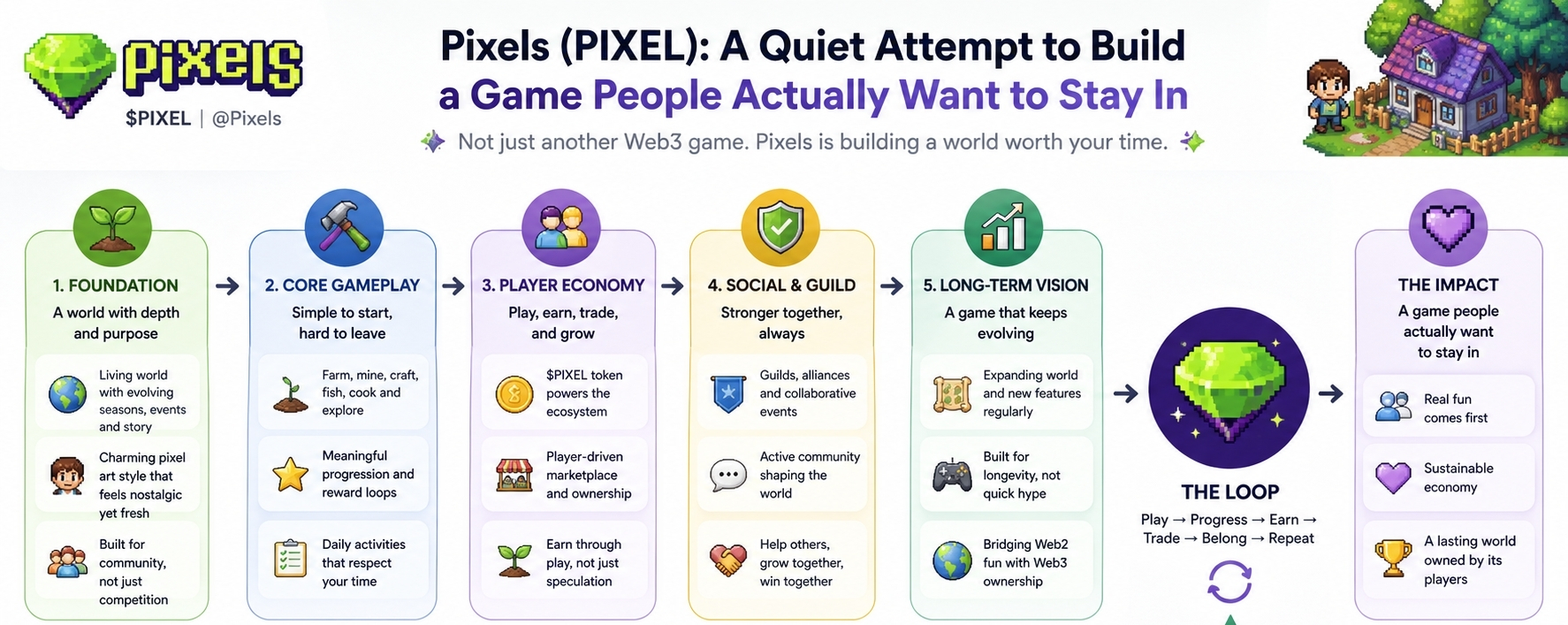
At its core, Pixels is just a game about farming, exploring, and creating things in a shared world. No complicated pitch, no heavy financial language trying to disguise itself as innovation. It reminds me more of the kind of games people casually return to after a long day, not because they expect to make money, but because it feels easy to exist there for a while. And that’s a different direction from what crypto usually pushes — less “optimize everything” and more “just spend time here.”
That shift, if it’s intentional, is interesting. Because when I think about what actually works outside of crypto, it’s rarely the most complex system. It’s the thing people don’t have to think too hard about. Habits form around simplicity. People come back when something feels comfortable, not when it promises them the highest return. Crypto, on the other hand, has spent years training users to chase incentives instead of experiences.
Still, there’s a big gap between a good idea and something that lasts. I’ve seen too many projects that looked thoughtful on the surface but struggled once the initial excitement wore off. Building a world people genuinely want to stay in is not easy. Keeping it alive is even harder. It takes time, consistency, and a kind of patience that doesn’t always align with how fast crypto tends to move.
There’s also the question of who this is really for. Crypto-native users might show up early, but they don’t always stay unless there’s something deeper holding their attention. And outside that bubble, most people still don’t care about tokens or chains. They care about whether something feels worth their time. Bridging that gap has always been one of the hardest parts of this space, and it’s where many projects quietly fall apart.
So I find myself somewhere in the middle with Pixels. I don’t dismiss it, but I’m not rushing to believe in it either. It feels like an attempt to move away from pure speculation toward something more grounded, something closer to how people actually behave. That alone makes it worth paying attention to.
Maybe it finds its audience and grows into something steady. Maybe it fades like so many others once the spotlight shifts. It’s hard to say. But at least it’s trying to build around a real human behavior — the simple idea that people might want to spend time somewhere because they enjoy it, not because they’re being told they should. In a market full of noise, that’s not the worst place to start.