I usually do not think much about the network behind a game when I am doing small things inside it.
That is probably how it should be.
When a game feels normal, I notice the world first. I notice where I am walking. I notice what needs to be collected. I notice whether there are other players around. I notice the little habits that start forming after a few visits. The technology underneath only becomes visible when something changes, pauses, breaks, or asks for attention.
That is why Ronin’s upcoming Ethereum move made me think about Pixels again.
Ronin has confirmed that its migration to Ethereum is scheduled for May 12, 2026. The official announcement says Ronin mainnet is expected to have about 10 hours of downtime between 8 a.m. and 6 p.m. PT, during which onchain actions like token swaps, NFT trades, and unstaking will not be available. It also says games may pause during that time, and after the migration, things should return to normal.
That is not only a technical note to me.
It is a reminder that even the quietest game routines depend on something underneath them.
Pixels is a social casual Web3 game powered by the Ronin Network. It has farming, exploration, creation, crafting, and open-world movement at the center of it. On the surface, it can feel like a familiar farming world. You move around, gather resources, complete tasks, build habits, and share the same space with other players. The official Pixels site describes it as a place where people can play with friends, manage crops, build communities, and create around digital collectibles.
But Pixels is also connected to ownership, land, assets, and the wider Ronin ecosystem.
That means the chain matters, even when players are not thinking about it.
For me, the interesting part is how easy it is to forget that. When I think about Pixels, I do not first think about bridges, hardforks, inflation changes, or builder rewards. I think about the routine. I think about the calm pattern of checking in. I think about farming as a small daily action. I think about players moving through Terra Villa, each with their own reason for being there.
That is the feeling a game has to protect.
The Ronin update is meaningful because it touches the background layer that makes many of those Web3 systems possible. The announcement says the move is meant to lower RON inflation, strengthen the Ronin Treasury, improve security, and introduce Proof of Distribution, an automated builder reward system. Those are big infrastructure ideas, but inside a game like Pixels, the best outcome is probably simple.
The world should keep feeling playable.
That sounds plain, but I think it matters. A player does not always want to feel like they are using infrastructure. They want to feel like they are entering a place. They want the crops, tasks, land, avatars, resources, and other players to stay in the front of their mind.
In a way, the brief downtime makes the invisible part visible.
For a few hours, players may be reminded that the game’s Web3 layer is not magic. It runs on systems. Those systems change. They need upgrades. They create limits. They can pause some actions. And then, if things go well, they fade back into the background again.
That fading back matters.
I think good game infrastructure should disappear most of the time. Not because it is unimportant, but because it is doing its job. When every action feels like a blockchain action, the game can become tiring. When the chain supports the world without constantly interrupting it, the game has more room to feel normal.
Pixels seems to work best in that normal space.
The game has Web3 parts, but its softer appeal comes from routine. Farming works because it is understandable. Exploration works because it gives players a reason to move. Creation works because players can shape parts of their experience. The social side works because other people are there, quietly filling the same world with their own habits.
That is what I notice most.
The technology can help make ownership and digital identity more meaningful, but it cannot replace the feeling of being inside a world. A player may care about land or assets, but they still need the daily loop to feel worth returning to. Otherwise, the ownership sits there without much life around it.
This is where Ronin’s role feels quiet but important.
Ronin does not need to be the loudest part of Pixels. It does not need to explain itself every time a player plants something or moves through the world. It just needs to support the experience well enough that the game can stay focused on being a game. That is harder than it sounds, especially in Web3, where the infrastructure often pulls attention away from the actual play.
I think Pixels benefits when that balance works.
A player can come in for farming. Another can care about land. Another can follow crafting updates. Another can focus on events or social routines. Another may care more about the token side. These different reasons can exist together, but they all depend on the world feeling steady enough to return to.
The May 12 downtime may not feel exciting to a regular player. It may even feel inconvenient. That is fair. Nobody loves being told a system will pause for hours. But I also think moments like this can show how much of a Web3 game lives beneath the surface.
The surface is the world.
The background is what holds it together.
Pixels is still evolving, and not every player will care about infrastructure changes. Some people may only notice if they cannot do an onchain action for a while. Some may not follow Ronin updates at all. Some may simply wait until the game feels normal again. That is probably healthy. A casual game should not require every player to study the network behind it.
Still, I find this moment worth noticing.
It reminds me that Pixels has two kinds of rhythm. One is the player rhythm: farming, exploring, crafting, talking, returning. The other is the network rhythm: upgrades, migrations, security, incentives, and systems that most players only think about when something changes.
Most days, the first rhythm is the one that matters.
But the second one makes the first one possible.
And maybe that is the quiet lesson here. Web3 gaming does not always need to make the chain the center of attention. Sometimes the chain should do its work, step back, and let the game feel like a place again.
That is what I hope for Pixels after this Ronin move.
Not something louder.
Just something smoother underneath the world players already know.
Still watching the quiet layer behind $PIXEL #pixel @Pixels

Article
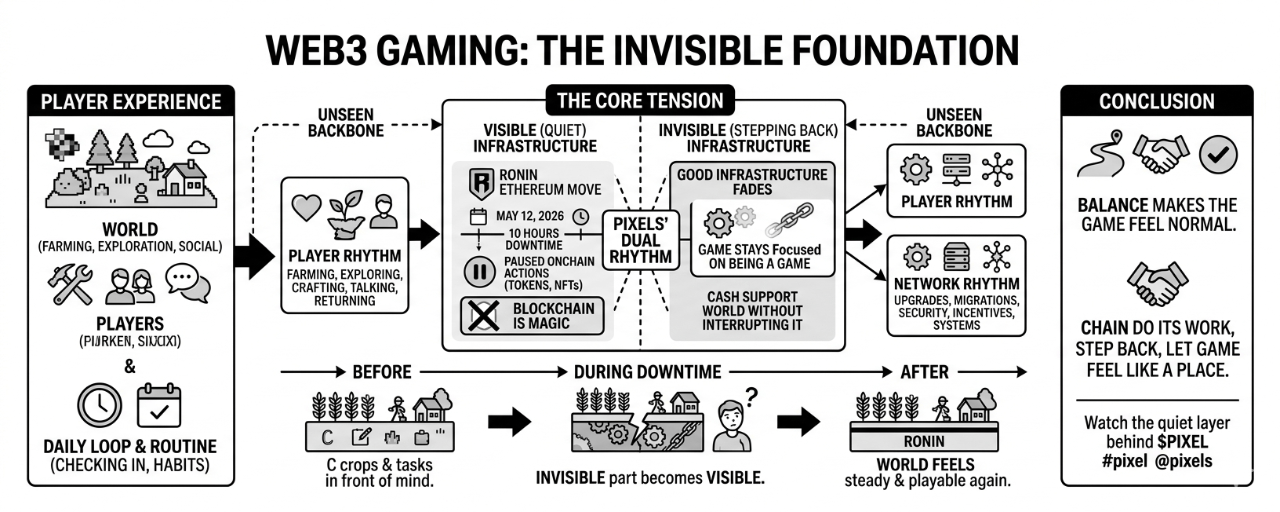
When Ronin briefly becomes visible and Pixels reminds me games need quiet infrastructure
Disclaimer: Includes third-party opinions. No financial advice. May include sponsored content. See T&Cs.