
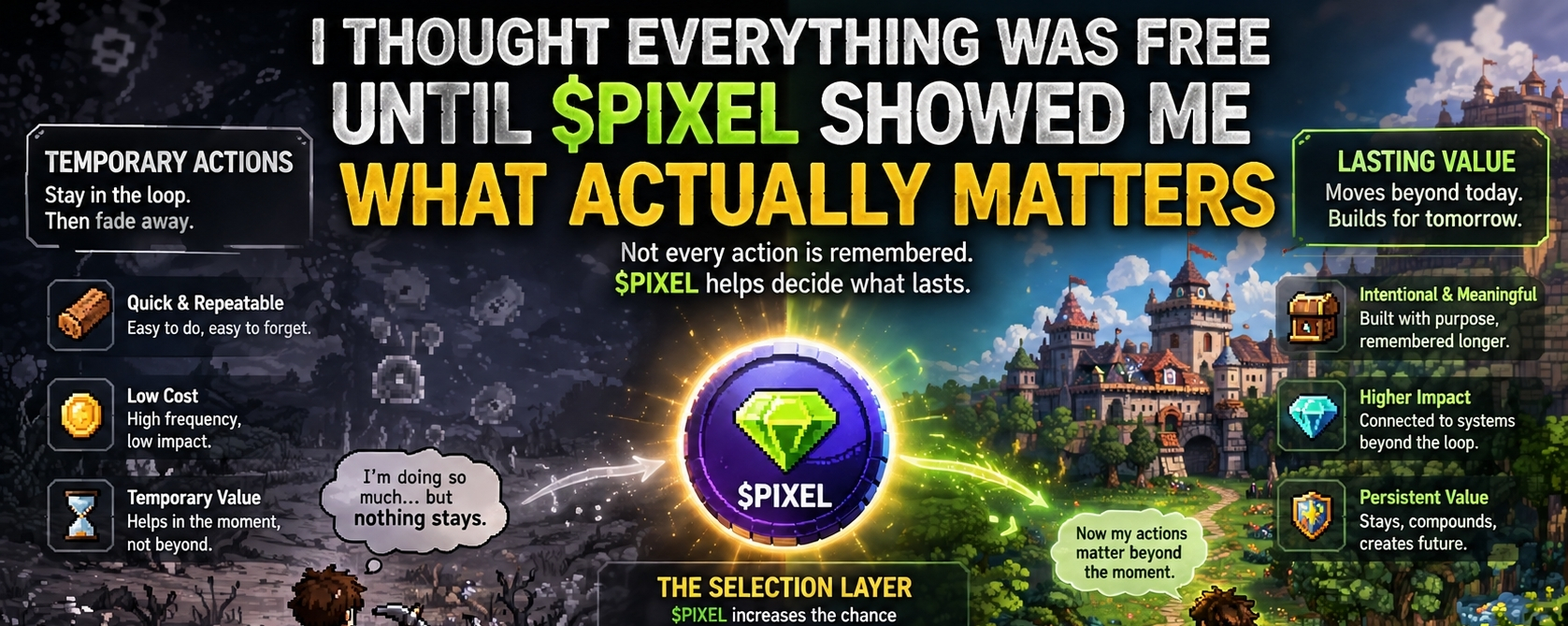
@Pixels $PIXEL #pixel
I used to believe that everything I did in Pixels carried weight in its own way. The system felt open and fair, almost like it respected every bit of effort I put into it. I could log in, follow my routine, farm, trade, and slowly improve without feeling any kind of pressure. There were no aggressive pushes, no forced decisions, and no clear signs that I was being guided toward a specific path. That sense of freedom made it easy to trust the experience.
But over time, I started noticing something that didn’t quite fit that initial impression. Some sessions felt meaningful even if I spent less time, while others felt empty despite doing more. I would repeat the same loops, invest similar effort, and yet the outcome didn’t always carry forward in the same way. It wasn’t obvious at first, but the pattern became harder to ignore the longer I paid attention to it.
That’s when I began to question the idea that all actions inside the system are equal. It made me realize that a system like this cannot realistically treat everything the same. Not every action can be stored, remembered, or given long term value. There has to be a layer where decisions are made about what stays and what fades away. That layer isn’t visible, but it’s always active.
Once I started thinking this way, I noticed the difference between being active and actually making progress. Just because I was doing something constantly didn’t mean it was building toward anything lasting. Some actions seemed designed to keep the loop going, to maintain engagement in the moment, while others quietly connected to something beyond the immediate session. That distinction changed how I viewed everything I was doing.
What makes this more interesting is that the system doesn’t clearly explain this difference. There are no labels telling you what is temporary and what is persistent. Instead, it creates a natural gradient. Some actions are easy, repeatable, and quickly completed, but they don’t leave much behind. Others require a bit more intention and input, and those are the ones that seem to carry forward. The system doesn’t force you to choose, but it subtly shapes the outcome based on what you do.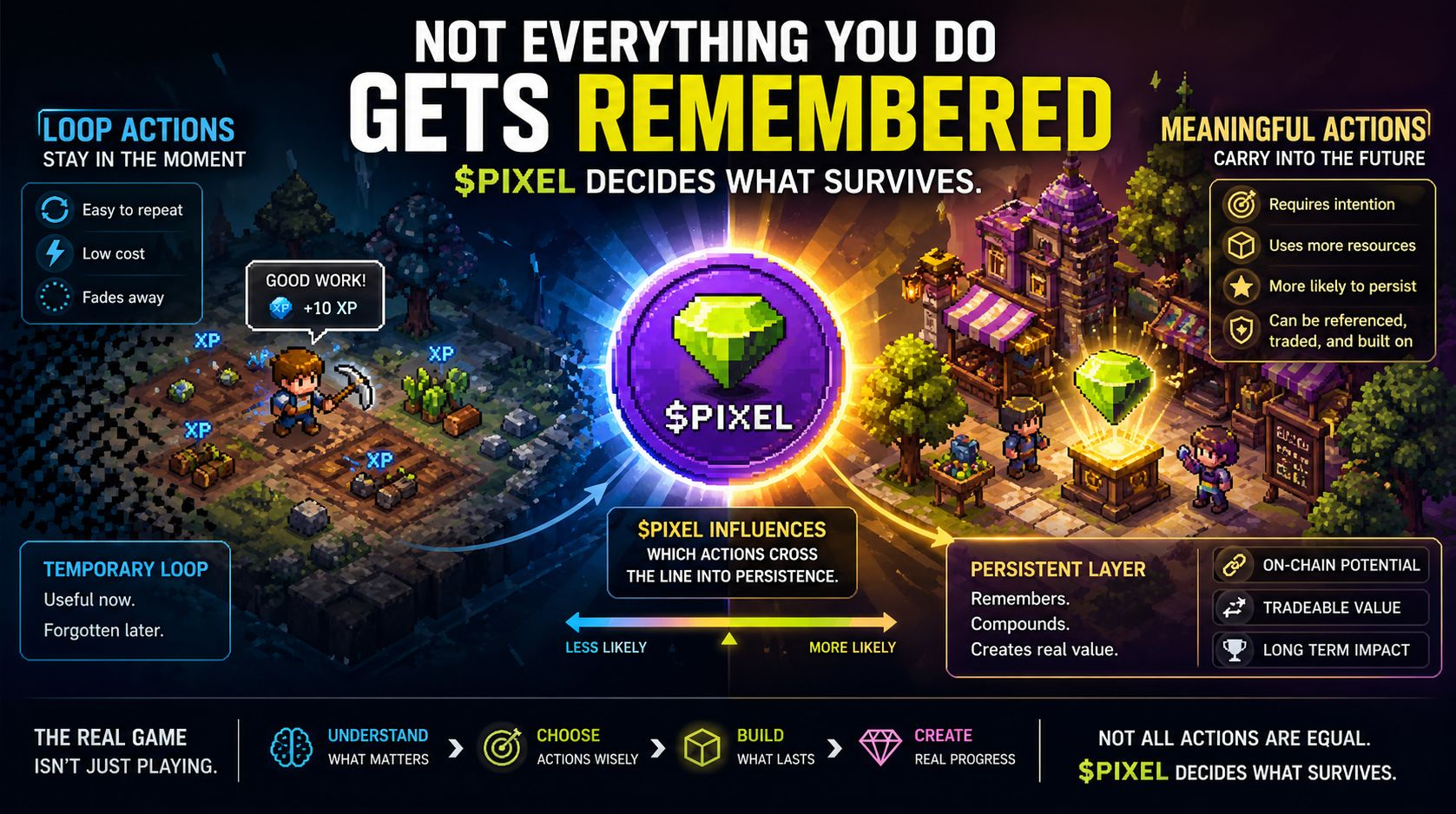
This is where my understanding of $PIXEL started to change. At first, I saw it as a simple utility, something meant to speed things up or make certain actions easier. That’s how most in game tokens work, so I didn’t think much of it. But the more I observed, the more it felt like its role was deeper than just convenience. It didn’t block me from playing if I didn’t use it, and that’s what made it different. I could still follow the loop and stay active without it. However, when it became part of my actions, the results started to feel more stable, more likely to carry forward in a meaningful way.
It doesn’t feel like a strict requirement, and that’s what makes it powerful. Instead of forcing value, it seems to influence it. It increases the chances that certain actions will matter beyond the moment they happen. That kind of design is subtle, but over time it becomes noticeable. It doesn’t change what you can do, but it changes what stays with you after you’ve done it. $PIXEL
This doesn’t make the system unfair. In fact, it highlights a necessary balance. A system that treats every action equally would struggle to maintain structure and long term value. Selection is not a flaw, it is part of how the system stays functional. But it does mean that freedom inside the game is not as simple as it appears. Access is open, but significance is still being decided somewhere beneath the surface.
Now when I play, I don’t just think about what I can do next. I think about whether what I’m doing will actually matter later. That shift in thinking changes the experience completely. It moves the focus away from repetition and toward intention. It makes me more aware of how the system responds to different kinds of actions, even when it doesn’t explain itself directly.#pixel
In the end, Pixels doesn’t tell you what it values. It allows you to discover it over time through your own behavior. And somewhere in that process, there is a quiet system constantly deciding what to keep and what to let go. It still feels open and accessible, but it is not neutral. It is selective. And once you start noticing that selectivity, it becomes clear that the real game is not just about playing, but about understanding what the system chooses to remember. @Pixels