
I’ve been thinking about why most GameFi projects die the same death.
it’s not the gameplay. it’s not the team. rewards too easy to sell, exits too frictionless — and eventually the people who figure that out first run for the door. then everyone else does. you know how it ends.
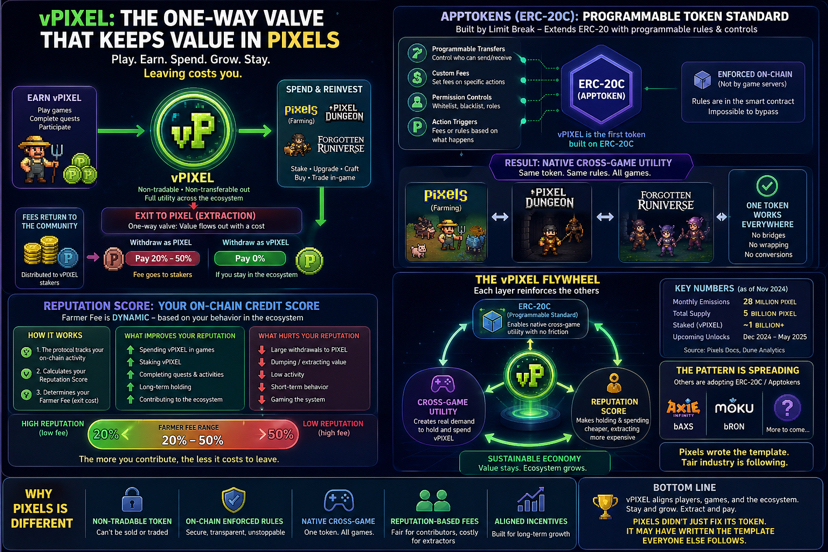
the companion token is Pixels’ answer to that problem. and understanding how it actually works at the technical level changes how you see the whole ecosystem.
the spend token can’t be traded. can’t be sold. can’t leave without cost. withdrawing directly as PIXEL costs you somewhere between 20% and 50% — that fee flows straight back to stakers. but withdraw as the spend token and you pay nothing, as long as you stay inside. spend it in Pixel Dungeon, Forgotten Runiverse, stake it back in. the ecosystem keeps the value. the moment you try to extract it, you pay.
one-way valve. value flows in freely. flowing out costs you.
what most people miss is the infrastructure underneath this. the spend token isn’t just a game mechanic — it’s the first implementation of Limit Break’s Apptokens protocol, formally known as ERC-20C. this is a new token standard built on top of ERC-20 that gives developers programmable control over how their token behaves. who can hold it, who can transfer it, what actions trigger fees, what actions don’t. the rules are baked into the contract itself — not enforced by a game server that can be bypassed, but by the blockchain.
the practical implication is significant. because the spend token runs on ERC-20C, it works natively across every game in the Pixels ecosystem without bridges, without wrapping, without conversion. a player earns the companion token in the core farming game and spends it in Pixel Dungeon or Forgotten Runiverse as-is. the token moves between games the way money moves between stores — seamlessly, because the underlying standard is the same everywhere.
this is what makes Pixels genuinely different from the multi-game ecosystems that came before it. most tried to connect games through bridges or shared currencies that required manual conversion. Pixels built the connection into the token standard itself.
then there’s the Reputation Score layer, which almost nobody talks about. the exit fee isn’t a flat number. it’s dynamic — calculated based on your on-chain behavior inside the ecosystem. the more you spend and engage, the higher your reputation, the lower your fee. the more you extract without contributing, the more leaving costs you. effectively Pixels has built a credit scoring system on-chain, one that distinguishes long-term participants from short-term extractors at the protocol level — not at the game server level where it can be gamed.
combine all three layers and you have something architecturally interesting: a token that can’t be sold, running on a standard that works natively cross-game, with exit costs that decrease the more committed you are to the ecosystem. each layer reinforces the others. the ERC-20C standard makes cross-game utility possible without friction. the cross-game utility gives the spend token real reasons to be held. the Reputation Score makes holding and spending the cheapest path, and extracting the most expensive one.
whether it holds under pressure — 28 million PIXEL in monthly emissions, more unlock events coming, partner games still unproven at scale — is genuinely uncertain. the design is the most coherent I’ve seen in this space. execution is a different question entirely.
but here’s what I keep coming back to: Axie Infinity already copied this for their bonded token. Moku just launched using the same standard. the pattern is spreading faster than most people realize.
Pixels didn’t just fix its own token. it may have written the template everyone else follows.
