
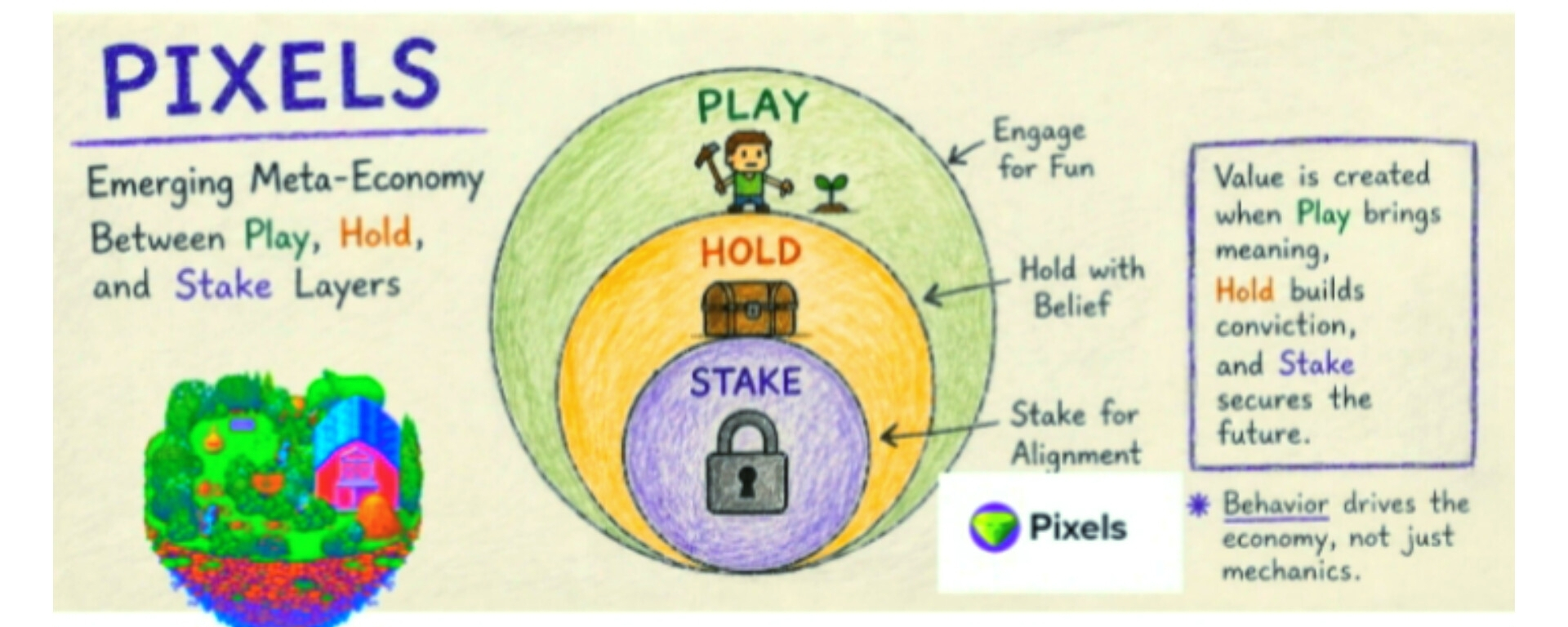
There’s something familiar about the way new GameFi ecosystems present themselves. A playable world, a circulating token, a staking layer humming quietly in the background. It all feels structured, almost predictable, as if we’ve learned how to recognize the architecture before we understand the behavior inside it.
At first glance, Pixels looks like a layered system built around simple roles: you play, you earn, you hold, you stake. The surface model appears balanced. Time converts into assets, assets connect to tokens, tokens loop back into governance or yield. It resembles a clean economic circle, one that suggests sustainability through participation rather than speculation alone.
But after watching more closely, the alignment between those layers feels less seamless than it first appears.
The play layer encourages repetition. Farming, crafting, gathering—activities that are intentionally steady rather than explosive. The hold layer suggests patience. Accumulation over time. The stake layer introduces a different psychology entirely: delayed gratification, strategic positioning, and quiet competition for yield or influence. Each layer operates with its own tempo.
That distinction changes the lens.
Because this isn’t just a game economy. It’s a behavioral economy. And behavior doesn’t always synchronize neatly.
The players who enjoy the rhythm of daily tasks may not be the same participants who think in terms of lockups and capital efficiency. Those who stake heavily may rarely log in to farm. Those who farm obsessively may prefer liquidity over commitment. On paper, the system interlocks. In practice, it relies on psychological overlap that isn’t guaranteed.
And that’s where the token quietly enters.
The token is not merely a reward unit. It becomes the bridge between play and positioning. When someone chooses to hold rather than sell, that decision reflects belief in future demand. When someone stakes instead of flipping, it signals trust in structural durability. The token absorbs emotion—confidence, doubt, boredom, conviction.
Hidden demand doesn’t always come from new users. Sometimes it comes from existing users shifting their posture.
In Pixels’ emerging meta-economy, that shift matters more than surface growth metrics. The obvious narrative focuses on user counts, activity loops, or liquidity. But the subtler driver may be how often players graduate from participation to alignment. When a player begins thinking like a stakeholder rather than a visitor, the economy deepens.
It feels less like a game with optional finance, and more like a layered environment where finance quietly reshapes the game.
Yet that boundary feels intentional.
The play layer is designed to be accessible. The hold and stake layers introduce subtle barriers—knowledge, patience, and capital. Access expands at the surface but narrows as you move inward. This tension between openness and control creates both strength and fragility.
Efficiency is another quiet tension inside the system. A highly efficient economy reduces friction, but friction is sometimes what creates value. If earning becomes too predictable, the sense of discovery fades. If staking becomes too optimized, it turns mechanical rather than strategic. Growth demands smooth onboarding, but longevity often depends on imperfect incentives that force adaptation.
I’m not fully convinced the balance is stable.
The repetition inherent in farming-based systems can slowly flatten emotional engagement. Players log in because they should, not because they want to. When that shift happens, the token layer bears the pressure. Prices react not only to macro forces, but to silent fatigue. The ecosystem must then rely on belief rather than excitement.
And belief is harder to measure.
There’s also a subtle hierarchy forming between those who treat the system as labor and those who treat it as leverage. Players who grind for incremental gains contribute activity. Stakers who lock tokens contribute stability. Both are necessary, but they experience the ecosystem differently. One seeks flow. The other seeks positioning.
If too many migrate upward toward staking without equivalent engagement in play, the world risks thinning out. If too many remain at the surface without transitioning into longer-term commitment, liquidity may outpace conviction.
That equilibrium is delicate.
Behavioral loops inside Pixels seem to encourage progression—not only in assets, but in mindset. A new entrant begins by exploring. Over time, familiarity breeds calculation. Decisions become less about fun and more about optimization. It’s a natural evolution in any tokenized environment.
But optimization changes atmosphere.
When players begin analyzing opportunity cost instead of scenery, the experience shifts. The game becomes a platform. The platform becomes a portfolio. The portfolio becomes a thesis.
That transformation isn’t inherently negative. In fact, it may be the intended design. A meta-economy forms when actions inside the game ripple outward into staking decisions, liquidity strategies, and governance alignment. The layers begin speaking to one another.
Still, fragility lingers beneath that sophistication.
If token incentives ever drift too far from in-game meaning, the connection weakens. If staking rewards feel detached from actual player activity, the system risks becoming extractive rather than participatory. And if play no longer generates emotional attachment, holding becomes purely speculative.
Yet the model is not careless. There’s restraint in how the layers are introduced. The transitions feel measured rather than rushed. That pacing suggests awareness of past GameFi cycles where rapid expansion outpaced cultural grounding.
It feels less like a rush to scale, and more like a cautious attempt to build internal gravity.
But gravity takes time to form. And time in crypto is compressed.
The true test of this emerging meta-economy may not be in explosive growth, but in subtle persistence. Do players gradually increase their stake because they believe in the world, or simply because yield remains attractive? Do stakers engage with gameplay out of curiosity, or remain financially distant from the experience?
Those behavioral crossovers are the hidden demand drivers. Not marketing campaigns. Not temporary hype.
When play, hold, and stake layers reinforce one another organically, the ecosystem begins to feel self-sustaining. When they drift apart, tension surfaces quietly at first—lower engagement here, softer conviction there—before eventually becoming visible.
And perhaps that’s the most interesting part.
Pixels doesn’t exist purely as a game or purely as a financial instrument. It sits somewhere in between, where enjoyment, habit, and strategy intersect. That in-between space is difficult to stabilize. It requires participants to believe that their time, their tokens, and their patience all connect to something coherent.
Whether that coherence strengthens or unravels will depend less on feature releases and more on how human behavior settles into the layers.
For now, the system feels balanced but watchful. Structured, yet still testing itself.
And maybe that’s what a meta-economy really is—not a finished design, but a living negotiation between play and commitment, repetition and belief.@Pixels $PIXEL $PEPE $TRADOOR
