
I looked at PIXEL again today, and the same tension showed up. The token is still active enough to trade, but the real story isn’t whether price can spike. It’s whether the system behind it can decide when value should actually be allowed to flow out without breaking player trust.
That’s a harder problem than most GameFi projects admit.
On the surface, reward transparency sounds straightforward. Players want clarity: what they earned, when they can claim it, and why outcomes differ. Traders want a parallel version of that clarity: are rewards building real engagement, or just creating delayed sell pressure?
Pixels sits right in between those expectations.
With PIXEL hovering around the low single cent range and a relatively small market cap compared to total supply, the margin for error is thin. Tokens at this scale don’t get infinite retries. If reward design fails, the market reacts quickly.
That’s why timing matters more than distribution.
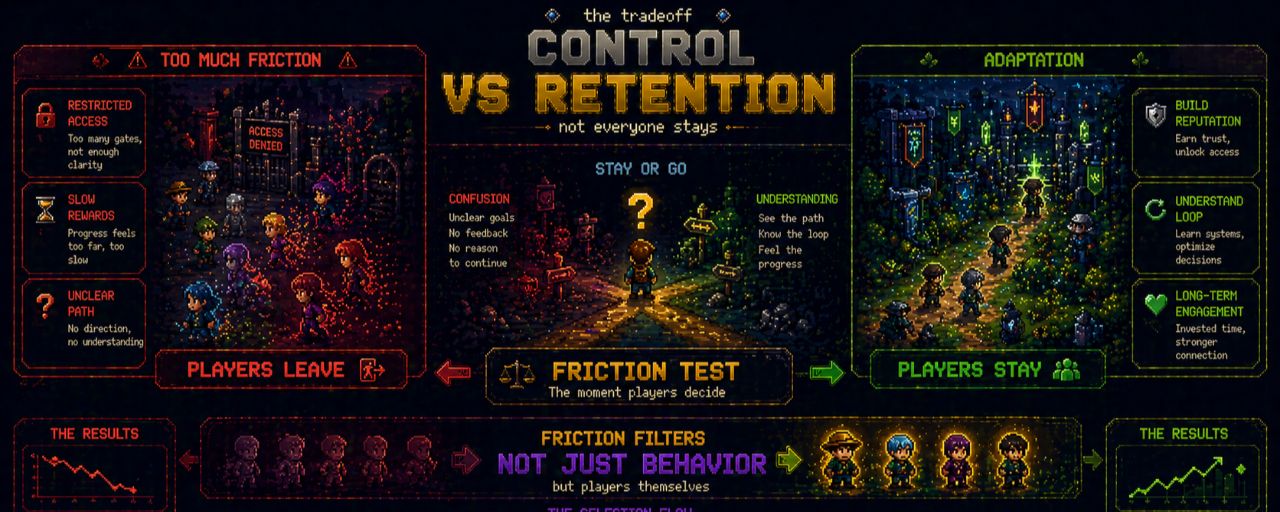
If value is released too freely, the system trains short-term behavior. Players optimize extraction, not participation. But if access is too restricted, friction builds in the wrong places. Instead of protecting the economy, it starts pushing normal users away.
Pixels is trying to walk that line by filtering who gets access and when.
The reputation layer is central to that approach. Instead of treating all activity equally, the system differentiates between users based on consistency and perceived contribution. Access to trading, withdrawals, and deeper economic features becomes conditional, not automatic.
That’s not just game design. That’s controlled liquidity.
From a token perspective, it means rewards are not simply emitted into the system. They’re gated, delayed, and shaped by behavior. In theory, that reduces abuse and slows down pure extraction cycles.
But it introduces a different kind of risk.
Friction always asks for patience. And not every player will give it.
Some users will understand the system, build reputation, and integrate deeper into the loop. Others will bounce the moment access feels restricted or unclear. That’s the tradeoff Pixels is making: tighter control in exchange for potentially lower immediate participation.
Which brings everything back to retention.
Pixels doesn’t need players to show up once. It needs them to keep showing up when rewards feel less obvious, less immediate, and more conditional. That’s where most GameFi systems fail. They can attract activity, but they can’t sustain it without constantly increasing incentives.
If Pixels can turn its loops farming, crafting, guild coordination, land usage, and reputation building into something users return to without needing constant reward escalation, then the token starts to look fundamentally different.
If not, the system risks becoming another cycle where engagement tracks reward intensity.
The market is already signaling caution. With PIXEL trading far below its historical highs, this isn’t a narrative driven valuation anymore. It’s a wait and see structure. Traders aren’t pricing in potential they’re waiting for proof.
So for me, Pixels is worth watching, but for a very specific reason.
Not because of short-term price action.
Because it’s actively testing whether a game can stay transparent about rewards while still controlling their timing tightly enough to protect the economy.
That’s a difficult balance. Most projects choose one side and fail on the other.
Pixels is trying to hold both.
And the real signal won’t come from a chart. It will come from behavior whether players keep coming back when rewards feel slower, more selective, and more earned.
That’s where the system either proves itself or breaks.