
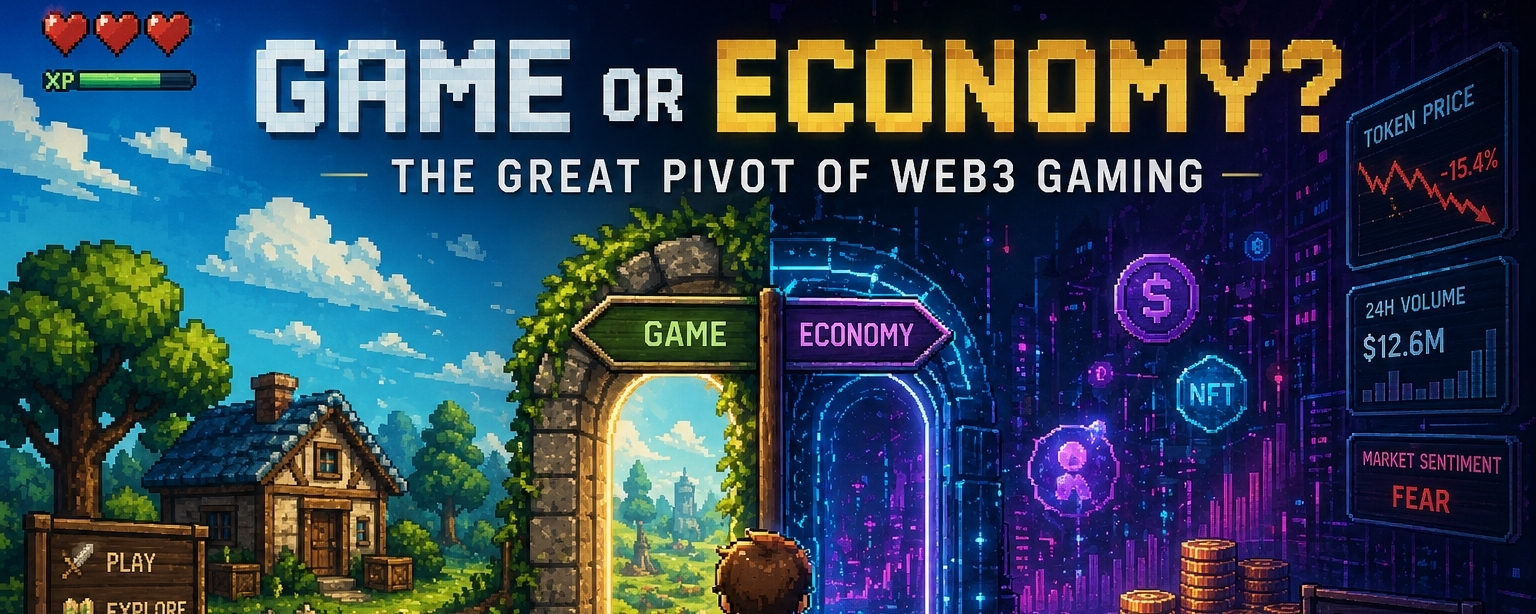
Look, I keep coming back to the same question every time I open one of these so-called “Web3 games”…
Am I playing a game?
Or am I just stepping into a small, slightly disguised economy?
Because honestly, the line isn’t just blurry anymore it’s basically gone.
You log in, you see avatars, land, quests… sure, it looks like a game. But then five minutes in, you’re thinking about token prices, rewards, timing your actions. It starts to feel less like playing and more like… managing something. Optimizing something. Extracting something.
And that’s where things get weird.
I’ve seen this before, by the way. Systems that look fun on the surface but are really built around incentives. They work at first. Then they don’t.
Now zoom out for a second.
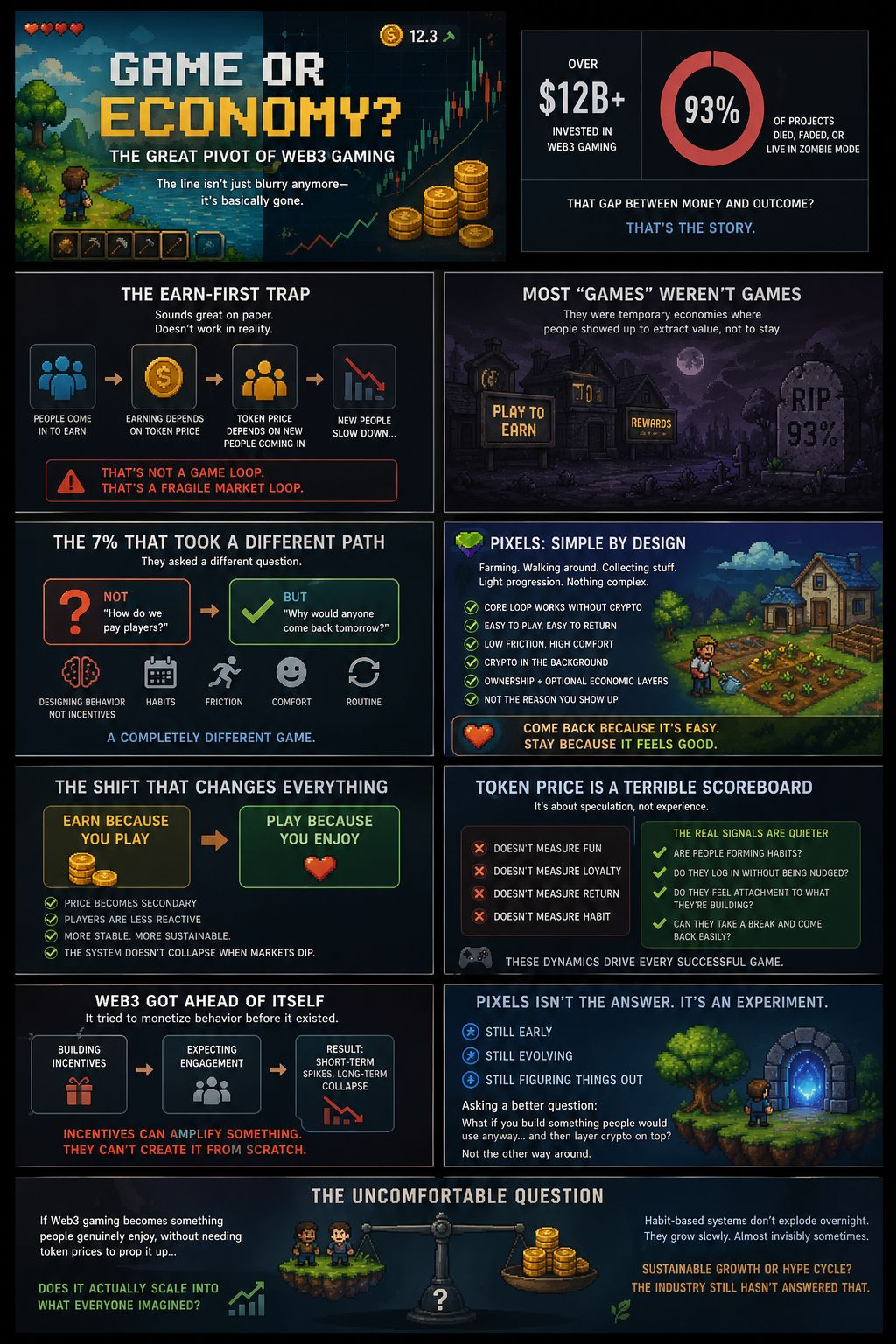
Over $12 billion went into Web3 gaming. That’s not small money. That’s serious conviction, serious bets, serious expectations.
And still around 93% of projects either died, faded out, or just kind of… exist in zombie mode.
That gap between money and outcome? That’s the story.
Because here’s the thing people don’t like to admit: money doesn’t make something good. It just makes more of it.
In this case, it made more games, more tokens, more reward systems… but it didn’t make people care. It didn’t make people come back.
And that’s the part that actually matters.
Most of these projects fell into the same trap. The “earn-first” mindset.
Sounds great on paper, right? Pay people to play. Incentivize behavior. Align economics with engagement.
Except… it doesn’t really work like that.
Because when you build a system where the main reason to show up is money, everything becomes tied to price. Everything.
Token goes up? Players flood in. Activity spikes. Everyone looks like a genius.
Token goes down? People disappear. Fast.
No drama. No loyalty. Just… gone.
So what you end up with is this loop:
People come in to earn.
Earning depends on token price.
Token price depends on new people coming in.
New people slow down…
And yeah. You know how that ends.
That’s not a game loop. That’s a fragile market loop.
And honestly? A lot of these “games” weren’t really games. They were temporary economies where people showed up to extract value, not to stay.
That distinction matters more than most teams realized.
Now here’s where it gets interesting.
A small group maybe that remaining 7% didn’t follow that path all the way down.
They didn’t win by throwing more tech at the problem. Or better tokenomics. Or bigger rewards.
They just asked a different question.
Not “How do we pay players?”
But “Why would anyone come back tomorrow?”
Simple question. Hard answer.
Because now you’re not designing incentives you’re designing behavior.
You’re thinking about habits. Friction. Comfort. Routine.
That’s a completely different game.
And this is where Pixels comes in.
If you’ve looked at it, you probably noticed something right away. It’s… simple. Almost suspiciously simple.
Farming. Walking around. Collecting stuff. Light progression.
Nothing about it screams “complex Web3 economy.”
And that’s kind of the point.
The core loop works without crypto. You can play it, engage with it, and come back to it without thinking about tokens at all. You plant, you harvest, you explore a bit, you log off. No pressure.
Then you come back later.
Not because you’re calculating ROI. Just because… it’s easy.
That low friction? That’s doing a lot of heavy lifting.
People don’t talk about this enough, but the easier it is to return to something, the more likely you actually will. Sounds obvious. It isn’t.
Most Web3 games made re-entry feel like work. Pixels doesn’t.
And yeah, crypto is still there. It hasn’t disappeared.
But it sits in the background.
It handles ownership. It adds optional economic layers. It gives players ways to engage deeper if they want to.
But it’s not screaming at you every time you log in.
It’s not the reason you show up.
That shift from “earn because you play” instead of “play because you earn” is bigger than it sounds.
It changes how people behave.
If you’re there for the experience first, price becomes secondary. You don’t instantly leave when things dip. You’re less reactive. More… stable.
And suddenly the system doesn’t collapse every time the market sneezes.
Now, let’s talk about something the space still gets wrong.
Token price.
Everyone watches it. Everyone uses it as a scoreboard.
But let’s be real it’s a terrible metric for actual success.
Price tells you what traders think. It tells you about speculation, liquidity, hype cycles.
It doesn’t tell you if people enjoy the game.
It doesn’t tell you if they come back.
It definitely doesn’t tell you if they’d still play if the token disappeared.
The real signals are quieter.
Are people forming habits?
Do they log in without being nudged?
Do they feel some weird attachment to what they’re building?
Can they drop off for a week and come back without friction?
That’s the stuff that matters.
And yeah, it’s harder to measure. It’s messy. It doesn’t fit neatly on a dashboard.
But every successful game Web2, mobile, whatever you name it, runs on those exact dynamics.
If I’m being honest, this is where Web3 got ahead of itself. It tried to monetize behavior before it actually existed.
That’s backwards.
Incentives can amplify something. They can’t create it from scratch.
Pixels doesn’t solve all of this. Let’s not pretend it does.
It’s still early. Still evolving. Still figuring things out.
It’s an ongoing experiment. That’s the right way to look at it.
But it’s asking a better question than most.
What if you build something people would use anyway… and then layer crypto on top?
Not the other way around.
Now here’s the uncomfortable part.
If this approach actually works if habit-driven, low-friction, “quiet” engagement is the real path forward then what happens to scale?
Because let’s be real again.
VCs want growth. Tokens want liquidity. Markets want momentum.
But habit-based systems don’t explode overnight. They grow slowly. Almost invisibly sometimes.
No hype cycles. No sudden spikes. Just steady usage.
And that creates tension.
Do you build something sustainable… but slower, smaller, less flashy?
Or do you chase scale and risk breaking the whole thing again?
That’s where things get tricky.
And I don’t think the industry has answered that yet.
So here’s the question I keep coming back to
If Web3 gaming finally becomes something people genuinely enjoy, without needing token prices to prop it up…
does it actually scale into what everyone imagined?
Or does it settle into something smaller… quieter… but real?
