
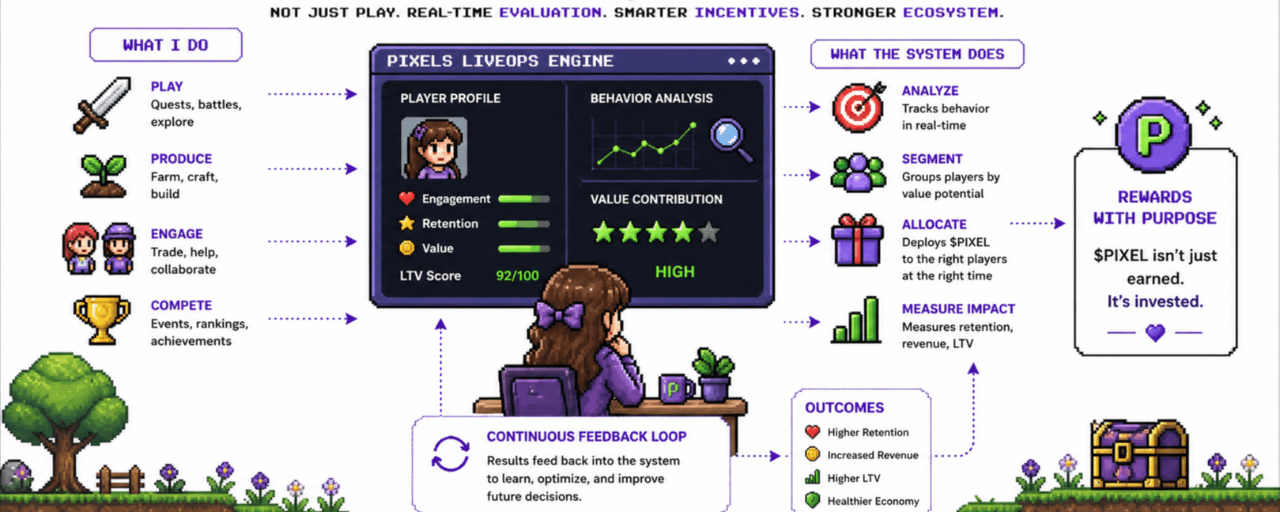

I remember the moment it stopped feeling like I was just playing. Nothing obvious changed on the surface. I was still running the same loops, farming, crafting, moving through familiar paths but the outcomes didn’t feel evenly distributed anymore. Some actions seemed to matter more, not because they were harder or more efficient, but because they triggered something deeper in the system. It felt less like progression and more like evaluation. Not in a restrictive way, just selective. And that’s when it started to click that maybe this wasn’t just a game reacting to me, but a system actively deciding which behaviors were worth amplifying.
At first, I defaulted to the usual mental model. $PIXEL is the reward, the output of time spent, something you either accumulate or rotate out of. That framing usually holds in GameFi because most systems are fairly static underneath. But here, it started to feel incomplete. The token didn’t behave like something passively earned. It felt like it was being deployed. Almost like it had intent behind it. And the more I paid attention, the more it seemed like I wasn’t just earning rewards, I was being positioned to receive them under specific conditions.
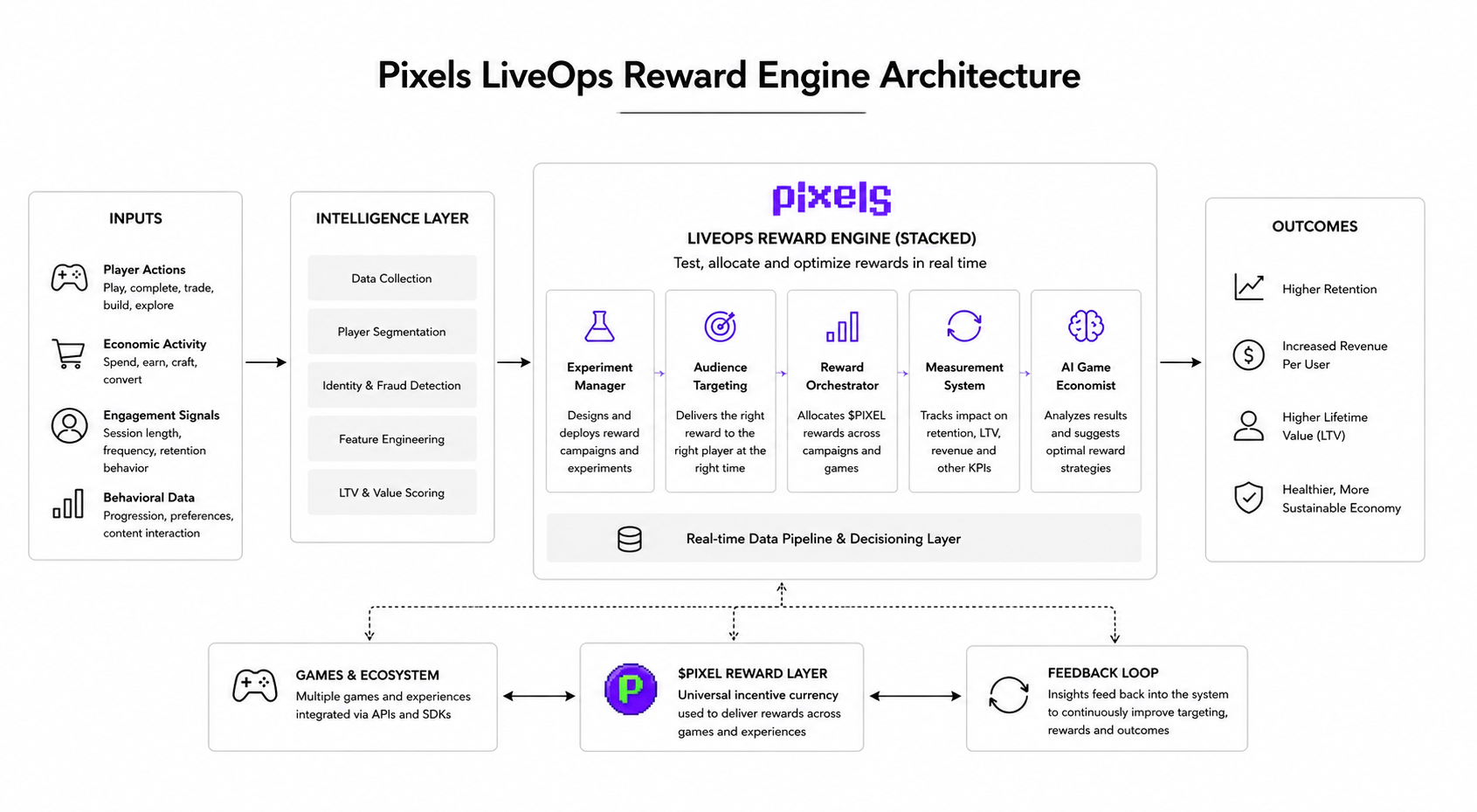
The shift became clearer when I stopped thinking about activity and started thinking about outcomes. Pixels doesn’t really optimize for how much you do. It seems to optimize for what your actions lead to whether they increase retention, whether they contribute to the in game economy, whether they signal long term value. That kind of system can’t rely on fixed rewards. It needs measurement, and more importantly, it needs the ability to adjust incentives based on what actually works. That’s where it starts to feel less like a designed economy and more like something running controlled experiments in real time.
And it’s not passive. There’s a loop underneath that feels deliberate and continuous. Players act, rewards are allocated to specific cohorts at specific moments, the system measures whether those incentives improve retention, revenue per user, and lifetime value, and then it adjusts the next cycle. That loop repeats, constantly. It’s not just reacting, it’s testing with the expectation of return. Rewards in that context start to look less like giveaways and more like capital being deployed, with the assumption that they should generate measurable outcomes.
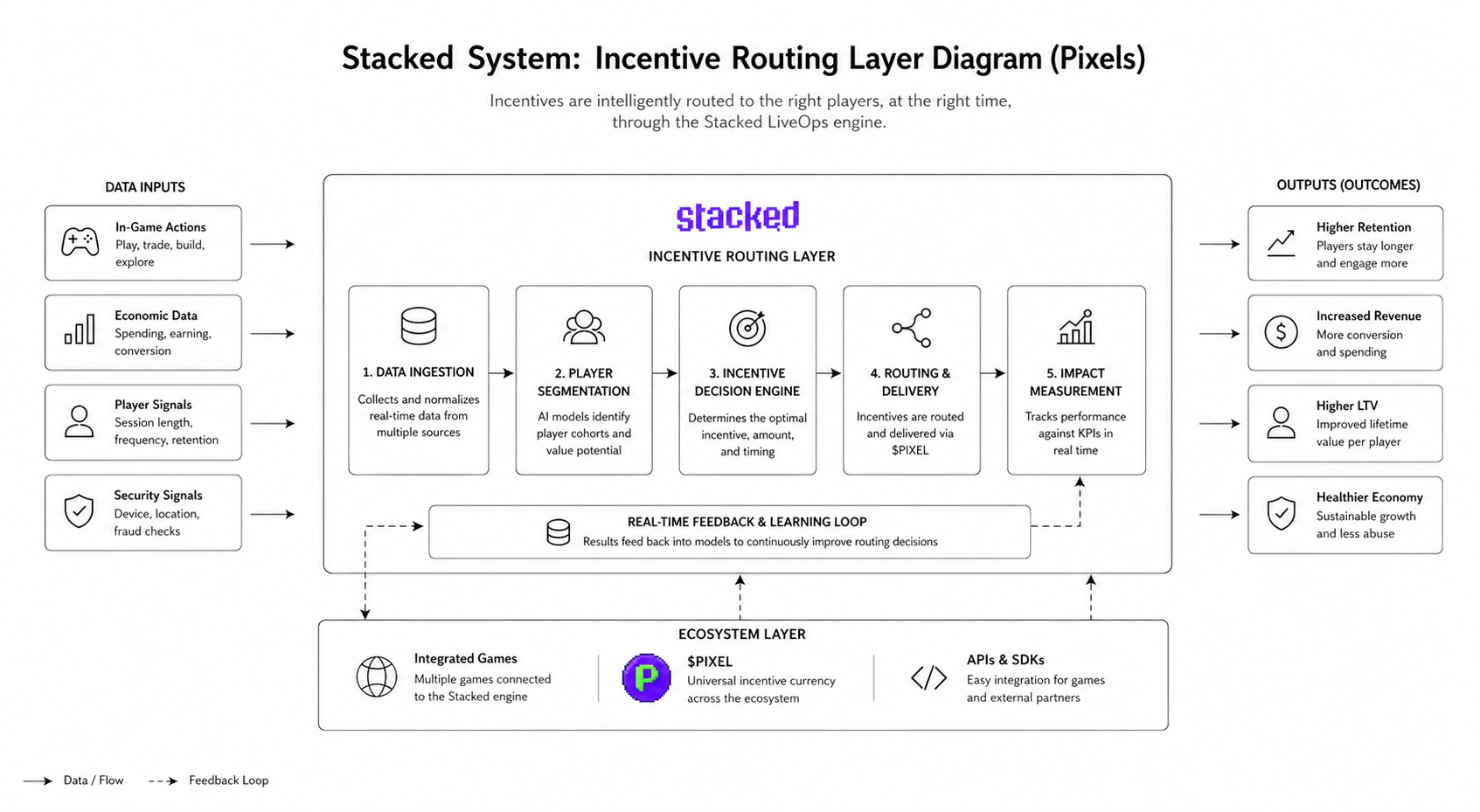
Stacked, their LiveOps engine, is where that loop actually operates. Not as a visible feature, but as the layer routing incentives across the system. It has already processed over 200 million reward events and influenced more than $25 million in revenue, which makes it hard to frame this as early experimentation. It’s already functioning at scale. The AI layer sitting on top isn’t there for abstraction, it’s there to identify which reward strategies are worth running based on real player behavior. At that point, the system isn’t guessing. It’s iterating with data.
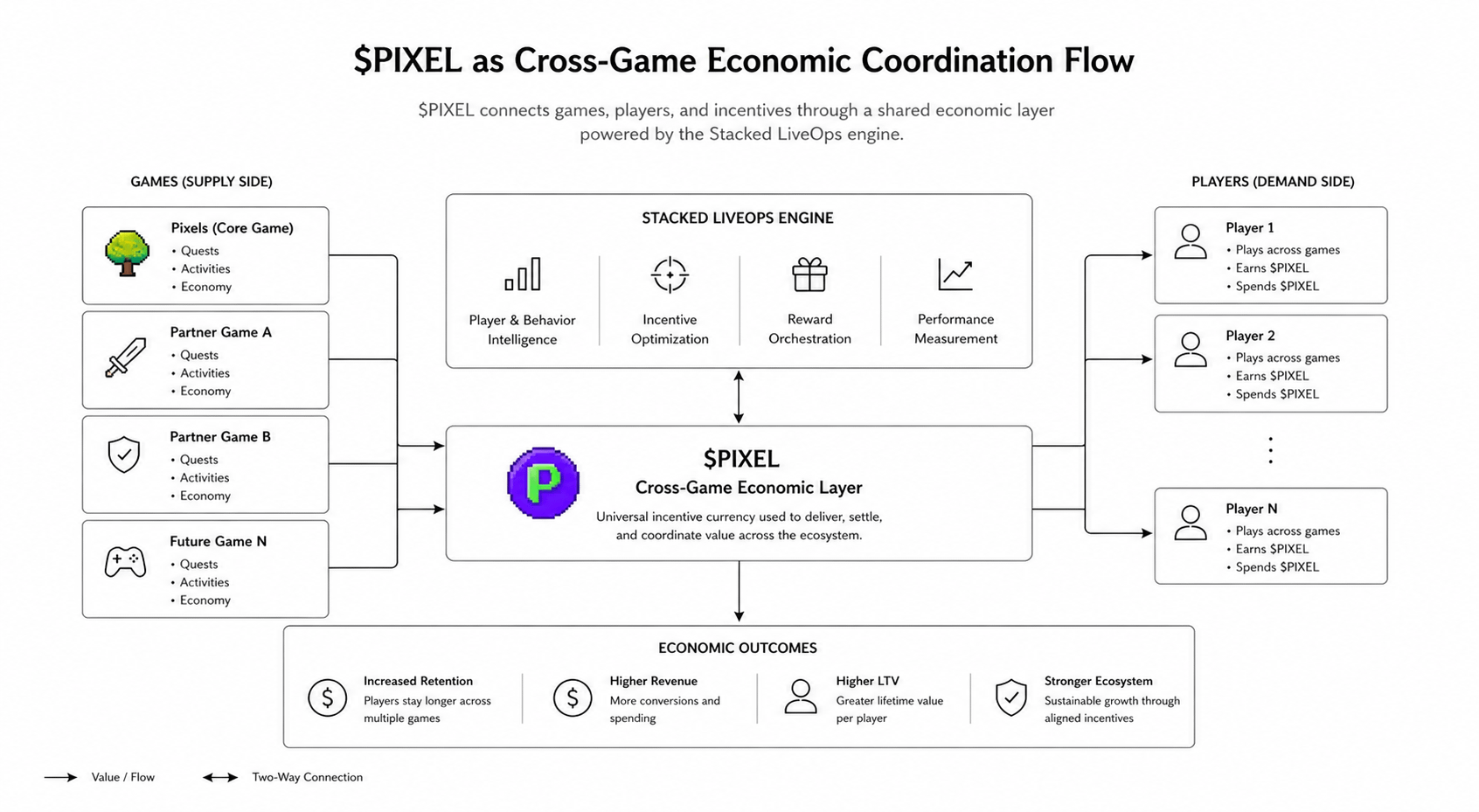
That’s also where @Pixels takes on a different role. It’s not just a token tied to a single gameplay loop. It’s the unit through which incentives are delivered, measured, and recalibrated across an expanding network of games. As more environments plug into the same reward infrastructure, the token starts acting less like a local currency and more like a shared economic layer. Not hypothetical, but already in motion. In that sense, #pixel isn’t just moving through the system, it’s coordinating how value flows between players, behaviors, and outcomes.
There’s still a visible gap between what the system is doing and how the market treats it. On the surface, Pixel trades like any other asset, shaped by sentiment and short term narratives. But underneath, its role is tied to whether these reward loops actually produce return,whether they improve retention in a measurable way, whether they increase revenue efficiency, whether they extend player lifetime value. If those loops hold, the token has a clear function. If they don’t, then the structure doesn’t carry much weight. That tension hasn’t fully resolved yet.
What I keep coming back to is the tradeoff. A system that allocates rewards with precision doesn’t treat all participation equally. It filters. Not just for quality, but for legitimacy removing behaviors that don’t contribute, limiting abuse, and protecting the economy from extraction loops or automated farming. That makes the system more stable, but it also changes the feel of the experience. It becomes less about open ended play and more about aligning yourself with what the system recognizes as valuable. Not forced, but continuously evaluated.
At the same time, it’s hard to ignore why this direction exists. Most GameFi economies broke because they distributed rewards without understanding their impact. They rewarded activity without measuring whether it created value. Pixels approaches that differently. It treats rewards as inputs, not outputs, something to deploy, test, and refine based on actual economic results. That shift from distribution to allocation is subtle, but it changes how the entire system behaves over time.
So I don’t really see Pixels as just a game anymore. It feels more like an economic layer using gameplay as its interface. The mechanics are still there, but underneath, there’s a system constantly measuring behavior, reallocating incentives, filtering out noise, and reinforcing what works. $PIXEL, in that context, isn’t just something you earn. It’s the mechanism that carries those decisions across the ecosystem.
I’m still not fully certain what that means for players long term. Part of me respects the design, it’s intentional, it’s already running, and it’s producing measurable outcomes. Another part of me wonders how it feels to exist inside a system that continuously evaluates and adjusts around you. Maybe that’s the real shift happening here.
Because when rewards stop being fixed and start being deployed with expectation, the question isn’t how much you can earn.
It’s whether the system keeps finding reasons to invest in you.