The first time I watched a Genesis Pet trail behind a player in the heart of Terravilla, I dismissed it as a vanity metric. I saw a cosmetic flex, a pixelated status symbol meant to signal early adoption and little else. What I missed was the math hiding under the hood.
In the current Pixels economy, energy is the only true currency. Everything else—the crops, the wood, the industrial tiers—is just a derivative of how much effort you can output before hitting a wall. Genesis Pets are not just digital companions; they are the quiet machinery of industrial scaling.
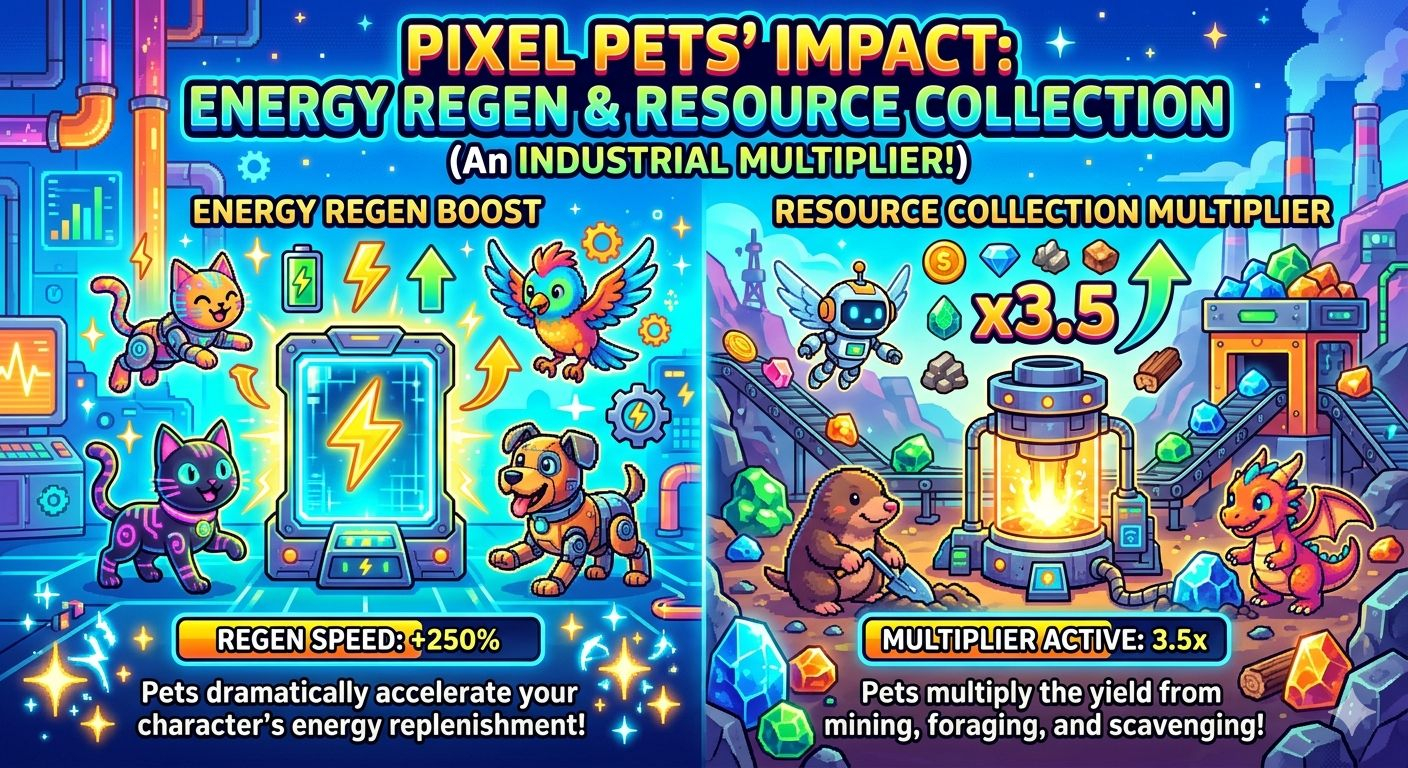
When you look at a Pet, you are looking at an "Energy Regen" multiplier that operates while you sleep. Most players operate on a fixed biological clock, waiting for timers to reset or consuming berries to stay functional. A Pet changes how that clock ticks by providing a steady, passive replenishment that others simply cannot access.
The market currently prices these assets based on floor price sentiment, which is a mistake. It ignores the texture of long-term resource collection. If a Pet provides a 5 percent boost to output—which means 5 extra units for every 100 harvested—that margin is the difference between a break-even operation and a profitable one.
The industrial multiplier effect is often overlooked because its impact is incremental. It does not provide a sudden windfall. Instead, it offers an earned advantage that compounds every single day you log in. Over a six-month period, those small percentages turn into thousands of additional resources.
What struck me recently is the foundation of the Pet's utility in Chapter 3 mechanics. As resource pipelines become more complex, the cost of manual labor is rising. We are moving away from simple farming toward a system where efficiency is the only way to survive the tightening margins of the marketplace.
There is a quiet tension in the current pricing. People are looking for the next big speculative pump, but they are ignoring the steady utility that sits right in front of them. The "Pet Factor" is undervalued because it requires a spreadsheet to appreciate, and most of the market is still trading on vibes.
I am not entirely sure if the broader player base will ever fully price in the technical debt of not owning a Pet. There is a high barrier to entry, but the cost of inefficiency is arguably higher over time. You are either paying for the asset now or paying for the lack of it in every transaction you make.
Underneath the bright colors and the playful animations, these Pets are acting as a secondary layer of infrastructure. They represent a shift from active play to optimized systems. If you treat your land like a business, you eventually realize that you cannot afford to leave these multipliers on the table.
The logic is simple: a player with a Pet is running a different version of the game than a player without one. One is fighting the energy cap, while the other is leveraging it. It is the difference between working for your resources and making your resources work for you.
The deeper point is that in a digital economy, we often confuse beauty with utility. We assume that because something looks like a toy, it must function like one. The reality is that the most powerful tools in this ecosystem are often the ones that look the least like tools. @Pixels $PIXEL