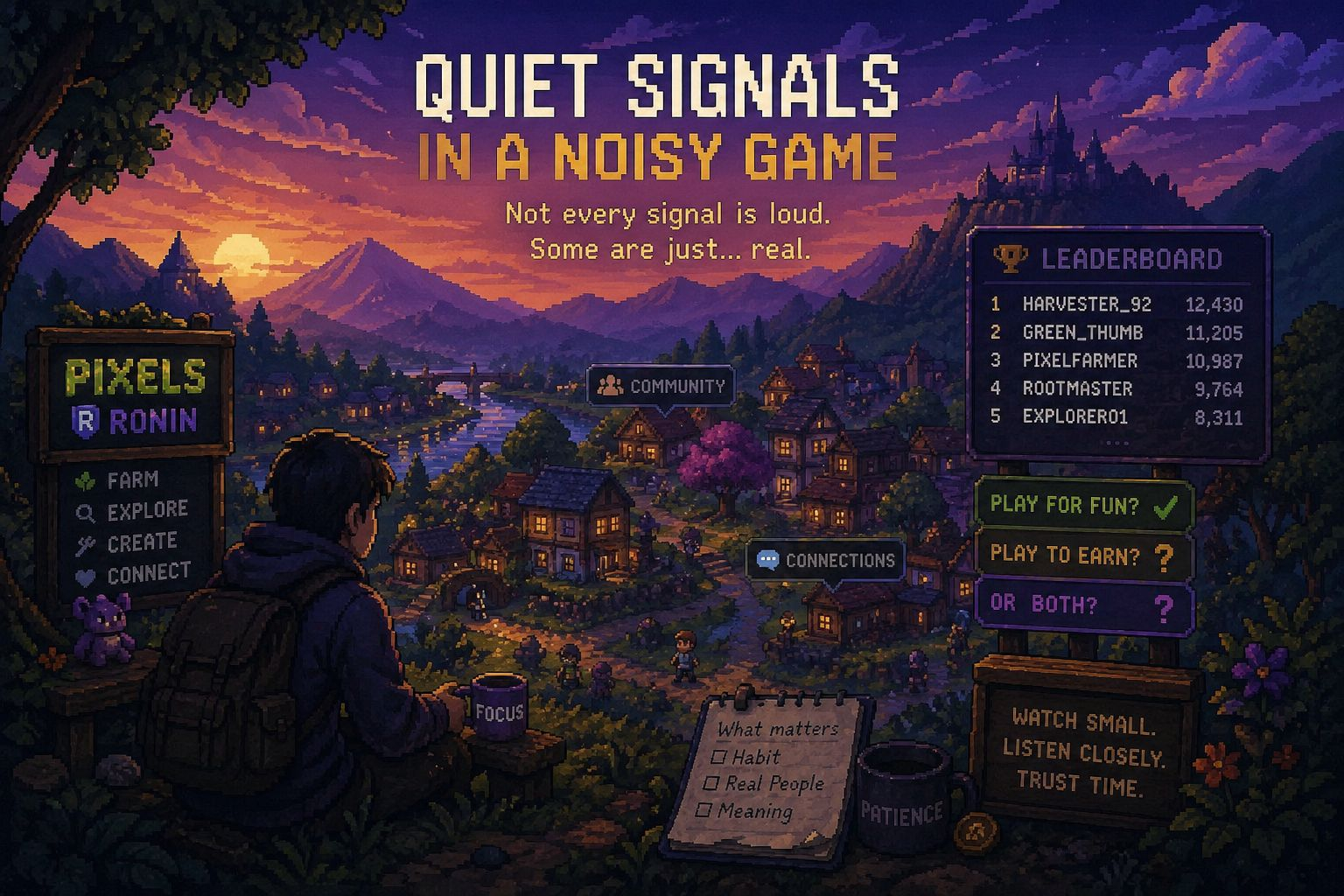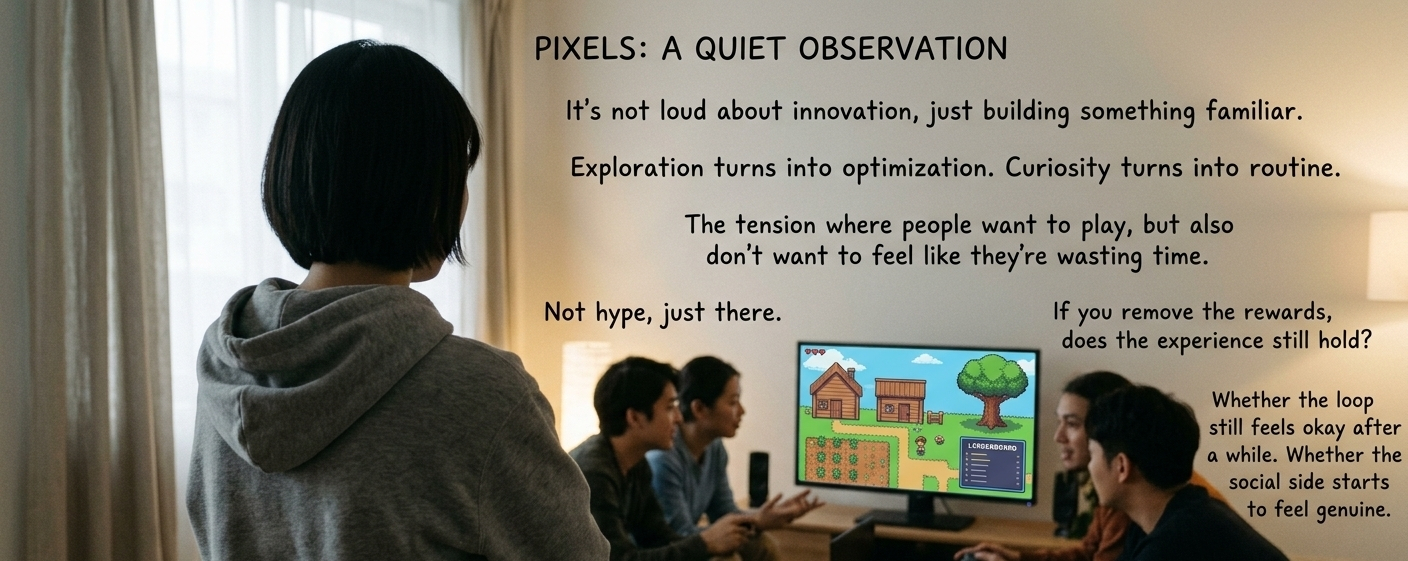
I’m watching Pixels the way you watch a room when you’re not fully part of the conversation, just standing there, listening, picking up tone more than words. People mention it casually, like something they’ve been checking on between everything else. Not hyped, not dismissed either. Just there. And that’s usually where I start paying attention.
At first it sounds simple. A farming game, a shared world, some exploration, a bit of creation, a leaderboard to keep things moving. Nothing complicated on the surface. But reality is different. I’ve seen how quickly “simple” turns into something layered the moment you add tokens, ownership, and a crowd that’s half playing and half calculating. You can feel it in how people talk about it. Some sound relaxed, like they’re just enjoying the loop. Others sound like they’re trying to stay ahead of soething.
That’s where things get interesting. Because when I look at Pixels, I don’t just see a game. I see that familiar tension again. The one where people want to play, but also don’t want to feel like they’re wasting time. It’s subtle, but it changes how everything feels. Planting, harvesting, moving around—it should feel light. But there’s always that quiet layer underneath asking, “is this worth it?” Not in a fun way, more in a slightly cautious way.
I’m not fully convinced yet that this tension ever fully disappears in Web3 games. Sometimes it just gets better hidden. Ronin helps, though. You don’t feel the chain much, which is probably the point. Things work, interactions feel smoother, and nobody is stopping every five minutes to think about wallets or fees. That’s a big deal, even if people don’t say it out loud. But it also means something else. When the tech fades into the background, the game itself has to carry everything. There’s nothing else to lean on.
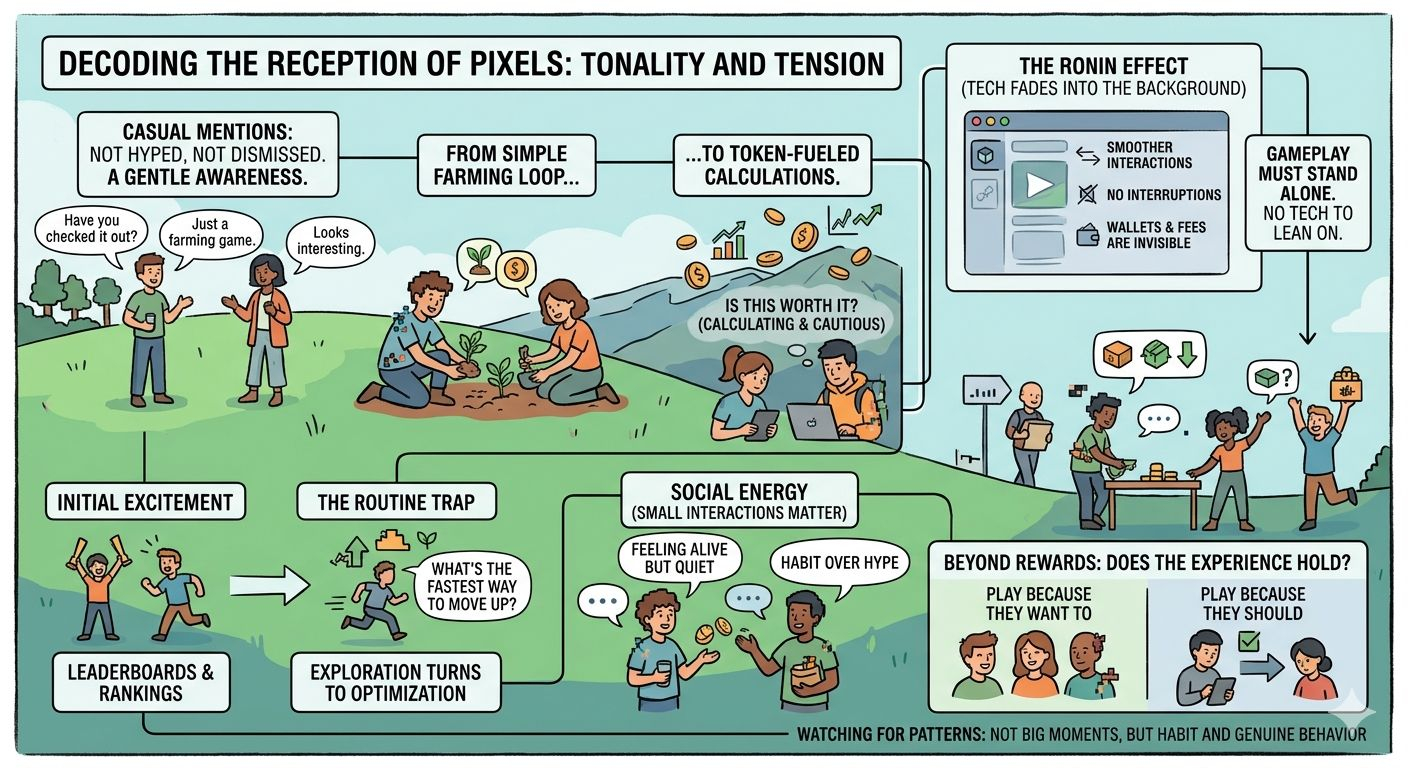
And this is where it gets complicated. The leaderboard, for example, feels like a small feature, but it changes behavior more than people realize. At first it just adds a bit of excitement. A reason to check in, to compare, to push a little. But over time, it can shift how people play. Exploration turns into optimization. Curiosity turns into routine. Instead of asking “what can I do here,” people start asking “what’s the fastest way to move up.”
I keep coming back to this idea because I’ve seen it happen before. Systems that start open slowly narrow themselves, not because they were designed that way, but because people naturally look for edges. And once enough people find those edges, the whole experience bends around them. Pixels still feels like it’s somewhere in between. Not fully optimized, not fully relaxed. And maybe that’s intentional. Or maybe it’s just where it is right now.
What I find myself watching more closely is the social side of it. Not the big announcements or campaigns, but the small interactions. How people talk to each other. What they share. Whether it feels like a place, or just a system. Because social energy is unpredictable. It can carry a project much further than expected, or disappear faster than anyone planned.
Right now, it feels alive, but in a quiet way. Not loud excitement, more like steady movement. People logging in, doing their thing, checking progress. That’s not a bad sign. But it’s also not enough on its own. Execution will decide everything. Because at some point, the question always comes back: if you remove the rewards, even just a little, does the experience still hold? Do people stay because they want to, or because it feels like they should?
Real systems don’t work in extremes. You can’t rely only on fun, and you can’t rely only on incentives. The balance has to feel natural, almost invisible. Ownership adds another layer to this. In theory, it should make everything more meaningful. In practice, it sometimes makes people more careful. Less experimental. A bit more calculated. That doesn’t ruin the experience, but it changes the tone. Play becomes slightly more serious, even if nobody says it directly.
And then there’s scale, which always shows up later. Everything feels fine when the world is small enough to understand. But growth changes things. More players, more activity, more pressure on systems that seemed simple before. Sometimes the world expands with it. Sometimes it starts to feel crowded or repetitive.
I’m standing here thinking that Pixels isn’t trying to be something extreme, and maybe that’s its strength. It’s not loud about innovation, not trying to reinvent everything. It’s just building something that feels familiar and letting people interact with it in their own way. But that also makes it harder. Because without hype or complexity to hide behind, what’s left is the experience itself. And people can feel when that’s thin. They can also feel when it’s real.
I keep seeing this pattern in Web3 where projects attract attention quickly, but holding that attention quietly is the real challenge. Not through campaigns or spikes, but through habit. Through people coming back without thinking too much about it. That’s the part you can’t fake.
So I keep watching. Not for big moments, but for small ones. Whether the loop still feels okay after a while. Whether the social side starts to feel genuine. Whether the system stays balanced when people push on it from different angles. Because in the end, it’s not about whether Pixels works today. It’s about whether it still makes sense when things slow down a bit.
And that answer doesn’t come from announcements. It shows up slowly, in how people behave when nobody is really paying attention anymore.