
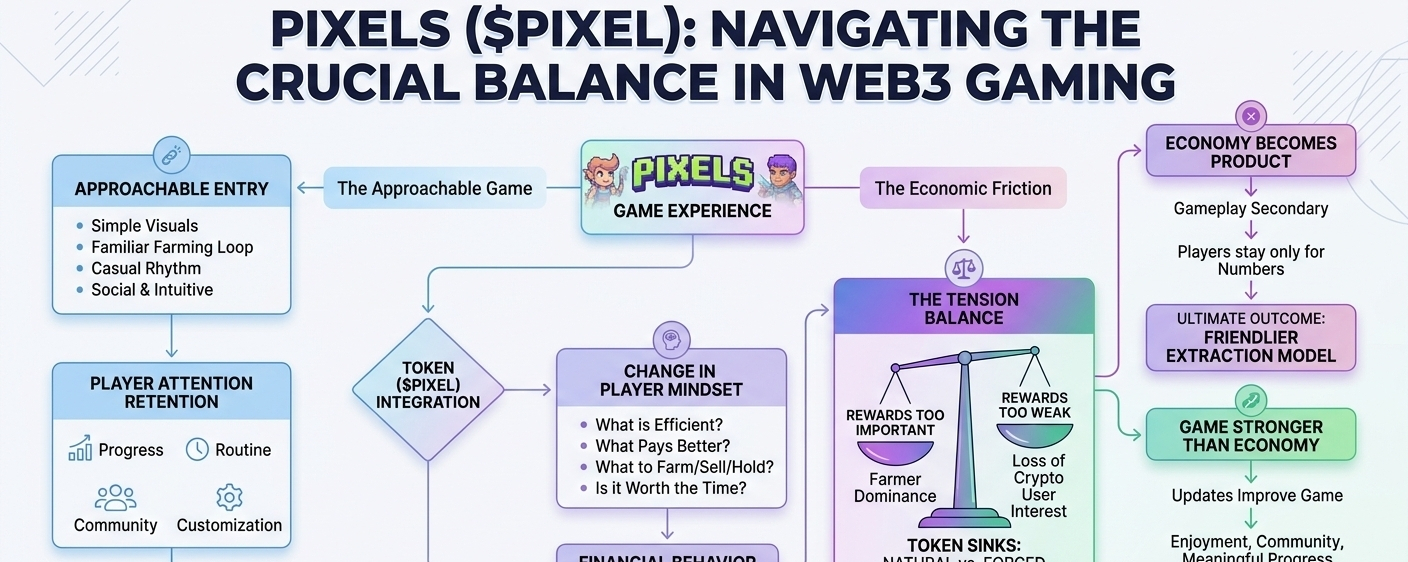

Pixels does something most crypto games struggle to do.
It feels approachable.
That alone makes it stand out. A lot of Web3 games begin with friction. Wallets, tokens, marketplaces, assets, rewards, and complicated economic language all show up before the player has a reason to care. By the time the “game” starts, it already feels like a financial product.
Pixels feels different.
It looks simple. It feels social. The farming loop is familiar. The world has a casual rhythm that normal players can understand without needing to think like traders.
That is a real strength.
Because crypto gaming does not need more projects that only attract people looking for yield. It needs games that can hold attention for ordinary reasons. Progress. Routine. Community. Customization. A sense that logging in is enjoyable even when there is no big reward waiting.
Pixels seems to be moving in that direction.
But the old problem is still sitting underneath the surface.
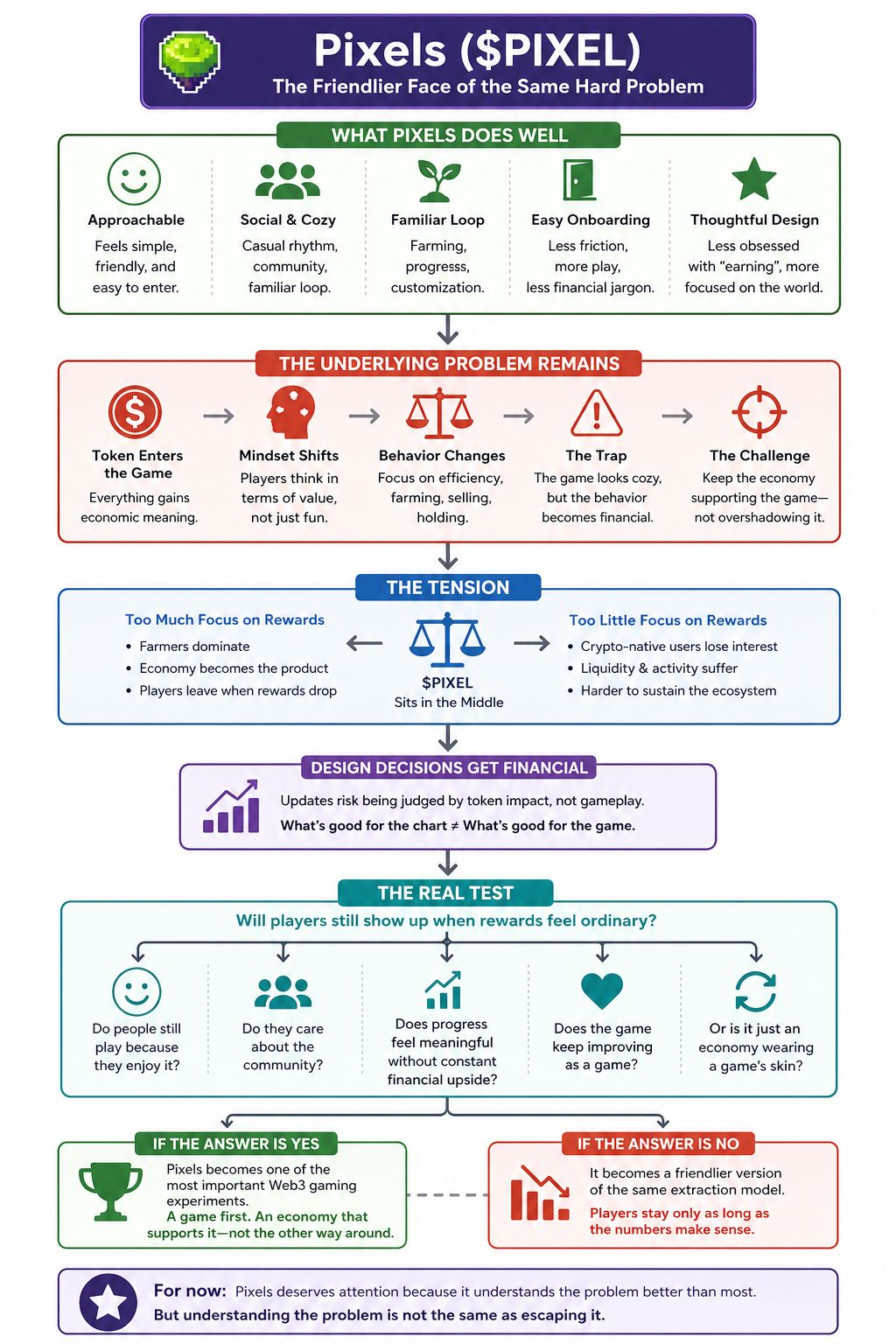
Once a token becomes part of the game, the player’s mindset changes. A task is no longer just a task. A resource is no longer just a resource. Time is no longer just time. Everything starts to carry economic meaning.
That is where the tension begins.
A player who might have explored casually now starts asking what is efficient. What pays better? What should be farmed? What should be sold? What is worth holding? What is not worth the time?
The game may still look cozy, but the behavior becomes financial.
That is the trap Pixels has to avoid.
It cannot just be more polished than older play-to-earn games. It has to prove that the game itself is strong enough to keep the economy from becoming the main attraction. That is much harder than making the experience look friendly.
To its credit, Pixels does feel more thoughtful than the old reward-first model. It seems less obsessed with shouting about earning and more focused on making the world easy to enter and easy to understand. That gives it a better foundation than many earlier projects.
But better foundations still need to survive pressure.
If rewards become too important, farmers dominate. If rewards become too weak, crypto-native users may lose interest. If token sinks feel natural, the economy can support the game. If they feel forced, the game starts to feel like it exists to protect the token.
That balance is extremely difficult.
And $PIXEL sits right in the middle of it.
The token can make the ecosystem more connected, but it can also make every design decision feel financial. Updates can stop being judged by whether they improve the game and start being judged by whether they help the token. That is dangerous, because what is good for a chart is not always good for a game.
This is where many crypto games lose their way.
They begin by promising ownership and open economies, but eventually the economy becomes the product. The world, the characters, and the gameplay become secondary. Players stay only as long as the numbers make sense.
Pixels is trying to be better than that.
Maybe it will be.
But the proof will not come during periods of excitement. It will come when the rewards feel ordinary, when speculation cools, and when players have to decide whether the world itself is worth returning to.
That is the real test.
Do people still play because they enjoy it?
Do they care about the community?
Does progress feel meaningful without constant financial upside?
Does the game keep improving as a game, not just as an economy?
If the answer is yes, Pixels becomes one of the more important Web3 gaming experiments.
If the answer is no, then it is just a friendlier version of the same extraction model.
For now, Pixels deserves attention because it understands the problem better than most.
But understanding the problem is not the same as escaping it.
