

Okay, so I’ve been sitting with Pixels for a while now, and I’m gonna be real with you—it’s weirdly one of the only Web3 games that doesn’t feel like it’s trying to scam your attention or your wallet every five seconds. And yeah, I know that sounds harsh, but let’s be honest here… most of the early blockchain games? Total hype machines. You clicked in because someone said “earn money,” and then you stayed because you didn’t want to admit you’d already sunk time into something kind of hollow.
Pixels feels different. Not perfect. Not even close. But different in a way that actually matters.
The first thing that hit me wasn’t the token or the NFTs or any of that stuff. It was just… the vibe. It’s chill. Like, actually chill. You log in, you plant stuff, you walk around, you see other players doing their thing. Nobody’s screaming about ROI. Nobody’s min-maxing like their life depends on it—well, okay, some people are, but that’s every game. The point is, it doesn’t force that mindset on you.
And honestly, that’s kind of a big deal in 2026, because the whole “play-to-earn” narrative burned a lot of people. You remember Axie days, right? People grinding like it was a second job, economies inflating out of control, tokens crashing, and suddenly the whole thing just felt… fragile. Like a house of cards built on new players coming in nonstop. That stuff left a bad taste.
Pixels doesn’t scream “earn.” It just lets it happen in the background. And weirdly, that makes it feel more real.
Actually, wait… I think what I’m trying to say is that Pixels finally understands something super basic that Web3 devs somehow missed for years: people don’t play games to work. They play because it’s fun. Or relaxing. Or social. Or just to kill time in a way that doesn’t feel empty. And if you accidentally make some value along the way, cool. But if the entire thing is built around extracting value, it breaks.
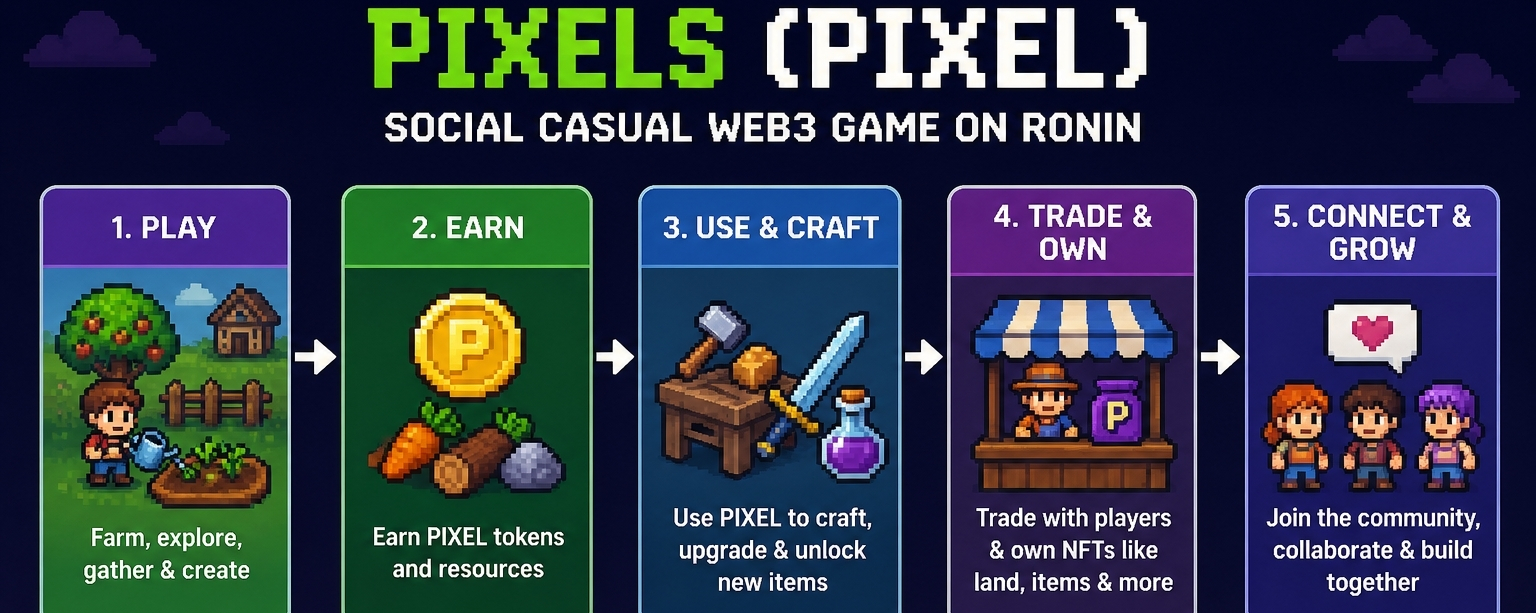
So yeah, you start farming. Simple loop. Plant, wait, harvest. Sounds boring, right? It kind of is. But also… it isn’t. There’s something about that loop that just works. It scratches the same itch as Stardew or Animal Crossing. You’re not rushing. You’re not stressed. You’re just there, doing your thing. And over time, you start optimizing without even realizing it.
Then you notice other people. That’s where it gets interesting.
Because Pixels isn’t just about you and your farm. It’s about everyone else’s farms too. You see people hanging out, trading, talking, sometimes just standing around like they’re in some weird digital town square. And I know that sounds small, but most blockchain games completely failed at this. They felt empty. Like ghost towns with token mechanics slapped on top.
Here, it feels alive. Messy, sure. But alive.
I almost forgot to mention the Ronin part, which is actually kind of important. Because if this was on Ethereum mainnet or something clunky, nobody would stick around. Fees would kill it. Ronin makes everything feel instant, cheap, almost invisible. You don’t think about the blockchain layer much, which is exactly how it should be. When tech disappears into the background, that’s when it’s working.
Now the PIXEL token… yeah, let’s talk about that, because this is where things can get a little shaky.
It has utility. That’s the good part. You use it for crafting, upgrades, all the usual stuff. It’s not just sitting there as a speculative chip. But it’s still a token. And tokens bring baggage. Price swings. Speculation. People trying to game the system instead of playing the game.
And you can see that tension inside Pixels sometimes. On one hand, you’ve got players who are just vibing, farming, exploring. On the other, you’ve got people calculating efficiency down to the minute, trying to squeeze every bit of value out of the system. Neither is wrong, but when the second group grows too big, things can get weird.
Like, suddenly the economy starts feeling less like a game and more like a spreadsheet.
That’s the tightrope Pixels is walking right now. And honestly, I don’t know if they’ll nail it long-term. Nobody really has yet.
Because here’s the thing people don’t like to admit: sustainable game economies are insanely hard. Not just in Web3—every game struggles with it. But when real money is involved, the cracks show faster. Inflation hits harder. Player behavior changes. People stop playing for fun and start playing for optimization.
And that can drain the soul out of a game if you’re not careful.
Still, Pixels is doing a better job than most. It’s trying to slow things down. Limit runaway rewards. Make you actually engage with the systems instead of just farming tokens mindlessly. It’s not perfect, but it’s… thoughtful. And that’s rare.
Let’s be honest here, the visuals help too. That pixel-art style? It’s doing a lot of heavy lifting. It makes everything feel approachable. Non-threatening. You’re not stepping into some hyper-competitive, ultra-polished environment where you feel behind from day one. You’re stepping into something that feels… cozy.
Yeah, cozy is the word.
And that matters more than people think. Because onboarding in Web3 has always been a nightmare. Wallets, keys, gas fees, weird jargon. Most people bounce before they even start. Pixels smooths that out just enough that you don’t feel overwhelmed. You can just… play.
Of course, there are still rough edges. Some parts feel clunky. Some loops get repetitive faster than you’d like. And if you’re the kind of player who needs constant excitement, Pixels might not hook you long-term. It’s slow. Deliberately slow. And not everyone has the patience for that.
Also, the whole NFT land thing… yeah, that’s still a bit of a dividing line. Owning land gives advantages. That’s just reality. And while you can play without it, there’s always that subtle feeling that you’re not fully in the game unless you own a piece of it. That can turn people off.
Then there’s the broader issue. Web3 gaming still has a reputation problem in 2026. A lot of gamers hear “blockchain” and immediately check out. They think scams, cash grabs, overhyped nonsense. And honestly, they’re not entirely wrong given the history.Pixels is trying to change that narrative, but it’s an uphill battle.What’s interesting though is how it’s attracting a different kind of player. Not just crypto people, but actual gamers who are curious. People who wouldn’t touch earlier Web3 games are giving this a shot because it feels closer to something they already understand.And once they’re in, they start to get it.Not the hype. Not the speculation. The idea.That maybe, just maybe, owning your in-game stuff actually makes sense. That maybe digital worlds can have real economies without turning into chaos. That maybe you don’t have to choose between fun and value.
But yeah, it’s still early. And things can go sideways fast if the balance tips too far in either direction.
If it leans too hard into earning, it becomes another grind machine. If it ignores the economy completely, it loses what makes it unique. That middle ground is fragile. Really fragile.
I guess what keeps me coming back isn’t the token or the mechanics or even the progression. It’s the feeling that this thing could actually work if they don’t mess it up. Like, you’re watching something figure itself out in real time.
And that’s kind of rare.
Most games feel finished when you play them. Pixels feels… in progress. In a good way. Like it’s still shaping itself based on how people interact with it. That makes it unpredictable. Sometimes messy. But also interesting in a way polished games aren’t anymore.
Anyway, I’ve probably spent way too long thinking about this, but that’s kind of the point. It sticks with you. Not because it’s flashy or groundbreaking in some obvious way, but because it quietly fixes things that were broken before.
And yeah, it still has problems. Plenty of them. But at least it feels like it’s trying to be a game first and everything else second, which—honestly—shouldn’t be a radical idea, but here we are.
