
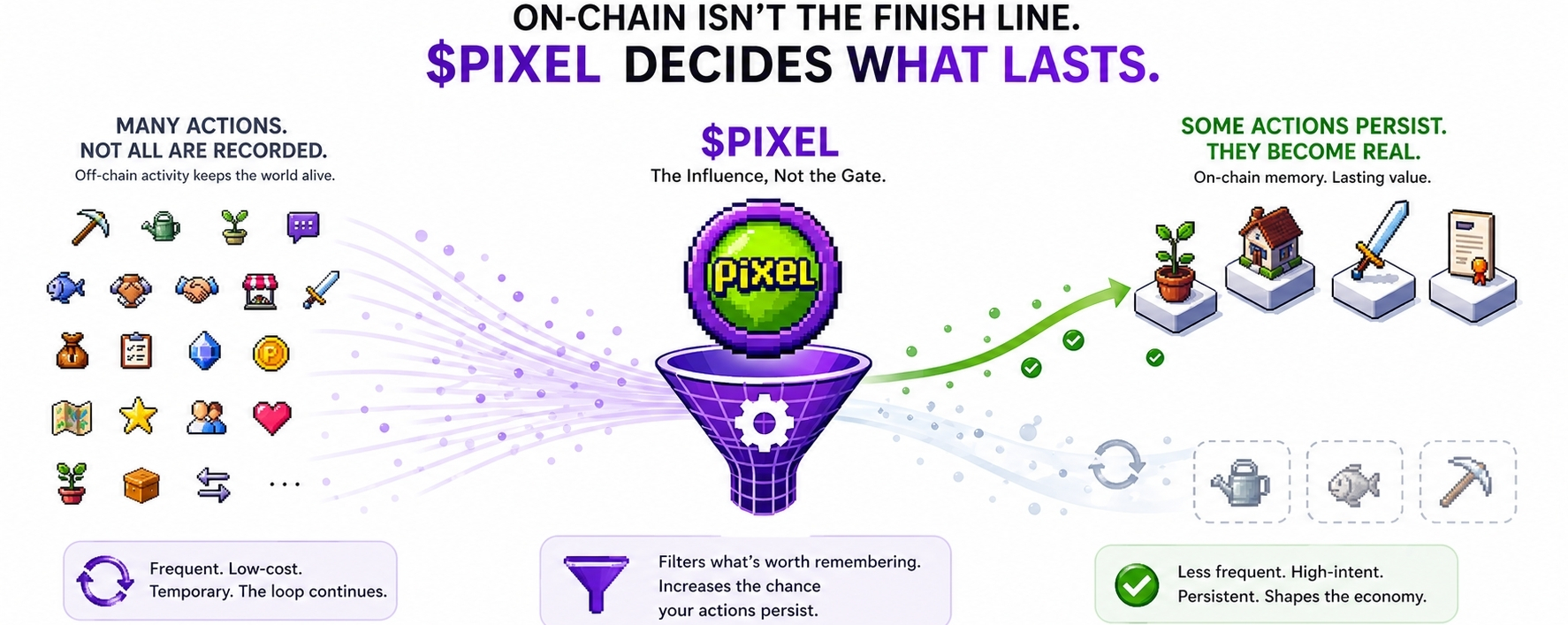
What if we’ve been thinking about “on-chain” all wrong this entire time? For a long while, it felt natural to treat it as a finish line. You do something—anything—and once it’s recorded on-chain, it counts. It becomes real, permanent, final. That idea is neat, almost comforting, a clear boundary between what matters and what doesn’t. But the deeper you look into how these systems actually function, the more that clean line starts to blur. Because the truth is, most of what happens in these digital economies never touches the chain at all, and yet the system doesn’t feel empty. It feels active, alive, meaningful even. That contradiction—between what’s recorded and what still feels valuable—is where things start to get interesting. Step into Pixels and, at first, everything feels open. You log in, you farm, you explore, you trade a little, you experiment with your routine. There’s no immediate pressure pushing you to spend, no obvious walls stopping you, no aggressive monetization pulling you in a specific direction. It gives you something rare: the feeling that you are free. And with that freedom comes an assumption that everything you do carries equal weight, that your effort contributes in the same way regardless of how you play. But that assumption doesn’t hold for long. If you pay close attention, you begin to notice something subtle but powerful: not all actions are treated equally. Some actions echo, they ripple outward and persist, while others quietly fade away as if they were never meant to last. This difference is almost invisible at first. Early on, everything feels like progress, everything feels productive. But over time, patterns begin to form. Two players might invest similar effort, follow similar routines, spend similar hours, yet their outcomes diverge in ways that go beyond simple rewards. One player’s progress compounds, building into something that can be referenced, traded, or leveraged later, while the other remains stuck in a loop that resets again and again, creating motion without true accumulation. This is not random. There is a deeper structure at play. Beneath all of this sits a constraint that rarely gets discussed: you cannot record everything on-chain. Not because it is conceptually wrong, but because it is impractical. Every action placed on-chain carries a cost in speed, efficiency, and resources. If every small action were recorded, the system would slow down and become unsustainable. So something has to decide what gets recorded and what does not. That decision is not announced, but it exists. And in Pixels, that decision seems closely tied to $PIXEL. At first glance, it looks like a standard in-game token, something you use to speed up progress or unlock certain options. But over time, it begins to feel like something else entirely. It behaves less like a simple utility and more like a filter. Not a hard gate that blocks you from playing, because you can still grind, wait, and repeat loops without it, but a soft influence that increases the likelihood that your actions will matter in a lasting way. When $PIXEL becomes part of your decisions, something shifts. It is not just about saving time, it is about increasing the chances that what you are doing will persist beyond the immediate moment. That idea of persistence is crucial. In most systems, recognition is tied to visibility or rewards, but here it feels tied to memory. Whether an action remains temporary within the loop or moves into a layer where it can be used, referenced, or valued later. It is the difference between something that disappears and something that stays. This creates a system that behaves less like a recorder and more like a curator. It does not aim to capture everything equally, it selects. This idea is similar in spirit to concepts like Zero-knowledge proofs, where only certain information is revealed while the rest remains hidden. The goal is not total exposure but meaningful inclusion. Pixels seems to follow a comparable logic, where not every action deserves to be part of the system’s long-term memory. Instead of a binary structure where actions are either recorded or ignored, what emerges is a gradient. On one end are actions that are frequent, low-cost, and temporary, keeping the system active but not defining it. On the other end are actions that require more intention and resources, actions that persist and shape the long-term structure of the economy. Where an action falls on this spectrum depends on behavior, and subtly, on the presence of $PIXEL. This reshapes the idea of a free economy. While access remains open and anyone can participate, the system still determines what matters. It simply does so through incentives rather than restrictions, guiding behavior without forcing it. From a market perspective, this changes how the token should be understood. Its value is not just tied to player numbers or spending levels, but to how often players choose to move their actions into that persistent layer, how often they decide that what they are doing should last. If that decision is rare, the token remains peripheral. If it becomes habitual, the token becomes embedded within the core loop of the system. There are multiple ways this can evolve. In a balanced scenario, players feel free while still recognizing pathways to meaningful accumulation, allowing the system to remain efficient while valuable behaviors naturally rise. In a less stable scenario, players begin to feel that their actions only matter when the token is involved, weakening the sense of openness and creating a fragile perception of fairness. There is also a quieter possibility: many players may not care about persistence at all. They may simply enjoy the loop, farming, trading, and repeating without any desire for long-term recognition. If that happens, the demand for crossing into persistence may never fully develop, and the token’s role could remain limited. This leads to a different way of thinking about these systems. The question is no longer how much can be recorded on-chain, but what is worth remembering. Which actions deserve to persist, which can fade without consequence, and how a system guides that decision without making it feel forced. Pixels does not answer these questions directly. Instead, it allows behavior to shape the outcome over time. And at the center of that process, $PIXEL sits quietly, not as a gatekeeper, but as an influence, shaping what the system ultimately chooses to remember.
