
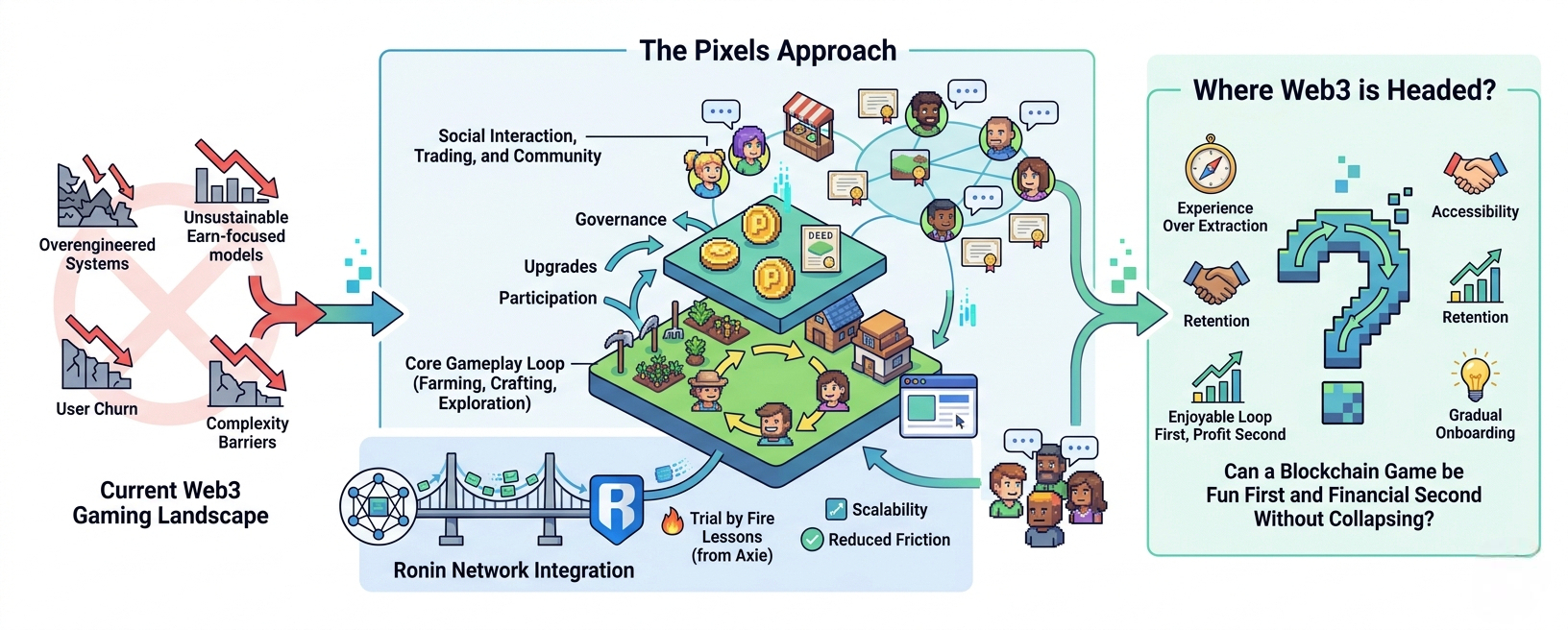

Lately I’ve been noticing something strange in the market. It’s not just about price anymore. Sure, Bitcoin moves still set the mood, liquidity still rotates like it always does, but underneath all that noise, I keep seeing a quiet shift in what people actually do on-chain. Not speculate. Not farm points. Actually play, interact, stick around. And that’s where Pixels somehow slipped into my radar.
At first, I almost ignored it. A pixelated farming game on the Ronin Network? It sounded like something I’d seen a hundred times before. Another attempt to revive the “play-to-earn” narrative that burned out hard after 2021. But then I started noticing something I couldn’t easily dismiss. People weren’t just talking about Pixels because of token incentives. They were talking about what they were doing inside the game. Farming. Trading. Socializing. Logging in daily without sounding like they were being forced by rewards.
That caught me off guard.
Because if there’s one thing the last cycle taught me, it’s that most Web3 games didn’t fail because of bad graphics or weak mechanics. They failed because nobody actually wanted to play them once the rewards slowed down. The “earn” part was doing all the heavy lifting. Remove that, and the whole thing collapsed.
So I started digging into Pixels with a bit more curiosity than I expected.
From what I’m seeing, Pixels isn’t trying to reinvent gaming in some overly complex way. It’s actually doing something much simpler, which might be why it’s working. At its core, it’s an open-world farming and social game. You plant crops, gather resources, craft items, interact with other players. It’s familiar. Almost intentionally so. It doesn’t try to overwhelm you with mechanics that feel like a whitepaper disguised as gameplay.
And I think that’s the point.
Web3 has this habit of overengineering things. We try to make everything revolutionary, and in doing so, we forget that people just want something intuitive. Pixels feels like it understands that. You don’t need to understand blockchain to start playing. The crypto layer sits quietly in the background, which honestly feels like a design choice more projects should be paying attention to.
The Ronin Network plays a big role here, and I think that’s another piece people might be underestimating. Ronin already went through its own trial by fire with Axie Infinity. It saw what happens when a game becomes too dependent on financial incentives. It saw what breaks when user growth outpaces sustainability. So when Pixels moved onto Ronin, it didn’t feel random. It felt like a second attempt at getting things right, with lessons already baked in.
What I find interesting is how Pixels approaches its in-game economy. Instead of pushing aggressive “earn” mechanics, it leans more into utility and participation. The PIXEL token exists, but it doesn’t feel like the only reason the game exists. It’s used for governance, upgrades, certain in-game actions, but it’s not screaming for attention every second.
That subtlety matters more than people realize.
Because once a game starts revolving entirely around token extraction, players behave differently. They optimize instead of explore. They grind instead of engage. And eventually, they leave.
Pixels seems to be trying to avoid that trap by making the game loop enjoyable before it becomes profitable. And I think that’s where the real experiment is happening.
I’ve also noticed how the social layer plays into this. It’s not just a solo farming simulator. There’s a shared world, player interaction, community dynamics. And this is where Web3 actually makes sense. Ownership, trading, identity… these things only matter if there’s a social context around them. Otherwise, NFTs are just static assets sitting in a wallet.
Pixels gives those assets a reason to exist.
When I look at traction, I try not to get distracted by vanity metrics. But in this case, the activity patterns are hard to ignore. Daily users sticking around, consistent engagement, not just spikes around token events. That tells a different story. It suggests retention, not just attraction.
And retention is where most Web3 games quietly fail.
Another thing that stood out to me is how accessible the game feels. You don’t need high-end hardware. You don’t need deep crypto knowledge. It runs in a browser. That might sound like a small detail, but in a space where onboarding is still one of the biggest bottlenecks, it’s actually huge.
I’ve seen too many projects build for an audience that doesn’t exist yet. Pixels feels like it’s building for the audience that’s already here, while slowly making room for new users to come in without friction.
Of course, it’s not all smooth. There are real risks here, and I think ignoring them would be naive.
The biggest one, in my opinion, is sustainability. Even if Pixels is doing a better job than previous games, the question still stands: can it maintain engagement if token incentives become less attractive? That’s the ultimate test. Not just for Pixels, but for the entire Web3 gaming narrative.
Then there’s the broader market pressure. Gaming is one of the most competitive industries in the world. Web3 games aren’t just competing with each other. They’re competing with traditional games that have decades of experience, massive budgets, and deeply polished user experiences. Pixels doesn’t need to beat them outright, but it does need to offer something compelling enough to justify why a player would choose it instead.
There’s also the token side of things. Unlock schedules, liquidity dynamics, market sentiment… all the usual variables still apply. Even the best-designed ecosystem can struggle if the token experiences heavy sell pressure or loses narrative momentum.
And speaking of narrative, that’s another layer I’ve been thinking about.
Right now, Web3 gaming feels like it’s trying to rebuild trust. The last cycle left a lot of skepticism behind. People are more cautious. They’re less willing to believe in promises. So projects like Pixels aren’t just building a game. They’re rebuilding confidence in the idea that blockchain gaming can actually work.
That’s a heavy responsibility, whether they intended it or not.
One thing I didn’t expect, but now can’t ignore, is how Pixels subtly shifts the conversation from “how much can I earn?” to “what can I do here?” It’s a small change in framing, but it changes everything. It moves the focus from extraction to experience.
And maybe that’s the direction this space needs.
I’ve also been thinking about how this fits into the bigger picture of crypto cycles. Narratives rotate. Liquidity follows attention. And attention follows what feels real. Not in a technical sense, but in a human sense. What people actually enjoy, what they talk about, what they come back to.
Pixels feels closer to that than most projects I’ve seen in this category.
But I’m still cautious.
Because I’ve seen promising trends fade before. I’ve seen strong communities lose momentum. I’ve seen well-designed systems break under pressure. So while I find Pixels genuinely interesting, I’m not rushing to label it as “the future” of anything.
If anything, it feels more like a live experiment. A test of whether Web3 gaming can evolve past its early mistakes and find a model that people actually want to engage with long-term.
And maybe that’s why I keep coming back to it in my mind.
Not because it’s perfect. Not because it guarantees anything. But because it’s asking a question that the space hasn’t fully answered yet.
Can a blockchain game be fun first… and financial second… without collapsing under its own design?
I don’t think we have the answer yet.
But Pixels is one of the few projects that feels like it’s genuinely trying to find out.
