

Pixels is one of those projects I do not want to judge from the surface anymore, because the surface is too easy to misunderstand.
You open the game, you see the farm, the tasks, the resources, the reward structure, the usual player movement, and your brain immediately wants to file it under another crypto game trying to keep people active with incentives. I get why people do that. I’ve done it too. After enough cycles in this market, you start seeing the same shape everywhere. A game launches, attention comes in, rewards create noise, wallets multiply, activity looks good for a while, then the grind starts showing underneath. People pretend it is adoption until the sell pressure says otherwise.
But Pixels feels more complicated than that now.
Not perfect. Not safe. Just more complicated.
The thing I keep coming back to with Pixels is that it seems to understand something a lot of crypto games only understand after the damage is already done: you cannot pay every loop forever. You cannot keep feeding every action just because it creates movement. Movement is cheap in crypto. Wallets can move. Bots can move. Farmers can move. Mercenary users can move faster than anyone. If a project rewards movement without knowing whether that movement actually helps the world, it is not building an economy. It is just recycling emissions through people who already know where the exit is.
That is the old failure pattern.
I have seen it too many times.
The project reports activity. The community celebrates numbers. People say the ecosystem is growing. Then you look closer and half the activity is just reward-chasing with better branding. The game starts to feel like a job board wearing a costume. The players are not really players in the emotional sense. They are workers, claimers, optimizers, temporary visitors with spreadsheets in their heads. And once the rewards get thinner, they vanish like they were never part of the world at all.
Pixels is trying not to become that. At least that is how I read the current direction.
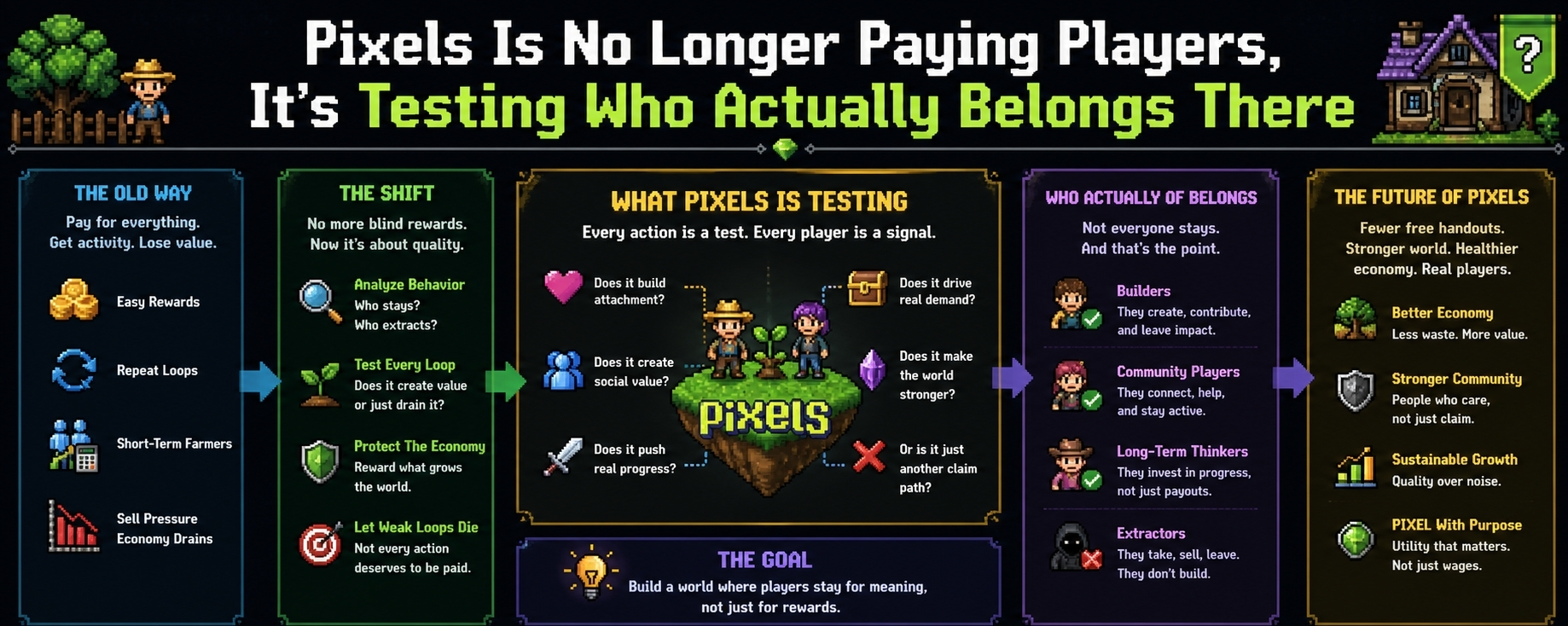
The project is not only asking how to bring people in anymore. That question is too basic. Any project can bring people in if the reward is loud enough. The harder question is what kind of people are worth keeping, what kind of activity is worth paying for, and what kind of loops should be allowed to die quietly before they turn into permanent weight on the economy.
That is where the project gets interesting.
A farming loop in Pixels is not just a farming loop now. It is a test. Does this action create attachment, or does it just create another claim path? Does it make the player care about the world, or does it teach them to calculate the fastest exit? Does it bring social behavior, land value, trading, identity, progress, something that sticks? Or is it just another little machine that turns time into token pressure?
Most people do not want to ask that because the answer is uncomfortable.
Some loops are useless.
Some users are expensive.
Some activity is fake even when a real human is doing it.
That last part matters. Everyone likes blaming bots because bots are easy villains. Fine, bots are a problem. But the uglier truth is that a normal human can behave like a bot if the incentives are dumb enough. Give people a repeated action with a predictable payout, and they will grind it down to its most profitable shape. They will remove the fun themselves if the system pays them to do it. That is not moral failure. That is market behavior. Crypto has trained people to do this for years.
So when I look at Pixels, I am less interested in whether it can attract more wallets and more interested in whether it can make low-quality behavior less comfortable.
That is the hard part.
If Pixels becomes too generous, farmers eat it. If it becomes too strict, normal players feel punished. If the reward logic is too clear, people farm the logic. If the reward logic is too hidden, players start feeling like the game is judging them from behind a wall. There is friction in every direction. No clean answer. No pretty roadmap slide fixes this.
This is why I think the project’s real work is not the visible farm. The real work is sorting. Sorting players from extractors. Sorting useful loops from dead loops. Sorting habits from temporary reward traffic. Sorting people who care about the world from people who only care about the next claim.
And yes, that sounds cold. It is cold.
But crypto gaming forced it to be cold.
The early dream was softer. Play, earn, own, participate, build community. It sounded good when the market was warm and everyone wanted to believe games could become economies overnight. Then reality showed up. The tokens became wages. The wages became sell pressure. The gameplay became labor. The world became a place people entered only when the math worked.
Pixels cannot build its future on that version of the dream.
It needs players who return for reasons that are not always financial. Not because rewards do not matter. Rewards matter. Anyone pretending otherwise is selling something. But rewards cannot be the whole reason the world stays alive. If the only reason people enter Pixels is because the game pays them, then the game is not strong. It is renting attention.
Rented attention is brutal. It looks good until it doesn’t.
That is why I care more about natural return than raw activity. A player checking their land because they care. A group showing up because they have history. Someone upgrading because it gives them status or progress. People joining events because there is some small social pull beyond the payout. These things are harder to measure cleanly, and they do not always make the loudest marketing posts, but they matter more than another spike in activity from people grinding a reward window.
Pixels needs more of that.
The token has to fit into that world too, and this is where I’m still cautious. PIXEL cannot just feel like wages. If players mostly think of it as something earned from tasks, then the instinct is simple: earn it, sell it, repeat. That is not a deep relationship with an asset. That is payroll behavior. For PIXEL to matter long term, it has to sit closer to access, progress, status, ownership, and serious participation inside the game. Players should feel that using it or holding it changes their position in the world in a way that actually matters.
Not fake utility.
Not a menu option.
Real pressure.
The kind where a serious player eventually feels, alright, I need this because it helps me inside the world, not because someone wrote utility in an announcement.
That is a much harder thing to build than another rewards campaign.
And I am looking for the moment this actually breaks, because every project has one. Maybe it breaks when casual players feel too filtered. Maybe it breaks when farmers find the next exploit in the reward logic. Maybe it breaks when people start feeling the system is too quiet, too measured, too controlled. Maybe the token never gets enough organic demand beyond rewards. Maybe the game keeps improving but the market is too tired to care.
That last one is real.
The crypto gaming market is exhausted. People have seen too many promises. Too many economies that looked clever until they met sell pressure. Too many games that talked about ownership but built shallow loops. Too many reward systems that called themselves sustainable while quietly bleeding from ten places at once.
So Pixels does not get trust for free.
It has to earn it in boring ways. By reducing waste. By making rewards less blind. By protecting real players without making the game feel hostile. By letting weak loops die instead of keeping them alive because they look good in a dashboard. By making PIXEL useful without forcing it into every corner like a desperate utility patch.
That is not glamorous work. It is maintenance work. It is economy plumbing. It is the kind of work nobody cheers for until they realize the project did not collapse when the easy money got thinner.
There is something almost unfair about that. If Pixels does the work properly, some of the improvements may look like less excitement. Fewer easy rewards. Less obvious farming. More friction. More selectiveness. People may confuse that with decline. Maybe sometimes it will be decline. Hard to know in real time. This market is not patient enough to separate cleanup from weakness.
But here’s the thing. A project that pays everything is usually afraid to choose. Pixels has to choose.
It has to choose which player behavior deserves oxygen.
It has to choose which loops are worth feeding.
It has to choose whether it wants activity that looks good today or an economy that is still alive later.
That choice will annoy people. It already should. Healthy economies are not built by making everyone happy all the time. They are built by saying no to the behavior that drains the system, even when that behavior appears in the form of users, engagement, and nice-looking numbers.
I do not think Pixels is safe. I do not think any crypto game is safe. The category itself is a grind against human incentives. But I do think Pixels is asking a better question than most of the projects that came before it.
Not how do we pay more people.
Which is the lazy question.
The better question is: what should we stop paying before it ruins the game?
That is where Pixels sits now, at least to me. Somewhere between a game, an economy, and a filter that is still learning what kind of activity is worth keeping. Maybe that makes it less exciting than the old pitch. Maybe that is the point.