
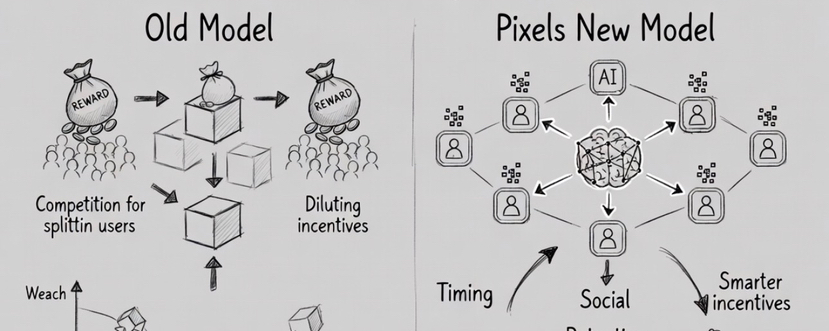

I used to think Pixels needed bigger games to grow.
A hit title. More players. Bigger seasons. Louder numbers.
That’s how most gaming ecosystems are judged. If a new game launches and brings users, it’s called growth. If it doesn’t, it’s seen as dead weight.
But the longer I watched Pixels, the less that logic made sense.
Because I started noticing something uncomfortable:
Even an average game can be valuable if it makes the system better.
That changes everything.
Most ecosystems treat games like isolated products.
Each title tries to win attention, run rewards, hold users, and justify itself alone. If it underperforms, it gets ignored. If too many games launch, the ecosystem often gets weaker because attention splits and incentives get diluted.
Pixels seems to be building toward the opposite model.
Games are not only products.
They are signal generators.
That’s the anchor.
When players move through a Pixels title, they are not just producing activity.
They are producing behavioral evidence.
Who returns without being bribed. Who only appears during high-reward periods. Who becomes more valuable when social loops form. Who burns through incentives then disappears. Who migrates naturally into another game. Who stays when the grind gets harder.
A single title may only reveal part of that.
But across multiple games, the picture gets sharper.
That’s where the network effect starts.
One game might reveal patience.
Another might reveal competitiveness.
Another might reveal social stickiness.
Another might expose pure extractors instantly.
Most ecosystems never combine those signals.
Pixels can.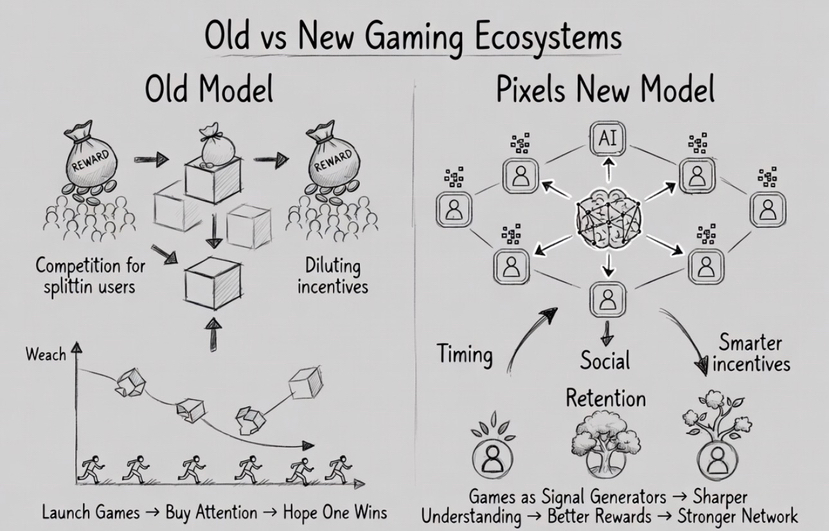
That means a player who looks average in one environment may be extremely valuable across three. Another who looks active in one loop may be weak everywhere else.
That’s hard for one game to understand.
A connected system can understand it.
Now the Events layer matters more than people think.
Many see events as quests, campaigns, seasonal content.
I think it’s closer to a sensing layer.
Every mission joined, reward claimed, return session, churn point, completion style, cross-game movement, and response to incentives becomes useful input.
Not vanity metrics.
Training material.
That’s a different use of activity.
Then Stacked starts looking different too.
From the outside it can look like another rewards surface.
Inside the machine, it may be where all that learning gets expressed.
Who receives incentives. When they receive them. Which game gets pushed next. How much value gets deployed. What behavior gets reinforced.
So rewards are no longer just payouts.
They become outputs of a smarter system.
This is why adding games may strengthen Pixels instead of diluting it.
In most ecosystems, more games means more competition for the same users.
Here, more games can mean more environments to learn from.
More environments create better decisions.
Better decisions improve rewards.
Better rewards improve retention and movement.
That creates stronger future launches.
That loop compounds quietly.
And this is hard to copy.
Competitors can copy quests.
They can copy tokens.
They can copy reward campaigns.
What they cannot copy quickly is years of behavior tied to reward outcomes across multiple game environments.
That history matters.
Because it teaches the system who creates lasting value and who only extracts temporary value.
Every new cycle improves that judgment.
That becomes a moat deeper than branding.
There are risks.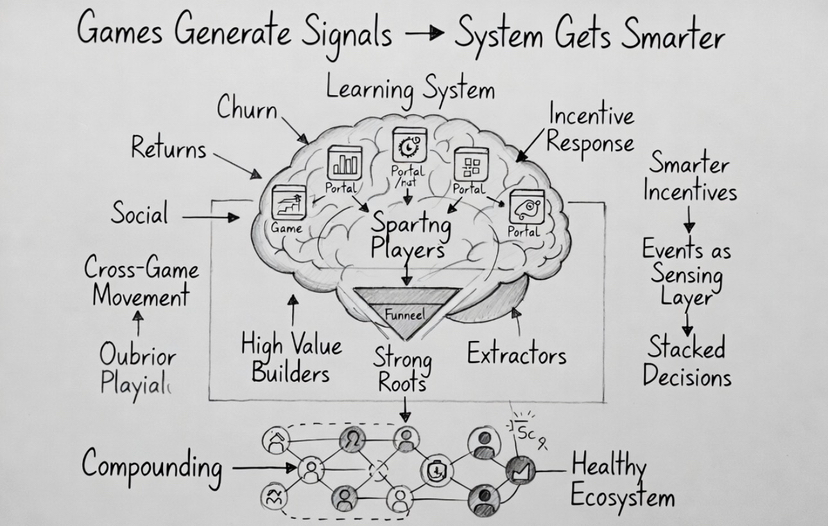
Bad signals can create bad decisions.
Too much optimization can feel manipulative.
Opaque reward logic can feel random.
And weak games that add noise instead of useful signal can slow progress.
So this only works if the architecture stays disciplined.
But if it does, the upside is bigger than most people realize.
I changed how I look at Pixels.
I stopped asking whether every game would become a hit.
I started asking whether every game makes the network smarter.
That’s a better question.
Because hit games create spikes.
Learning systems create compounding.
The old ecosystem model was simple:
launch games buy attention hope one wins
Pixels seems to be testing a stronger one: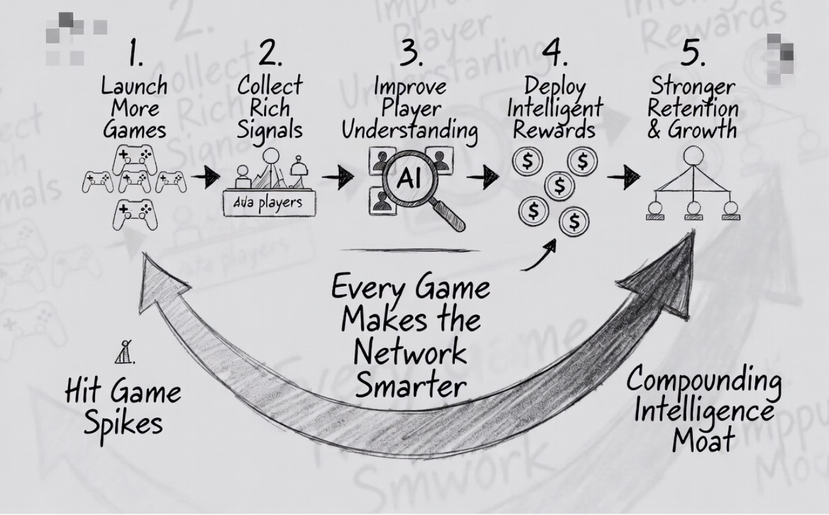
launch games collect signal improve incentives understand players better make the next launch stronger
If that loop keeps working, Pixels won’t grow only because it added more titles.
It will grow because every new title improves the machine underneath.
And systems that learn usually outlast systems that only advertise.