
@Pixels didn’t notice it at first, but something about Pixels doesn’t behave like a normal game. On the surface, it looks simple. Farms, resources, tasks, social spaces, progression loops. amiliar mechanics that anyone who has touched browser games or casual simulators would recognize. But beneath that softness sits a system asking a harder question. What happens when time inside a game becomes economically measurable?
That question matters because gaming has already lived through several economic eras. First came the traditional model where players paid upfront and owned nothing. Then free to play systems emerged where attention became the currency and monetization happened through cosmetics, convenience, and recurring spend. After that came early play to earn models in Web3 where players were promised ownership and income. It sounded revolutionary, but many of those systems carried a hidden flaw. Rewards were too easy to extract and too hard to sustain.
When tokens are printed faster than value is created, the math eventually speaks. New players subsidize older players. Inflation eats motivation. Gameplay becomes secondary to extraction. Communities start talking less about strategy and more about price. Retention drops because once earning weakens, the underlying game often isn’t strong enough to stand alone. We have seen this pattern enough times that skepticism is healthy.
That is where Pixels feels interesting. Not because it solved everything, but because it appears to understand what failed before. Built on the Ronin Network ecosystem, Pixels seems less obsessed with immediate earning and more focused on persistent loops. The shift is subtle but important. Instead of presenting rewards as the center of the experience, it wraps rewards inside activity, progression, coordination, and routine.
This may sound like a cosmetic difference, but it changes incentives. In weak systems, players ask how do I withdraw. In stronger systems, players ask what should I build next. That psychological movement matters more than token charts.
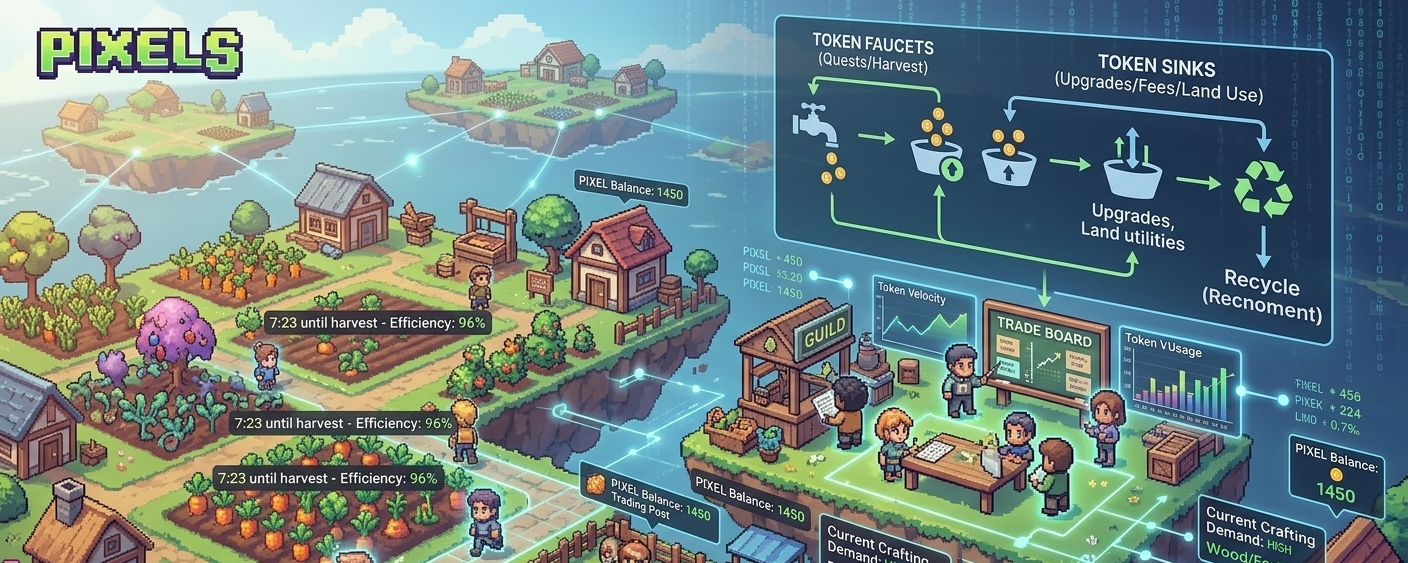
The introduction and use of PIXEL creates a bridge between game actions and economic meaning, but the bridge alone is not enough. What matters is whether the token circulates through sinks, upgrades, land utility, crafting demand, and social status rather than simply flowing outward. A token economy dies when everyone wants to remove value at the same time. It stabilizes when enough participants choose to redeploy value back into the system.
Pixels seems designed around this tension.
Player behavior changes noticeably in systems like this. When rewards become tied to efficiency, people stop wandering randomly and start routing their day. They calculate crop cycles. They compare yields. They optimize travel time. They coordinate with guilds or social groups. They learn the rhythm of resets and opportunities. Even casual spaces begin producing serious behavior.
This is where many outsiders misunderstand Web3 games. They assume players are only greedy. Often the truth is more nuanced. Humans naturally optimize any repeatable environment once feedback is visible. Leaderboards do it. XP bars do it. Battle passes do it. Tokens simply make the optimization more explicit.
So in Pixels, the real commodity may not be crops or coins. It may be structured attention.
That sounds abstract, but think about it. Millions of people already spend time in systems that convert behavior into value for platforms. Social media monetizes attention. Mobile games monetize habit. Streaming apps monetize retention. Web3 games attempt something different. They expose part of the value loop back to users. Imperfectly, unevenly, often chaotically, but visibly.
That visibility changes behavior.
When players know that efficient action has measurable output, time feels different. Logging in is no longer just leisure. It can feel like maintenance, investment, routine, even responsibility. Some people enjoy that because it gives direction. Others eventually feel burdened by it because obligation can quietly replace play.
This is the central tension of Pixels.
From a design perspective, the most important mechanics are not flashy features but balances. Faucets versus sinks. How much value enters through quests, farming, drops, or emissions, and how much leaves through crafting, upgrades, fees, vanity items, land systems, breeding mechanics, or progression gates. If faucets dominate, inflation arrives. If sinks dominate too harshly, users feel punished and disengage. Good economies live in motion, not equilibrium. They need continuous adjustment because player behavior adapts faster than static rules.
Reward loops also matter. Earn spend upgrade repeat sounds simple, but the emotional quality of each step decides whether the loop feels satisfying or extractive. If spending creates visible progress, players tolerate sinks. If spending feels like plugging leaks, resentment grows. If upgrades unlock identity, status, or meaningful capability, people reenter the cycle willingly.
Social systems can carry more weight than tokenomics alone. Guilds, cooperative tasks, shared land, trade relationships, reputation layers. These create stickiness that charts cannot. A weak economy can sometimes survive longer with strong community. A strong economy can still fail if players feel isolated.
Pixels seems aware that economies need culture.
And there is a deeper layer here that is easy to miss.
This may not just be a farming game. It may be a sorting machine for behavior.
Some players reveal patience. Some reveal discipline. Some reveal speculative instincts. Some prefer social coordination. Some chase novelty then leave. Some quietly compound progress over months. The system does not merely entertain users. It classifies them through repeated incentives.
That is true of many digital systems, but Web3 games make the classification legible because rewards are traceable and actions have external consequence. You can often see who values speed, who values ownership, who values status, who values liquidity.
In that sense, Pixels is less about farming carrots and more about farming behavioral profiles.
There are trade offs, of course.
The positive side is structure. Many online games waste time beautifully but pointlessly. Systems like Pixels can make effort feel connected to progression in a more tangible way. Ownership can increase commitment. Markets can create emergent professions. Builders, traders, organizers, farmers, speculators all find niches. That diversity can be powerful.
The negative side is over optimization. Once the best path becomes known, many players stop exploring and start repeating. Creativity narrows. Community discussion turns into spreadsheets. Fun can become subordinate to efficiency. And because crypto markets exist outside the game, volatility can distort in game motivation. A token move can matter more than a patch note.
That is dangerous because games need internal meaning to survive external noise.
So the bigger question is not whether Pixels has users or token volume or daily activity. The bigger question is whether it can preserve the feeling of a world while carrying the weight of an economy.
Can people still play when systems invite them to work
Can routine feel satisfying rather than compulsory
Can ownership deepen immersion rather than instrumentalize it
Those questions extend beyond one project. They point toward the future of digital environments generally. More and more online spaces are trying to monetize behavior. Fewer are asking how behavior feels from the inside.
Pixels matters because it sits directly on that fault line.
It is not perfect, and it likely should not be static. Economies need tuning. Communities change. Incentives decay when copied too easily. New players need room. Old players need reasons to stay. Speculators need boundaries. Genuine players need protection from systems built only for extractors.
The real question is not whether Pixels works today.
It is whether it can keep transforming faster than the behaviors it creates.
