
I keep coming back to this one moment.
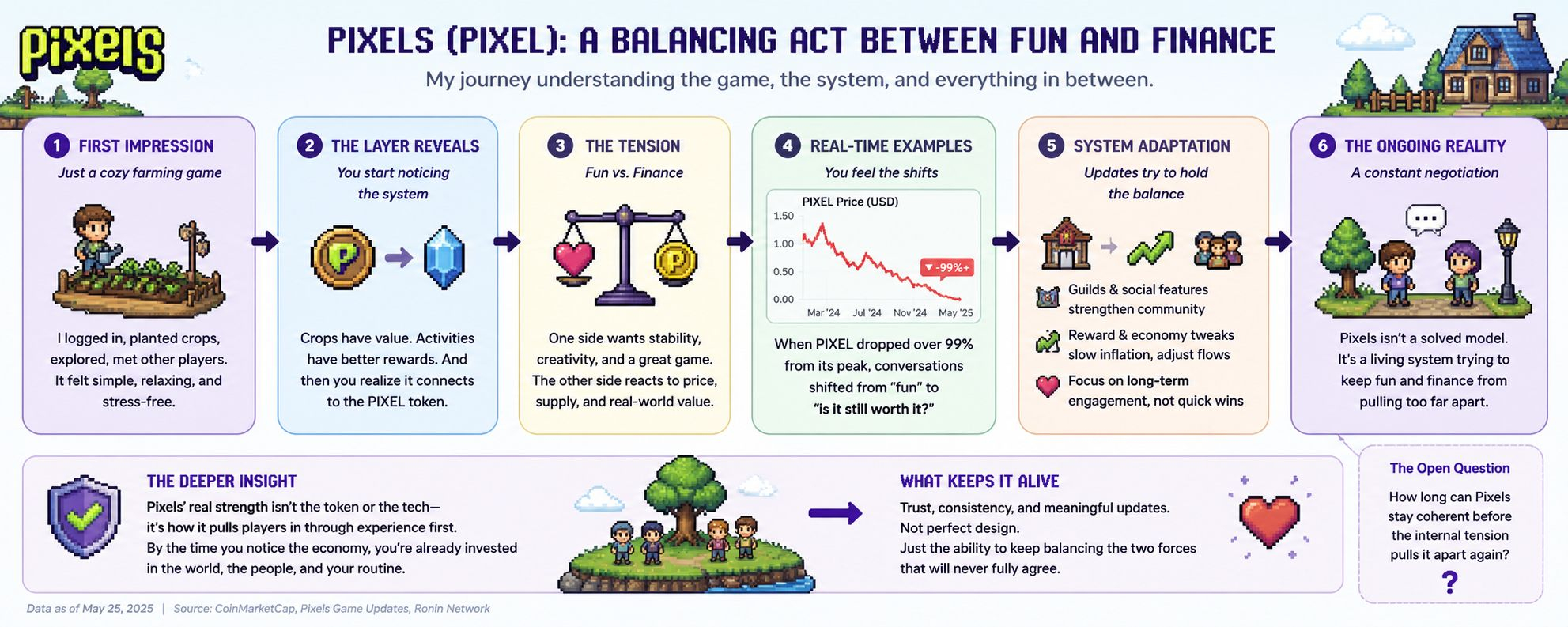
The first time I logged into Pixels, I wasn’t thinking about tokens or economies. I was just watering crops, wandering around, bumping into other players doing the same thing. It felt… simple. Calm, even.
And honestly, that’s the story most people tell about Pixels that it’s finally a Web3 game that feels like a real game. No complicated barriers, no immediate pressure to “optimize earnings.” Just farming, exploring, and slowly building your space.
But the longer you stay, the more you notice something else running underneath.
At first, you’re planting crops because it’s relaxing. Then you realize some crops are more valuable than others. Then you notice how rewards connect to the PIXEL token. And suddenly, without any big shift, you’re not just playing you’re thinking about the system.
I’ve seen this happen in real time. A friend of mine started casually, just logging in after work to chill. A week later, he was tracking which activities gave better returns, timing his sessions, even talking about token price swings. Nothing forced him to do that it just… emerged naturally from the design.
That’s where Pixels gets interesting.
Because it’s not just balancing a game it’s balancing two very different mindsets.
On one side, it wants you to feel at home. Predictable loops, friendly interactions, that cozy farming rhythm. On the other side, it quietly introduces a live economy where value moves, sometimes unpredictably. When the PIXEL token dropped heavily from earlier highs, you could feel the mood shift—not dramatically, but subtly. People didn’t quit instantly, but conversations changed.
Less “this is fun,” more “is this still worth it?”
And that shift matters.
What I’ve noticed is that Pixels doesn’t break in obvious ways. It doesn’t suddenly collapse or stop working. Instead, it drifts. Updates come in new guild systems, balancing changes, reward tweaks—and each one is trying to keep things stable without killing the fun.
You can see it in how they’ve been adjusting the ecosystem. More focus on social play, more emphasis on long-term engagement instead of quick rewards. It feels like they’re constantly tuning the system, trying to keep both sides fun and finance—from pulling too far apart.
But here’s the thing: players feel that tension, even if they don’t talk about it directly.
I remember watching a group in-game debating whether to invest more time into land upgrades. Half of them were thinking about creativity and progression. The other half were calculating potential returns. Same feature, completely different lenses.
And neither side is wrong.
That’s probably the most honest way to understand Pixels. It’s not a pure game, and it’s not just an economy. It’s something in between and that “in between” space is messy.
What actually impressed me isn’t that Pixels solved this problem. It didn’t.
It’s that it manages the problem well enough to keep people around.
The real strength isn’t the token or even the mechanics. It’s how the game pulls you in before you start questioning everything. By the time you notice the deeper system, you’re already part of the world—talking to people, building routines, forming habits.
And that changes how you react when things fluctuate.
Instead of leaving immediately, you hesitate. You wait. You see how things evolve.
But that also means the system depends heavily on that trust holding up over time.
Because once players fully switch from “this is fun” to “this is a calculation,” the whole experience changes. Not instantly but enough to matter.
And that’s where I find myself now with Pixels.
Still logging in sometimes. Still enjoying parts of it. But also watching more closely how updates shape behavior, how the economy responds, how players adapt.
It doesn’t feel like a finished system. It feels like something constantly negotiating with itself.
And maybe that’s the real story here not whether Pixels succeeds or fails, but how long it can keep that balance without tipping too far in either direction.
Because the moment it leans too much one way…
it stops feeling like what made it interesting in the first place.
