
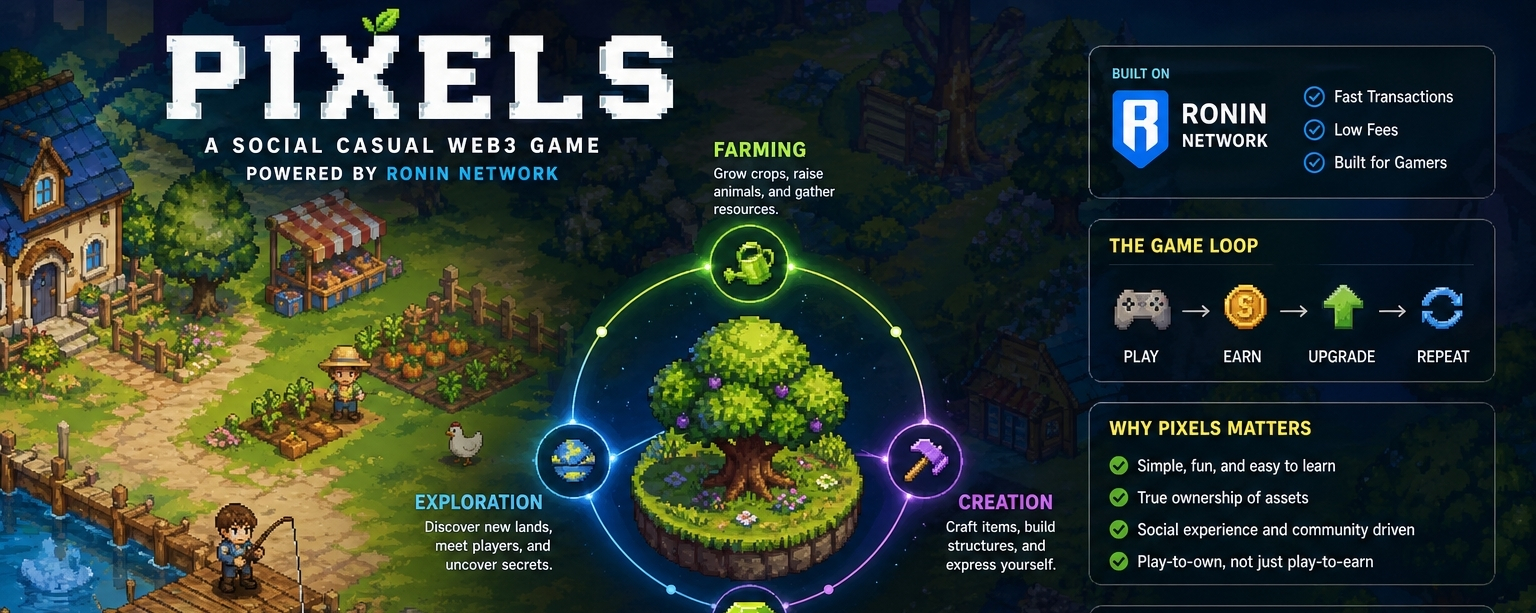
I’m looking at Pixels and trying not to treat it like a promise or a product, but like a place that exists between intention and attention. It calls itself a social casual Web3 game, built on the Ronin Network, and at first that sounds simple enough. Farming, exploration, creation — the kind of loop that should feel familiar even to someone who has never thought about blockchain at all. On paper, it’s just a game world. In practice, it’s something more fragile, because everything around it is tied to behavior that is constantly shifting.
Pixels lives in that category of Web3 games that tried to learn from earlier failures. Not just making something playable, but something that can hold users over time. Ronin gives it speed and low friction, which matters more than people admit. Because most users don’t leave because a game is bad — they leave because it feels slow, complicated, or emotionally empty after the first wave of curiosity. Infrastructure solves part of that. But only part.
What Pixels actually tries to do is build repetition that doesn’t feel like repetition. Farming cycles that reset. Exploration that gives small changes instead of dramatic ones. Creation systems that give players a sense of ownership without requiring them to understand why ownership matters in a blockchain context. It tries to blur the line between “I’m playing” and “I’m participating in an economy,” without forcing the second idea too aggressively.
But I keep thinking about how fragile that balance is.
Because Web3 games don’t usually fail at launch. They fail later, when incentives stop being enough and the underlying gameplay has to stand on its own. That’s where most systems start to feel exposed. Pixels, like many others, still carries that tension inside it — the need to attract attention through rewards while quietly hoping that enjoyment becomes the reason people stay.
I’ve been noticing how players behave in these environments. They don’t stay loyal to worlds, they stay loyal to momentum. When farming yields something, they return. When exploration feels productive, they continue. But when the loop slows, even slightly, the absence becomes louder than the design. That’s not a criticism of Pixels specifically — it’s just how digital attention works now. Everything competes with everything else, all the time.
And yet there is something PIXELS interesting in how Pixels chooses simplicity. It doesn’t try to look like a massive AAA blockchain universe. It feels closer to older social games, where repetition itself was the point. That might be its quiet advantage, or it might be its limitation. Sometimes simplicity is what keeps people comfortable, and sometimes it’s what makes them leave faster because there isn’t enough to discover underneath.
The PIXEL token sits in the middle of this, as expected. It carries the usual pressure every Web3 game token carries — utility, distribution, speculation, expectation. But tokens don’t really create engagement by themselves. They only amplify whatever behavior already exists in the game. If players are engaged, it accelerates. If they aren’t, it just exposes the emptiness faster.
There’s also the question of timing, which no one likes to admit matters this much. Web3 gaming has been “emerging” for long enough that the phrase itself has lost weight. Users have seen enough cycles to recognize patterns early. New worlds arrive with familiar promises: ownership, rewards, community. But users are not new anymore. They’ve adapted. They participate more cautiously, leave more quickly, return less emotionally.
So Pixels exists in that slightly uncomfortable space where it is not early enough to be experimental without scrutiny, and not mature enough to be taken for granted. That middle zone is where many projects quietly struggle, because expectations are already shaped before the experience fully unfolds.
Still, I keep coming back to the idea of its core loop. Farming, exploration, creation. These are not new mechanics, but they are resilient ones when they are allowed to breathe without constant economic pressure. The question is whether Pixels can separate the feeling of play from the pressure of output. Or whether those two things are now permanently fused in Web3 design.
I don’t think there’s a clean answer yet. Sometimes it feels like Pixels is trying to be a world, and sometimes it feels like it is trying to be a system that justifies participation. Those are not the same thing, and users can feel the difference even if they don’t articulate it.
And maybe that’s where PIXELS I keep getting stuck — not in whether Pixels works, but in whether people will keep caring long enough for it to matter what it becomes.
I’m still watching it, not because I expect resolution, but because I don’t see where the momentum settles yet.