



I used to think Pixels needed bigger rewards to grow.
That’s the usual logic in gaming. If activity slows, increase incentives. If users leave, run campaigns. If numbers weaken, distribute more value and hope momentum returns.
For a while, it works.
Then the same problem always shows up.
You attract people who came for rewards, not for the system. Real players get mixed with short-term extractors. Budgets get burned. Activity looks healthy on paper while the economy underneath gets weaker.
I started noticing Pixels may be moving in the opposite direction.
Not asking how to pay more.
Asking how to pay smarter.
That’s a much stronger question.
Most game economies still treat rewards like giveaways.
Pixels feels closer to treating them like investments.
That means the goal isn’t to reward every visible action. The goal is to identify which behavior actually strengthens the ecosystem.
Two players can complete the same task.
One returns next week, joins loops naturally, participates socially, moves across games, and adds long-term value.
The other appears only when incentives are high, farms every available edge, then disappears.
Same action.
Very different economic result.
Most systems still pay both equally.
That’s expensive blindness.
This is where the Pixels stack starts making more sense.
The Events system is not just tracking clicks and completions. It is collecting signals over time.
Who stays when rewards cool off. Who only appears during campaigns. Who becomes more active after small incentives. Who needs constant spending to remain visible. Who improves other players’ activity simply by being around.
Those patterns matter more than one task completion ever will.
That’s the anchor.
Pixels may be turning rewards from broad payouts into selective capital deployment.
Then Stacked looks different too.
From the outside it can look like quests, missions, points.
But if the system is reading behavior quality first, then Stacked becomes the place incentives get deployed after filtering.
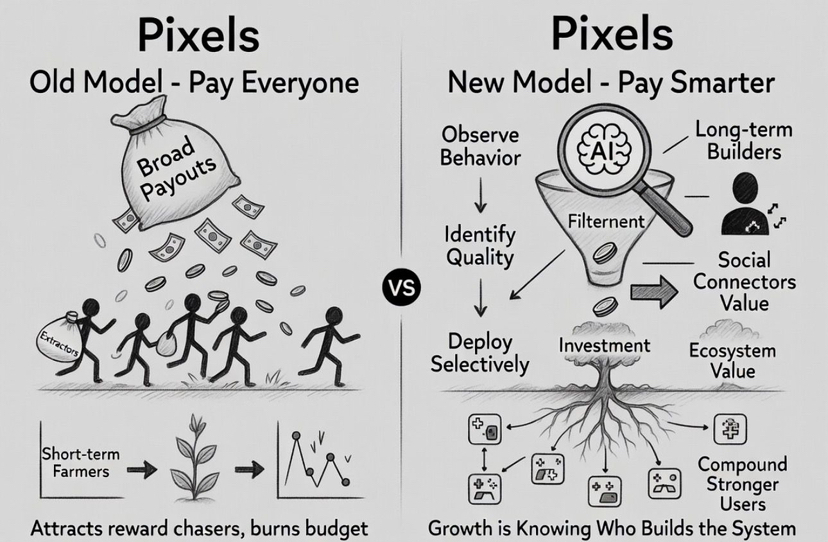
That’s a major shift.
Rewards stop being automatic.
They become conditional on expected value.
Not “who clicked fastest.”
More like:
“Where does spending here create something durable?”
This is where AI actually becomes useful.
Not writing dialogue. Not replacing gameplay. Not making louder marketing claims.
Useful for pattern recognition at scale.
A human team can notice trends. It cannot continuously score thousands of signals across players, timing windows, games, reward sizes, churn risk, and farming behavior.
A learning system can.
That means Pixels can improve the quality of reward decisions over time, not just the quantity of rewards distributed.
And that compounds.
It also scales across more than one game.
A player who looks average in one title may show strong long-term value across multiple environments.
Another who farms one loop often repeats that pattern elsewhere.
So each connected game can improve the system’s ability to judge where incentives belong.
One game learns.
The whole network gets sharper.
That is much harder to copy than token branding or prettier quest systems.
There are risks.
Over-filtering can feel unfair. Weak transparency can feel random. Misreading real players as low value would hurt trust.
So the challenge is balance.
Selective enough to protect the economy.
Open enough to let new value emerge.
That’s difficult.
But it’s the right difficulty.
What changed my view on Pixels was simple.
I stopped asking how much it rewards.
I started asking how intelligently it withholds.
That question explains more about durable game economies than most charts ever will.
The old model was:
pay widely celebrate spikes repair damage later
Pixels seems to be testing a better one:
observe behavior identify quality deploy incentives carefully compound stronger users over time
If that works, the story won’t be that Pixels gave bigger rewards.
It’ll be that Pixels learned growth is not about paying everyone.
It’s about knowing who actually builds the system.