
I was sitting outside after dinner, leaning back in an old chair, scrolling through Pixels without much focus. It was one of those slow evenings where you’re not really playing seriously—you’re just there, passing time.
I had already done my usual routine. Crops harvested, a bit of crafting, a few listings on the market. Nothing left that felt urgent.
So I drifted toward the guild section.
And instead of clicking through quickly, I stayed there for a bit.
Looking at names. Open spots. Shards. Entry requirements.
And without planning to, I started thinking about something I hadn’t really put into words before.
Guilds didn’t use to feel like this.
In most games I’ve played, a guild was something simple. You joined because someone brought you in—or because you found a group that didn’t feel completely random. You stayed because the people made it worth staying.
That was it.
No one talked about value. No one calculated entry. You didn’t think about whether the guild was “worth it.” You just knew, after a few days, whether it felt right or not.
Some guilds were chaotic. Some were organized. Some barely did anything but still felt alive because the same people kept showing up.
They had personality.
You remembered people, not positions.
Pixels keeps that idea—but it adds something else on top of it.
At first, the game doesn’t push you in that direction. It feels quiet. You farm, gather, craft, move at your own pace. There’s no pressure to compete or dominate. You just build your routine slowly.
That’s what makes it easy to settle into.
But then guild shards come into the picture.
And the feeling changes—just a little at first.
Because a shard isn’t just a symbol of membership.
It’s a form of access.
It turns something that used to be based on relationships into something that can also be measured, held, and in some cases… priced.
And once that happens, it’s hard to look at guilds the same way again.
A guild stops being just a group of people.
It becomes a space with a defined entry.
And that entry isn’t always social anymore.
There’s a layer of cost to it—even if no one talks about it directly.
That’s where things start to feel different.
Because belonging has always had value—but before, it was something you earned over time. You showed up, helped others, stayed consistent, built trust without even realizing it.
Now, part of that value is visible from the outside.
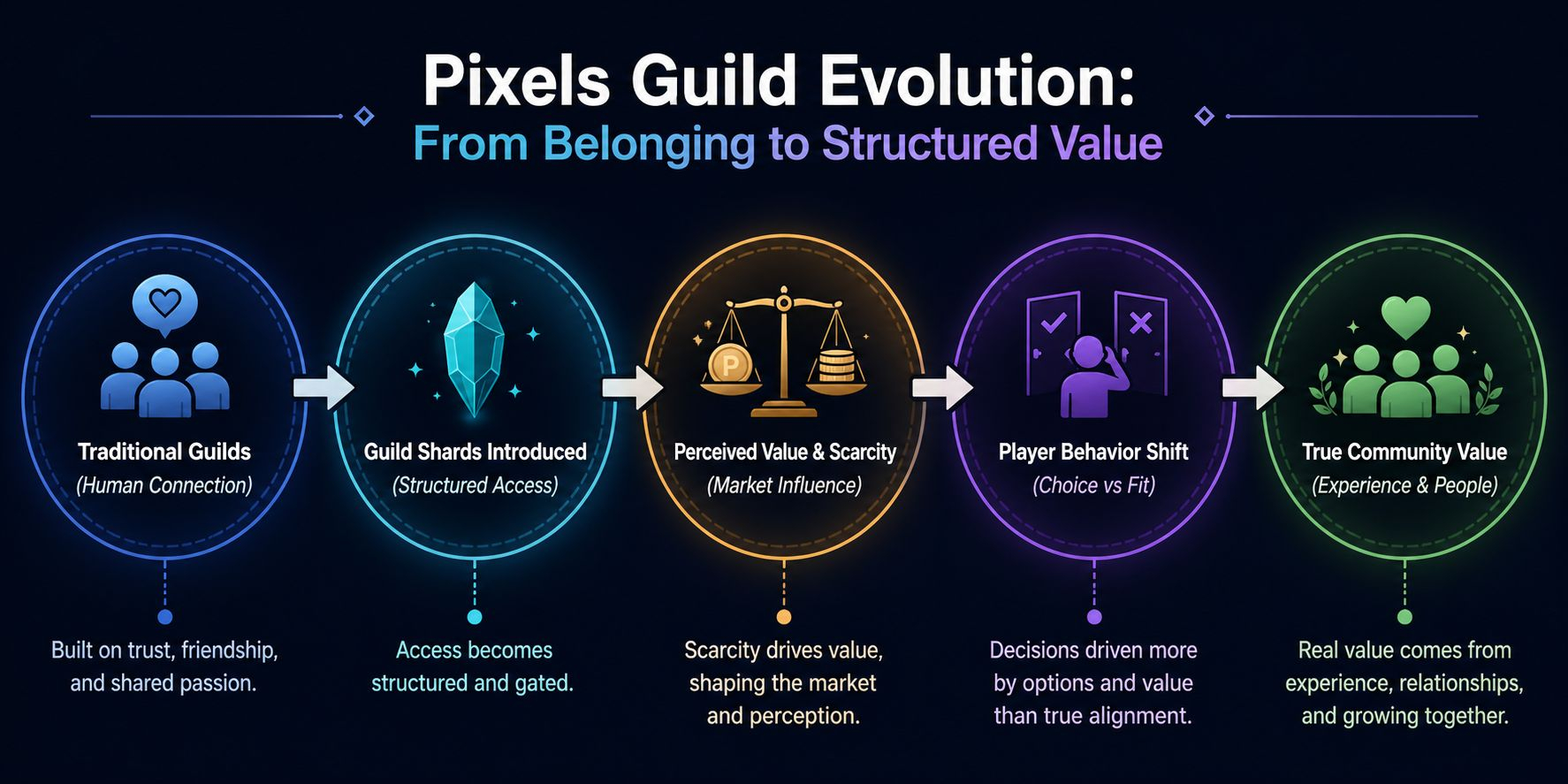
And when something becomes visible, people start judging it differently.
A guild with limited access starts to feel more important.
A guild that’s harder to enter looks more desirable.
A guild that people talk about becomes something others want to be part of.
None of that automatically means the community inside is strong.
But it creates a perception.
And perception changes behavior.
People don’t just ask “where do I fit?”
They start asking “where should I be?”
That shift is subtle, but it matters.
Because it brings the market into a space that used to be mostly human.
And once the market is there, it doesn’t stay quiet.
Even if players don’t focus on it directly, it sits in the background, shaping how choices are made.
At the same time, I can understand why shards exist.
In games without any barrier, guilds can feel temporary. People join easily, leave easily, switch whenever something better appears. It becomes hard to build something stable when nothing holds people in place.
A shard changes that.
It makes joining a decision.
And decisions create commitment.
When you think before joining, you’re more likely to stay. More likely to care. More likely to treat the guild as something real instead of something temporary.
That part makes sense.
But the same system that creates commitment can also create distance.
Not everyone arrives early.
Not everyone has the same resources.
Not everyone is ready to make that kind of decision right away.
So some people find a place easily.
Others stand outside, looking in.
And that’s where the tension sits.
Guild shards don’t just organize communities—they shape who gets to be part of them.
Who gets in early.
Who pays more later.
Who never finds a way in.
And in a game like Pixels, that matters more than it seems.
Because the real value of a guild isn’t the access—it’s the experience.
A good guild changes how the game feels. It makes repetitive tasks easier to handle. It gives you reasons to log back in, even when there’s nothing new to do.
It turns a routine into something shared.
And that kind of value can’t really be measured.
You don’t see it in a number. You don’t see it in a price.
You feel it over time.
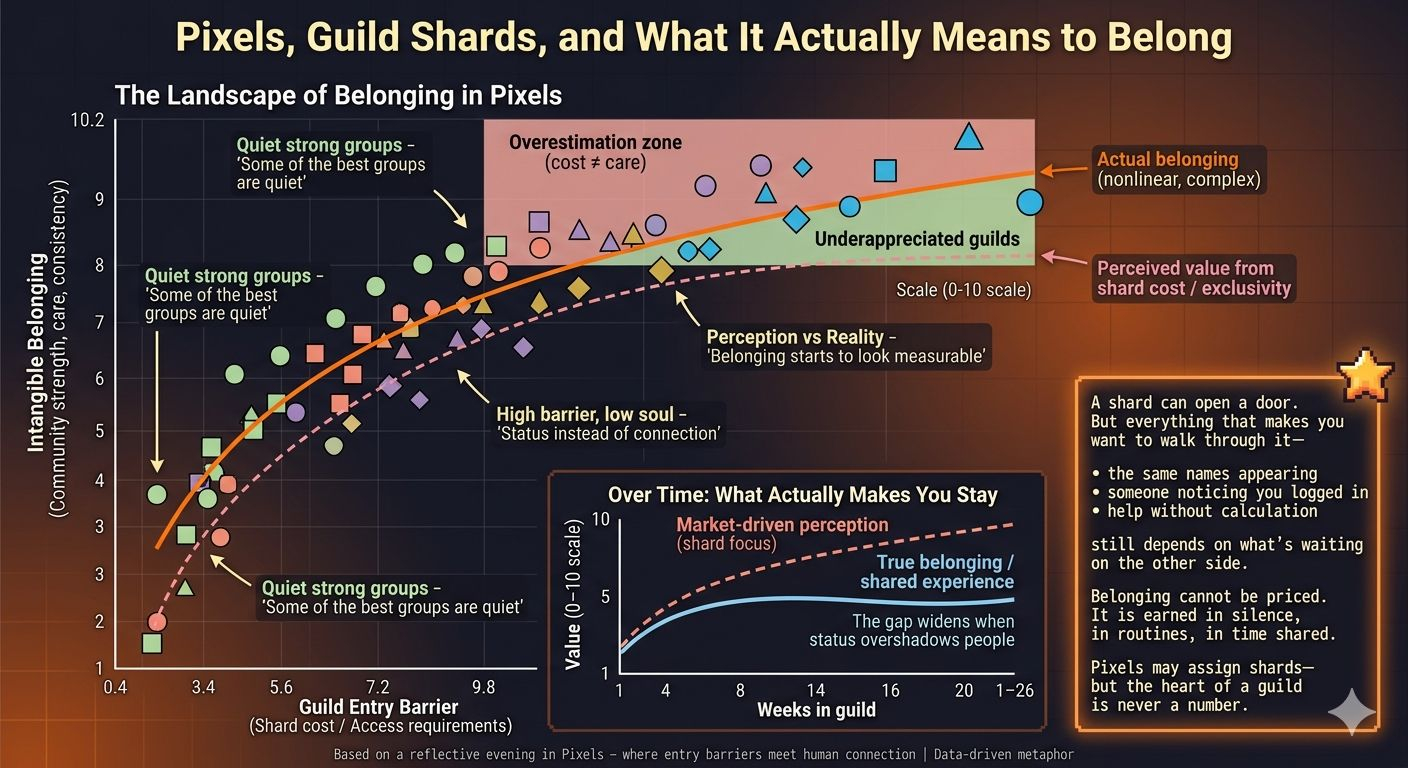
That’s why there’s a risk when belonging starts to look measurable.
Because it becomes easy to assume that higher cost means higher value.
But that’s not always true.
Some of the best groups are quiet.
Some of the most active ones don’t last.
Some of the most important players aren’t the ones with the most access—they’re the ones who stay, help, and keep the place alive.
A shard can show you who is inside.
It can’t show you what kind of place it is.
And that difference is important.
Pixels, as a game, actually gives communities space to grow properly. It’s not built on constant pressure. It’s built on repetition, familiarity, and time.
You come back. You see the same names. You start recognizing patterns.
That’s the kind of environment where real groups can form.
Guild shards could support that—if they’re used carefully.
They can give structure, create stability, make membership feel meaningful.
Or they can slowly shift attention toward status and positioning.
Not all at once.
Just gradually.
Players start comparing instead of connecting.
They choose based on signals instead of experience.
They treat membership like a move instead of a relationship.
And when that happens, something quiet disappears.
The guild stops feeling like a place you go.
It starts feeling like something you hold.
Sitting there that night, scrolling through different guilds, I realized I wasn’t really deciding where to join.
I was thinking about something simpler.
What actually makes a place worth staying in?
Not the cost.
Not the access.
Just the people.
The ones who notice when you log in.
The ones who answer when you ask something small.
The ones who make the game feel less empty.
That kind of value doesn’t show up anywhere.
And maybe that’s exactly why it matters.
Because a shard can open a door.
But everything that makes you want to walk through it—and stay inside—
still depends on what’s waiting on the other side.