
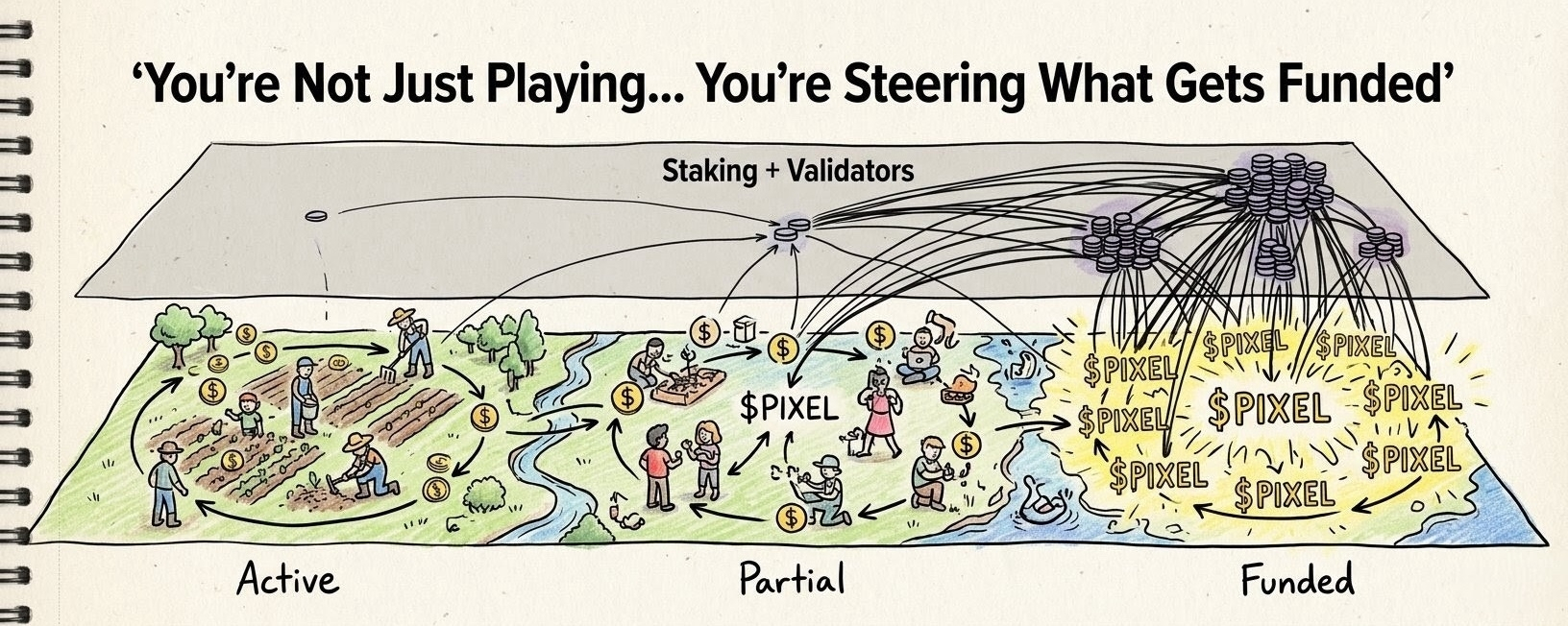
When I first thought about scarcity inside games, I treated it as something mechanical. Limited resources, cooldown timers, reward caps all the usual things systems use to slow players down or prevent abuse. Nothing about that felt particularly deep. It was easy to assume scarcity only existed as a brake, a way of saying “not everything can happen all at once.” But the more time I spent thinking about how value moves inside Pixels, the less scarcity felt like restriction and the more it started feeling like something much stranger… almost like memory.
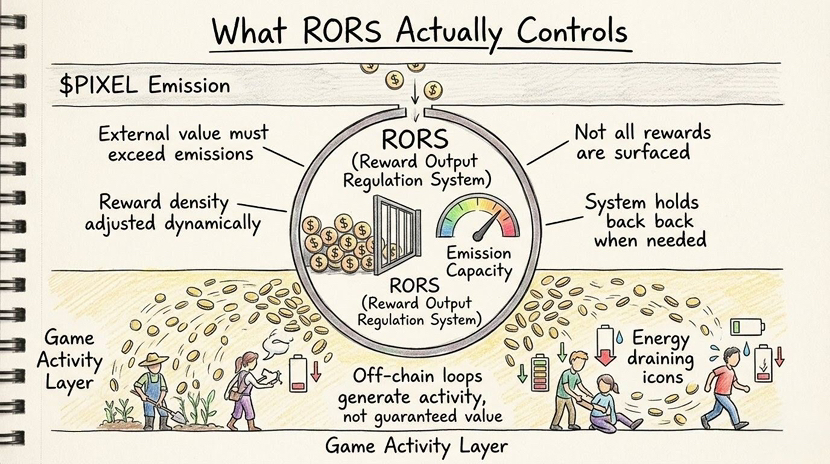
What pushed me toward that thought was noticing how not every loop inside the game seems to carry value in the same way, even when the visible mechanics look similar. Two task routes can appear equally active, two crop chains can seem equally viable, two crafting patterns can look identical from the outside — yet over time one feels like it keeps carrying weight while another quietly loses relevance. At first I read that as balancing or maybe simple optimization pressure, but eventually it started looking more like the system was preserving certain paths while letting others fade. And that made me wonder whether scarcity in a system like this does more than ration rewards. Maybe it remembers where rewards have already proven they can survive.
That changes the meaning of scarcity completely. Instead of absence, it starts looking like stored judgment. Because when rewards can flow everywhere without pressure, the system doesn’t need to discriminate. Every action can look fundable. Every loop can appear equally worth supporting. But once resources become selective, choices have to emerge. Some behaviors get reinforced. Others stop carrying the same economic weight. And that reinforcement starts resembling memory — not memory as data storage, but memory as accumulated preference about where value has held up before.
I keep thinking about this through repeated behavior. A farming route that consistently brings players back is not just productive in the moment; it creates evidence. A crafting chain that repeatedly absorbs demand isn’t only useful once; it leaves a trace. A task structure that keeps sustaining participation without collapsing under extraction begins to carry historical weight. Maybe scarcity is partly the mechanism through which that weight gets preserved. Not every loop is scarce because resources are simply tight. Some loops may feel scarce because the system has learned to defend value there more carefully.
That possibility makes ordinary mechanics look different to me. Energy systems stop feeling like pure pacing. Cooldowns stop feeling like simple friction. Even reward rotation starts looking less like randomness and more like a way of moving value through remembered pathways. Almost as if scarcity is where the economy stores its caution. It remembers where too much abundance has broken things before, and it responds by narrowing where incentives can safely concentrate.
“abundance forgets… scarcity remembers”
That line keeps staying with me because it explains something older GameFi systems often struggled with. Many of them treated activity itself as value. The more actions happened, the more rewards flowed. But abundance under that model often forgot to ask whether those rewards were reinforcing something durable or simply feeding extraction. Everything looked fundable until the economy hollowed out. In that sense, collapse was not always caused by scarcity arriving too late. Sometimes it was caused by abundance forgetting too much too early.
Maybe newer systems are trying to correct that, not by becoming harsher but by becoming more selective in what scarcity protects. That is where Pixels starts feeling interesting to me. Because some loops don’t just appear rewarded; they feel remembered. There is a difference. A rewarded loop may be temporarily profitable. A remembered loop may be structurally trusted. And those are not the same thing.
Even staking starts looking different through that lens. It is easy to interpret staking as passive commitment or alignment, but maybe it also functions as memory reinforcement. A signal that some forms of behavior deserve persistence inside the economy. Scarcity then isn’t just limiting what can be extracted. It may be preserving what the system continues to recognize as worth sustaining. That makes value feel less like something available for capture and more like something constantly negotiating its right to remain.
There is tension in that though, because memory can preserve but it can also exclude. If scarcity remembers some loops, it may also allow others to fade. And maybe that is why some mechanics still feel alive while others feel strangely decorative. Not because they disappeared, but because they no longer carry remembered weight. They still exist as gameplay, but perhaps not as economically defended behavior. That may be why two routes can feel different without looking different. One still sits inside memory. The other may have slipped outside it.
And honestly, I think players sometimes feel this before they can explain it. Sometimes a route simply feels supported. Other times it feels hollow. I used to read that as intuition. Now I wonder whether it is really contact with where the system still places remembered value. Not conscious analysis just sensing where scarcity continues to allocate protection.
The strange part is this makes scarcity feel less hostile than I used to think. Almost protective. Not protecting players directly, but protecting coherence. Protecting the economy from forgetting which incentives sustain participation and which only invite extraction. That is a much more subtle role than simple limitation.
I am not fully settled on whether this reading is right. Maybe I am overinterpreting ordinary mechanics. Maybe cooldowns are just cooldowns and scarcity is just balancing. But the longer I watch systems like Pixels, the harder it is to believe scarcity only reduces access. It seems to be doing organizational work. Holding traces. Sorting persistence. Remembering where repeated incentives have already taught something about what survives.
And if that is true, then maybe the real question is not whether scarcity makes a system efficient. It is whether scarcity remembers well enough to keep value from drifting back toward the same extraction traps older economies couldn’t escape.
Because maybe strong game economies are not built by paying everything.
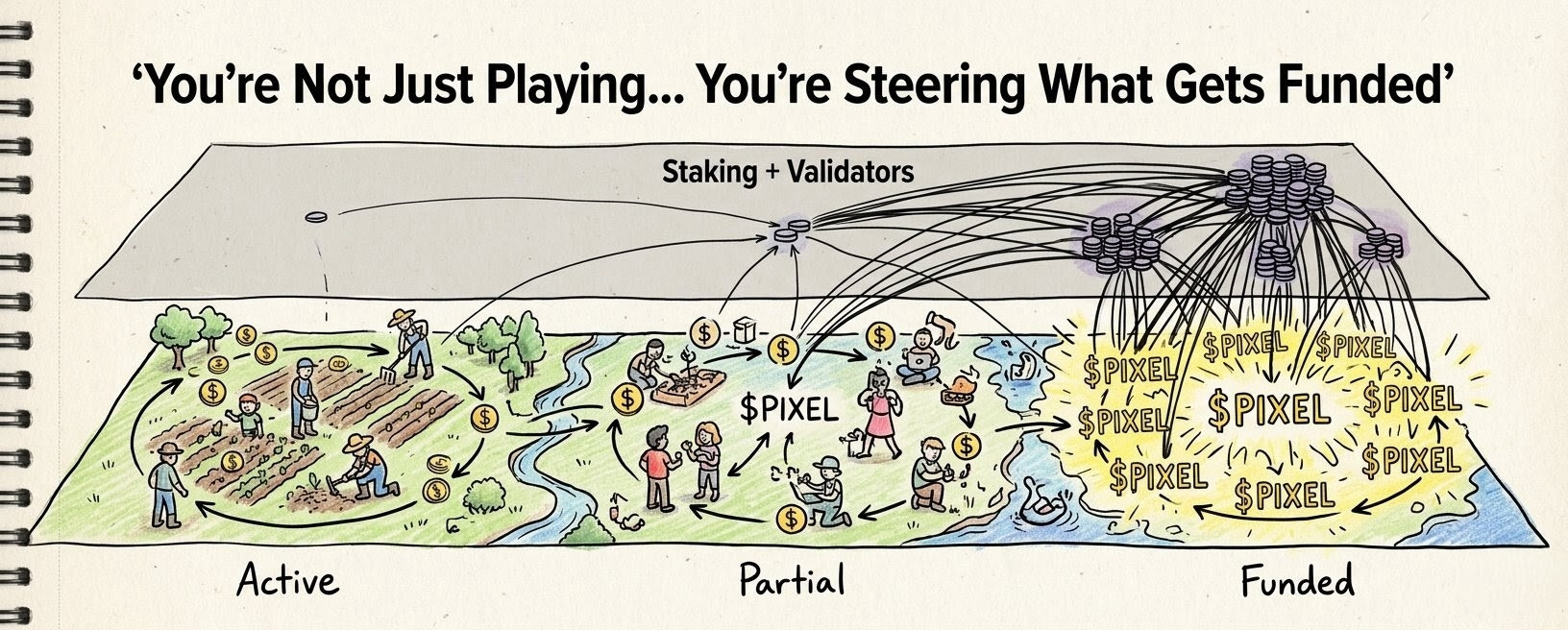
Maybe they are built by remembering what should keep being paid
And maybe that is what scarcity has been doing all along.
Not reducing possibility…
but preserving memory through limits.
That thought keeps staying with me.
Because if value flows where systems remember resilience, then maybe the deepest asset inside a game economy is not the token at all. Maybe it is the memory structure deciding where scarcity still believes value belongs.
And that raises a question I keep coming back to.
When a loop gets rewarded… is it because it created value today
or because the system remembers enough about that loop to trust value there tomorrow?