There’s something strangely calming about a game that asks you to slow down instead of speed up.
Most games want your full attention right away. They throw enemies at you, flash rewards on the screen, push you into battles, or make you feel like you are already behind if you do not keep moving. Pixels does the opposite. It gives you a small world, a few simple tasks, and that familiar farming-game feeling of, “Let me just do one more thing before I log off.”
And somehow, that is enough to pull people in.
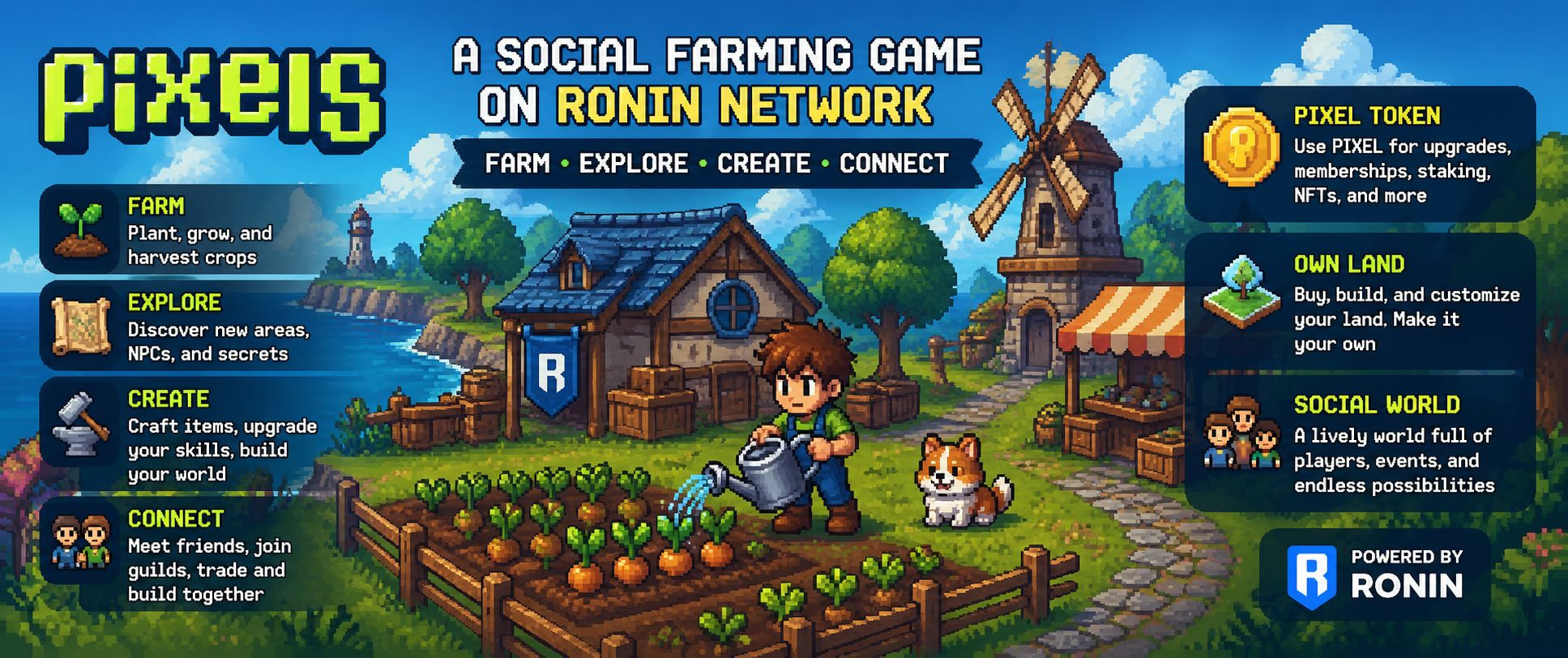
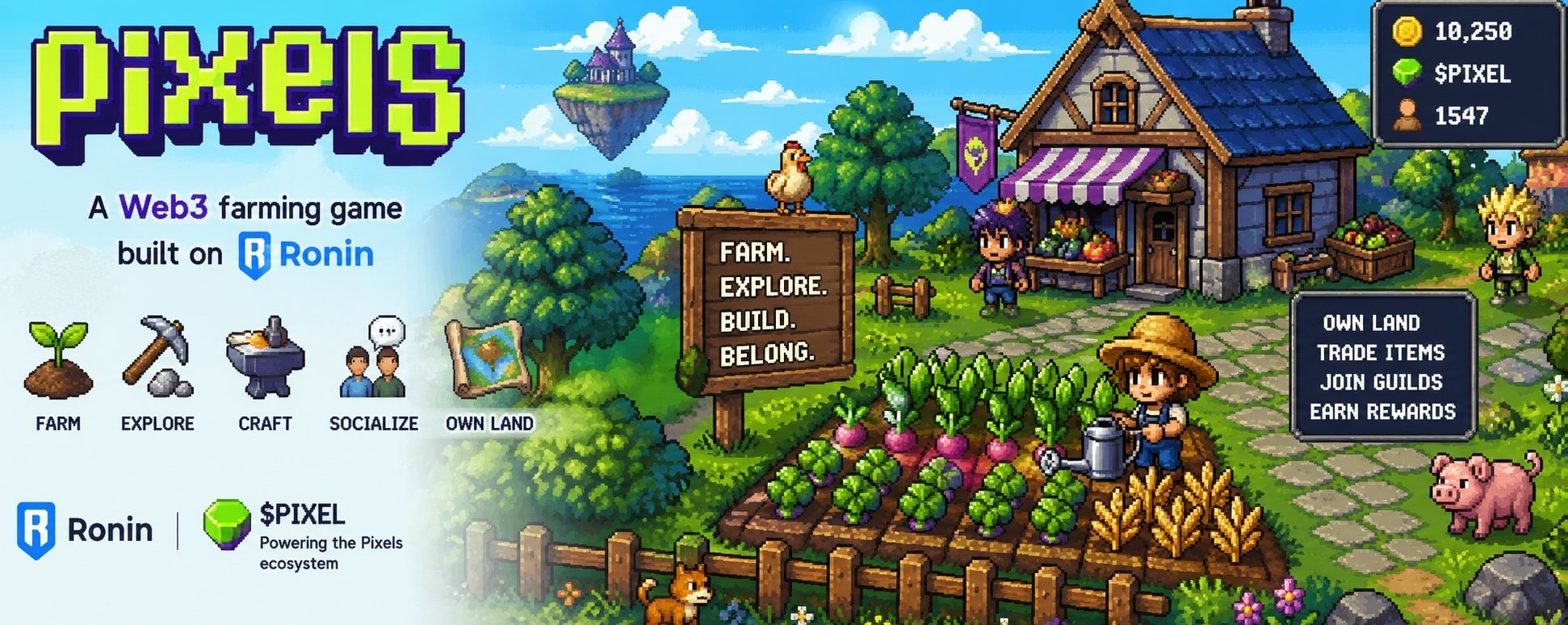
At first, Pixels looks very simple. You see the pixel art, the farms, the characters, the little online world, and you might think it is just another cozy farming game. Plant crops, collect items, craft things, talk to people, upgrade your space, repeat. Nothing too dramatic. Nothing that looks like it is trying to impress you with expensive graphics or huge cinematic moments.
But that is actually part of the charm.
Pixels does not feel like it is begging to be taken seriously. It feels relaxed. You can enter the game without feeling like you need to understand every system immediately. You walk around, learn slowly, make mistakes, figure out what resources matter, and begin to build a routine. It has that quiet satisfaction that farming games often have, where progress does not feel explosive, but it still feels real.
You plant something. You wait. You come back. You collect. You use what you collected to make something else.
It is basic, yes, but basic does not mean boring when the rhythm works.
The interesting part is that Pixels is not only a farming game. It is also a Web3 game built on the Ronin Network. That means it is connected to blockchain features like digital ownership, tokens, land, NFTs, and an in-game economy that can stretch beyond the game itself. The main token, PIXEL, plays a role in the wider ecosystem and can be used for different game-related features such as upgrades, memberships, guild systems, NFT-related activity, and other utility inside the Pixels world.
That is where things become more serious.
A normal farming game is just about playing. A Web3 farming game brings money, ownership, and speculation into the picture. For some players, that makes it more exciting. For others, it makes it more complicated. And honestly, both reactions make sense.
The good thing about Pixels is that it does not hit you over the head with crypto from the first second. A lot of Web3 games make this mistake. They act like the token is the main character. The game itself becomes a background image for charts, wallets, marketplaces, and earning systems. You feel less like a player and more like someone being pushed into a financial dashboard.
Pixels feels better than that.
It still has the Web3 layer, of course. You cannot separate it from the project. But the game tries to give you a world first. The farming, exploring, crafting, and social interaction are not just decorations. They are the reason the whole thing has a chance. You can understand Pixels as a game before you start thinking about it as a crypto project.
That matters a lot.
Because if Web3 gaming is ever going to work for normal people, it has to stop feeling like homework. Most players do not want to spend their first hour learning wallet terms, token systems, or marketplace logic. They want to play. They want to understand what they are doing. They want the game to make sense without needing ten tabs open.
Pixels is not perfect at this, but it is closer than many others.
The game has a soft, social feel. You are not locked alone in your own little space forever. There are other players, shared areas, events, and a sense that the world is alive around you. That makes a big difference. A farming game can get lonely if everything happens in silence. Pixels feels more like a place people visit, not just a task list dressed up with cute graphics.
The pixel art also helps. It is simple, but it fits. The world looks warm and easy to understand. It does not try to be realistic, and it does not need to. Pixel art has a way of making small actions feel cozy. A crop growing, a character standing near a path, a little item sitting in your inventory — none of it looks huge, but it creates a mood.
And mood is important in this kind of game.
People do not usually stay in farming games because every mechanic is revolutionary. They stay because the world becomes familiar. They know where things are. They remember what they were working on yesterday. They start planning small goals. Maybe they want to upgrade something. Maybe they want to craft a certain item. Maybe they just want to check in because their farm feels unfinished.
Pixels understands that feeling.
Still, the Web3 side cannot be ignored. PIXEL gives the game an economy that feels bigger than a normal in-game coin. That can make the world feel more meaningful, because your actions may connect to real digital ownership and market value. But it can also create pressure. Once a token has a price, some players stop asking, “Is this fun?” and start asking, “Is this profitable?”
That is where Web3 games become risky.
When money enters a game, behavior changes. Some people play because they enjoy the world. Some play because they want rewards. Some buy assets hoping they become more valuable. Some grind as efficiently as possible. Some leave the moment the rewards are not worth their time. This is not just a Pixels problem. It is a Web3 gaming problem in general.
The challenge for Pixels is to make sure the game does not become only about earning.
If people are farming only because they expect money, the game becomes fragile. Token prices move. Rewards change. Markets cool down. Hype fades. But if people enjoy the world even when the rewards are smaller, then Pixels has something stronger to stand on.
That is why the actual gameplay matters so much.
The farming loop, the crafting, the quests, the land, the social spaces — these things need to be enjoyable on their own. The token should add another layer, not replace the fun. A good Web3 game should still feel worth opening even when you are not thinking about charts.
Pixels has a real chance because its idea fits Web3 better than many other genres. Farming games already have resources, land, trading, crafting, ownership, and long-term progression. Players already understand why digital items matter in this kind of world. They already care about building a space and improving it over time. Blockchain ownership does not feel completely random here. It actually connects to the type of game Pixels is trying to be.
That is one of the reasons Pixels feels more natural than many blockchain games.
In some Web3 games, the blockchain part feels forced. You can almost see the developers thinking, “How do we add NFTs to this?” With Pixels, land, items, resources, and player-made progress already fit the structure. The Web3 layer still has problems, but at least it does not feel completely out of place.
Land is a good example. In a farming game, land matters. It is not just a collectible image sitting in a wallet. It can be part of how players express themselves, organize their progress, and build identity inside the world. Owning or using land can give players a stronger connection to the game.
But land can also create problems if it becomes too important.
If landowners get too many advantages, new players may feel left behind. If land becomes mostly a speculative asset, the game can start feeling less like a community and more like a real estate market. Pixels has to be careful with this. Digital ownership is exciting only when it improves the experience. If it makes the game feel unfair or closed off, it can damage the whole mood.
The same goes for guilds, VIP features, staking, and other systems tied to PIXEL. These features can give serious players more depth and more reasons to stay. But they can also make the game feel layered in a way that casual players may not enjoy. A cozy game should not feel like an exclusive club where the best experience is locked behind too much investment.
That balance is difficult.
Pixels has to serve different kinds of players at once. Some people just want a peaceful farming game. Some want to be part of a social world. Some care about land and assets. Some are focused on the PIXEL token. Some want to grind. Some only want to visit casually. Keeping all those people happy is not easy.
But the fact that Pixels even attracts these different groups is a sign that it has something interesting.
A lot of Web3 games only attract crypto users. Pixels feels like it has a better chance of reaching people who simply enjoy farming and social games. That matters because real players are more valuable than short-term hype. A game cannot live forever on people chasing rewards. It needs people who log in because they like being there.
That is where Pixels’ quieter side becomes its biggest strength.
It is not trying to be the loudest game in the room. It is not selling itself as some giant revolution every five minutes. It gives players a small world and asks them to care about it. That sounds simple, but it is harder than it looks. Many games, especially Web3 games, struggle to create that feeling.
Of course, there are still fair doubts.
Will the economy stay healthy? Will rewards be balanced? Will bots and farmers become a problem? Will new players still feel welcome later? Will the PIXEL token support the game without taking over the conversation? Will people stay when the market is quiet?
These questions matter because Web3 games have failed before for very predictable reasons. Too much hype. Too much focus on earning. Not enough actual fun. Weak economies. Players leaving when rewards drop. Pixels is not automatically safe from any of that.
But Pixels does seem more aware of the problem than many earlier projects.
It feels like the team understands that a game economy cannot just reward everyone endlessly and hope things work out. The game has already gone through changes, including shifts in how its tokens and reward systems work. That can be frustrating for players, but it is also part of keeping a live economy alive. If a Web3 game never adjusts, it usually breaks.
The tricky part is making changes without making players feel punished.
When people spend time, money, or energy inside a game, they become attached to how things work. If the rules change too much, trust can weaken. Pixels needs to keep improving while still making players feel respected. That is a delicate job.
The social side may help with that. A strong community can carry a game through rough patches. If players have friends, guilds, routines, and memories inside the world, they are less likely to leave at the first sign of trouble. Community gives a game a kind of emotional cushion. Pixels has that advantage more than many Web3 games because it is not just built around isolated earning.
What I like most about Pixels is that it feels ordinary in a good way.
That may sound like a strange compliment, but it is not. Web3 gaming often tries too hard to sound futuristic. Pixels works because it takes something familiar — farming, crafting, exploring, social play — and adds blockchain features where they make some sense. It does not need to convince players that every little action is revolutionary. Sometimes it is enough for a game to feel pleasant, useful, and alive.
The best version of Pixels is not a game where everyone is obsessed with the token. The best version is a world where the token quietly supports deeper ownership and better progression while players still care about the farm, the land, the people, and the daily routine.
That is the version that could last.
Because at the end of the day, no one stays in a game just because a whitepaper says the economy is smart. People stay because something about the world gets into their habits. They remember to check their crops. They want to finish a task. They like seeing progress. They feel like their space is slowly becoming theirs.
Pixels has that kind of pull.
It is not flawless. It still carries the risks of Web3 gaming. It still has to prove that its economy can remain healthy over time. It still has to protect the fun from becoming too financial. But compared to many blockchain games, Pixels feels more grounded. It has a real game loop, a clear identity, and a world that people can understand without being deep into crypto.
That gives it a better foundation.
Maybe Pixels will grow into one of the stronger examples of Web3 gaming. Maybe it will struggle with the same problems that have hurt many projects before it. Most likely, it will be somewhere in between: a promising, messy, evolving game that keeps improving as long as players keep caring.
And honestly, that feels more believable than the usual Web3 promise.
Pixels does not need to be perfect to be worth watching. It just needs to keep its heart in the right place. The heart is not the token chart. It is not the marketplace. It is not the technical language. The heart is that small, simple feeling of building something inside a world and wanting to come back to see it grow.
That is why Pixels works when it works.
You plant a crop. You collect a resource. You craft something. You talk to someone. You improve your land a little. None of it feels huge in the moment, but slowly it adds up. The game becomes part of a routine.
And in a space where so many projects try to sound bigger than they are, there is something refreshing about a game that starts with a farm and lets the rest grow from there.