
Pixels is one of those projects I don’t want to praise too fast.
I’ve seen too many games come and go in this market. Too many clean trailers. Too many big promises. Too many “ecosystems” that were just reward farms with nicer words. So when a game starts as something simple, almost boring on the surface, I usually pay more attention than when something arrives screaming for attention.
That’s where Pixels sits for me.
It didn’t start by trying to sound huge. It started with a farm, a few tasks, a grind, some crafting, land, movement, and the kind of daily loop that looks small until people actually begin returning to it. That part matters more than most people admit, because in Web3 gaming, the hardest thing is not getting someone to click once. The hard part is getting them to care enough to come back when the noise moves somewhere else.
Chapter 1 was the slow part.
Not slow in a bad way.
More like the base layer nobody respects until later.
Players were farming, collecting, crafting, building routine, and learning the world without being buried under heavy systems. It wasn’t trying to explain itself with big market language. It just gave people something to do. That’s rare now. Most projects explain too much and build too little.
Pixels did the opposite.
It made the grind visible.
The land mattered.
The resources mattered.
The small upgrades mattered.
The daily return started to matter.
That is usually where a game either begins to breathe or quietly dies.
And honestly, a lot of them die right there.
The loop gets stale. The rewards dry up. The player base starts farming only for extraction, not because the world has any pull. Then everyone pretends it was “early infrastructure” while liquidity leaves through the back door.
Pixels still has that risk.
I’m not ignoring it.
A farming loop can become repetitive fast. A social system can look active for one season and empty the next. A token economy can feel alive while rewards are flowing, then heavy when real demand has to carry it. I’ve watched this pattern too many times to pretend every update solves it.
But here’s the thing.
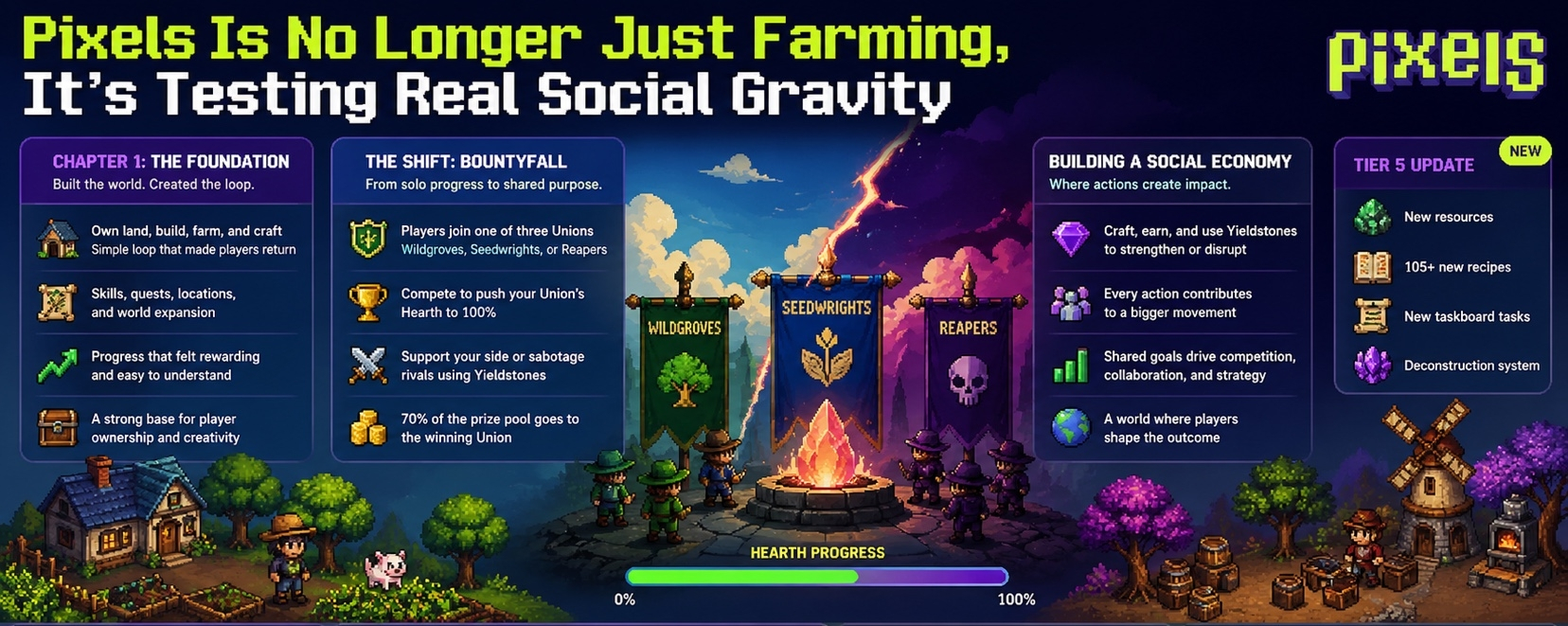
Bountyfall gives the game a different kind of friction.
Before, Pixels felt more personal. You could sit inside your own routine, farm your land, do your tasks, stack progress, and keep moving. That was useful. It made the game easy to enter. No massive learning wall. No forced pressure from day one.
Bountyfall changes the mood.
Now the grind is not only about you.
You choose a side. You push with others. Your actions feed into a shared race. That sounds basic, but basic systems are often where real player behavior begins. People don’t always need complex mechanics. Sometimes they just need a reason to care what happens after they log off.
That’s what I’m watching here.
Not the surface update.
The behavior under it.
If players start treating their side like it actually means something, then Pixels becomes harder to dismiss as just another farming game. If they don’t, then Bountyfall becomes another seasonal feature that looked good for a moment and faded into the pile.
That’s the real test.
Not the announcement.
Not the first wave of activity.
The second and third wave.
When the early excitement cools. When the grind feels heavier. When players have already seen the new system and the question becomes simple: do they still care?
That’s where most projects break.
Pixels is trying to move from solo farming into shared pressure, and that shift is more important than it looks. A player farming alone is one thing. A player farming because their side needs progress is different. It adds weight. It adds a reason. It turns a basic action into something connected to other people.
That’s how an economy starts to feel alive.
Not because someone calls it one.
Because players begin affecting each other.
The farm is still there, but now it has more context. The resources are not just items sitting in a loop. The tasks are not just boxes to clear. The daily actions can carry social weight if the system holds.
And that “if” is doing a lot of work.
I like the direction, but I’m not handing out easy conviction. Web3 gaming is full of projects that looked strong for one chapter and tired by the next. The market has no patience now. Players have even less. Everyone has been burned by recycled mechanics, weak economies, and games that only felt alive while incentives were fresh.
Pixels has to prove it can avoid that.
It has to keep the world useful.
It has to make the social side feel natural, not forced.
It has to make players feel like their time inside the game means something beyond chasing the next reward window.
That is not easy.
But I’ll give Pixels this: the growth does feel connected. Chapter 1 gave the game roots. Bountyfall adds pressure. It doesn’t feel like a random patch thrown in for attention. It feels like the project is trying to stretch the original loop into something bigger without cutting away the part that made people understand it in the first place.
That matters.
A lot of games lose themselves while trying to scale.
Pixels still feels like Pixels.
Just heavier now.
More social. More tense. More exposed to whether players really want to build around it or only farm it until the next thing appears.
That’s where my mind is sitting.
I’m not watching Pixels like it already won.
I’m watching because it has crossed from “simple farming game” into a more interesting zone, where the next few layers actually matter. The game is no longer only asking players to complete tasks. It is asking them to care about shared outcomes.
That is a harder ask.
But also a better one.
Because if Pixels can make people keep returning not just for the grind, but for the side they picked, the progress they pushed, and the world they feel tied to, then this starts becoming something with real weight.
Still early.
Still messy.
Still needs proof.
But in a market full of empty noise, Pixels at least has a pulse I can track. And right now, that is enough to keep me watching.