
I’ve been around crypto long enough to stop trusting big promises too quickly.
That doesn’t mean I’ve become completely negative. I still pay attention. I still notice when something feels a little different. But after watching so many cycles, so many “next big things,” and so many projects that looked strong for a few months and then slowly disappeared, I’ve learned to be careful.
Crypto gaming especially has taught me that.
Every few years, the same dream comes back in a new shape. Someone says gaming will bring millions of people into Web3. Someone says players will finally own their items. Someone says this token economy is better designed than the last one. Someone says the game is not just about rewards this time.
I’ve heard all of that before.
And to be fair, the idea still makes sense on paper. Games are digital worlds. Players already spend money on skins, items, land, characters, upgrades, and status. So when crypto people say, “Why shouldn’t players actually own these things?” I understand the argument. It’s not a stupid idea.
But the problem is that games are not just economies.
Games are feelings.
Games are habits.
Games are small daily routines.
Games are places people go when they want to relax, escape, compete, build, or belong.
And this is where a lot of Web3 games have gone wrong. They treated the economy like the main character. The token became more important than the world. The reward became more important than the reason to play. The player slowly turned into a worker, and the game started feeling less like entertainment and more like a job with unstable pay.
That’s why I look at Pixels with some interest, but also with caution.
Pixels is a social casual Web3 game on Ronin, built around farming, exploration, creation, and community. That sounds simple, maybe even ordinary. But honestly, that simplicity is exactly what makes it worth thinking about. It doesn’t begin with some complicated battle system or a financial dashboard. It begins with familiar things: land, crops, resources, crafting, movement, social spaces, and progression.
That matters more than people think.
Most normal players do not want to start a game by learning about wallets, chains, gas fees, token utility, asset ownership, marketplaces, and reward mechanics. They just want to play. They want to click around, understand the world, make progress, and feel like their time is not being wasted.
Web2 games understand this very well.
A good Web2 game hides most of the complexity. You don’t think about servers, databases, payment systems, account infrastructure, or item management. You just log in and play. The game may be completely centralized, and yes, technically you don’t own much. But the experience feels smooth. It feels safe. It feels normal.
Web3 games often do the opposite.
They put the complexity right in front of the player and then act surprised when people leave.
Connect this wallet.
Switch this network.
Claim this asset.
Understand this token.
Join this Discord.
Watch this marketplace.
Don’t make a mistake.
For crypto users, that may feel normal. For everyone else, it feels tiring.
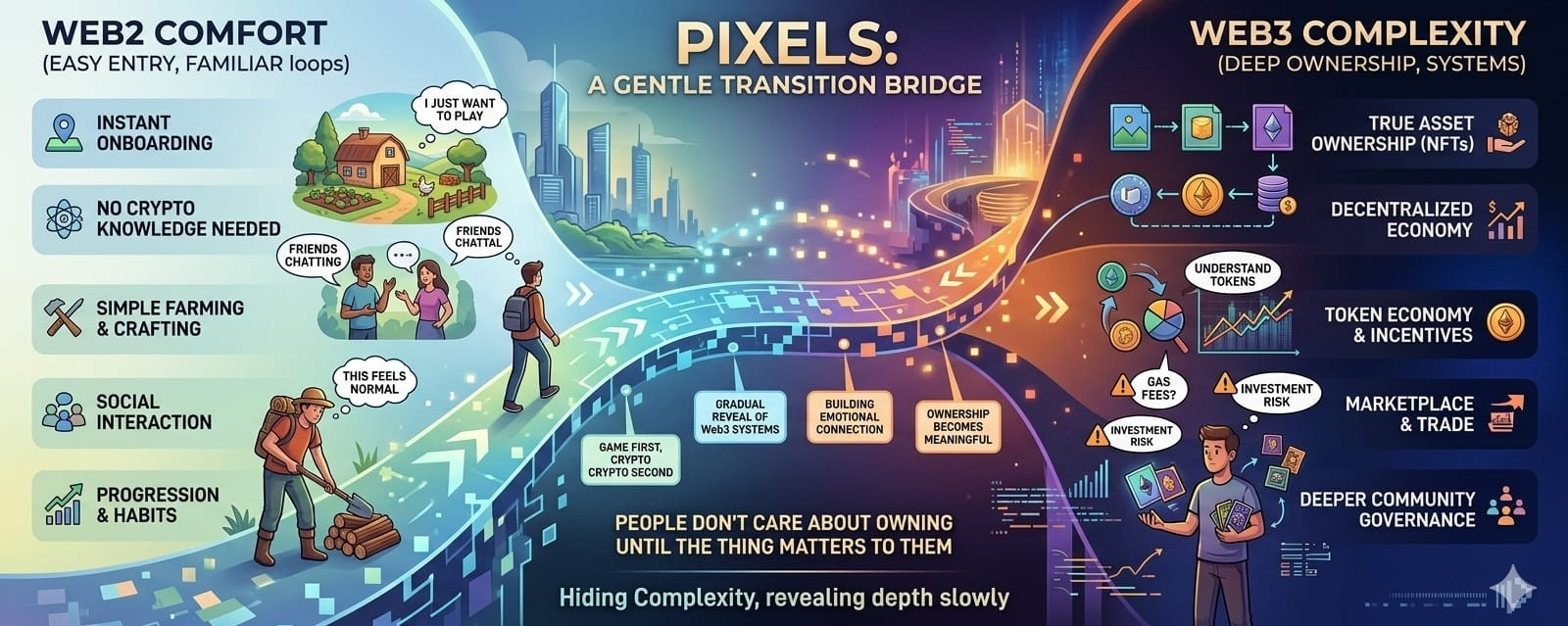
That is the gap Pixels is trying to stand in. On one side, there is Web2 comfort. On the other side, there is Web3 complexity. And somewhere in the middle, Pixels is trying to make the transition feel less painful.
I don’t know if it will fully succeed. I wouldn’t say that confidently. But I do think the attempt is interesting.
Because the best way to bring people into Web3 gaming is probably not by shouting “ownership” at them on day one. It is by giving them a game that feels easy to enter, then letting the deeper systems appear slowly after they already care.
That’s the part many crypto projects miss.
People don’t care about owning something until the thing itself matters to them.
If I don’t care about a game world, why would I care about owning an item inside it? If I don’t feel connected to my farm, my land, my character, or my progress, then ownership is just another word on a website. It only becomes meaningful after emotion is already there.
Pixels has a better chance than many Web3 games because its world is based on simple, human loops. Farming is easy to understand. Gathering is easy to understand. Building something over time is easy to understand. Decorating a space, completing small tasks, meeting other players, improving little by little — these are not crypto ideas. These are gaming ideas.
And maybe that is the right order.
Game first.
Crypto second.
But saying that is easier than doing it.
The moment a token enters the picture, everything changes. People start watching price. They start asking about rewards. They start calculating. They start thinking about whether their time is profitable. Some players come because they like the world, but others come because they see opportunity. And once that happens, the game has to serve two very different audiences.
One audience wants to play.
The other wants to extract value.
Sometimes the same person is both.
That is where Web3 gaming becomes complicated. A game like Pixels can look calm on the surface, but underneath it has to deal with all the pressure that comes with tokenized economies. Rewards need balance. Assets need purpose. New players need a fair path. Existing holders want value. Speculators want movement. Casual players want simplicity. Crypto users want utility.
Those needs do not always fit together neatly.
I’ve seen projects lose their balance here. At first, they talk about fun. Then the token launches, and suddenly every conversation becomes about price, supply, emissions, listings, rewards, and unlocks. The game is still there, but it gets pushed into the background. The community starts acting less like players and more like investors waiting for updates.
That can quietly damage a game.
Not all at once. Slowly.
The mood changes. The language changes. People stop asking whether the game is enjoyable and start asking whether it is “worth it.” That one phrase says a lot. In normal gaming, “worth it” might mean worth my time or worth the price. In crypto gaming, it often means worth the financial risk.
That is a very different feeling.
Pixels has to avoid becoming only that.
If it wants to be a real bridge, it has to protect the casual feeling. It has to let people enter without making them feel like they are already late to some economic game. New players should not feel like they are walking into a market where everyone else already knows the rules. They should feel like they are entering a world.
That sounds simple, but it is not.
Crypto communities can become intense very quickly. They develop their own language. They talk in tickers, snapshots, rewards, multipliers, and strategy. That can be exciting for insiders, but it can also push normal players away. A game that wants Web2 users cannot let the whole culture become too financially aggressive.
Because comfort is not only about the interface. It is also about the atmosphere.
If the game feels like a place where people are building, chatting, farming, exploring, and spending time, that creates one kind of culture. If it feels like everyone is trying to maximize rewards before the next update, that creates another. Both may create activity, but only one feels healthy for a long-term game.
This is why I’m careful with Pixels.
I can see the potential, but I can also see the risks clearly.
The potential is that Pixels becomes a soft entry point into Web3. A game where players don’t need to understand everything immediately. A place where Web2-style comfort comes first, and Web3 ownership adds depth later. A world where blockchain is not the whole personality of the game, but a layer that gives certain items, progress, and participation more weight.
That would be valuable.
The risk is that the Web3 side becomes too loud. The token becomes the center. The economy becomes the main topic. Players start treating the world like a reward system instead of a place to spend time. And once that happens, Pixels becomes just another crypto game fighting the same old battle.
I’m not saying that will happen. I’m saying the risk is real.
The hardest thing for Pixels is not launching features or getting attention. Attention is not rare in crypto. The hardest thing is keeping the game emotionally simple while the systems underneath are financially complex.
That balance is delicate.
Too much simplicity, and crypto users may ask why Web3 is even needed.
Too much complexity, and normal players may leave before they understand the value.
So Pixels has to walk carefully. It has to make ownership useful without making everything feel like an investment. It has to make the token relevant without letting the token take over the whole identity. It has to reward players without turning them into farmers in the worst sense of the word. It has to grow without becoming a place where only early users and insiders feel comfortable.
That is a difficult line to hold.
But maybe this is why Pixels feels more interesting than the usual Web3 gaming pitch. It is not trying to be impressive through complexity alone. At its best, it seems to understand that ordinary players need ordinary reasons to stay. A calm loop. A social world. Small progress. Familiar actions. A sense that the game can be played without constantly thinking about crypto.
That may sound basic, but in this space, basic is underrated.
I’ve watched too many crypto games try to solve everything except the most important thing: why would someone come back when there is no big reward to chase?
That question is brutal.
Airdrops can bring people in. Tokens can bring attention. Market cycles can create temporary excitement. But when all of that slows down, the game is left alone with itself. Then the only thing that matters is whether people actually want to be there.
Pixels will face that test like every other game.
If people return because the world feels alive, that means something.
If people return only because the rewards are good, that means something too.
And we should be honest about the difference.
I don’t think Pixels needs to be perfect to matter. No Web3 game is perfect. The whole category is still awkward, still experimental, still carrying baggage from the play-to-earn era. What Pixels needs is patience, consistency, and enough self-control not to let financial noise swallow the game.
That last part may be the most important.
Because crypto always wants to speed things up. It wants quick growth, quick listings, quick narratives, quick liquidity, quick results. Games usually need the opposite. They need time. They need slow trust. They need players to form routines. They need communities to develop naturally. They need the product to become part of someone’s day.
Those two rhythms fight each other.
Pixels is sitting right in the middle of that fight.
And maybe that is why I keep thinking about it. Not because I’m convinced it will win, but because it represents the real challenge better than many projects do. It shows how hard it is to make Web3 feel normal. Not exciting. Not revolutionary. Normal.
Normal is what crypto often fails to become.
For Web3 gaming to reach more people, it has to stop feeling like a test. It has to stop making every new user prove they understand the culture before they can enjoy the product. It has to stop turning every simple action into an economic decision. It has to let people play first.
Pixels has a chance to do that because its base idea is not intimidating. Farming, creating, exploring, and socializing are familiar. They give players a reason to enter before the blockchain layer asks for attention. That does not guarantee success, but it gives the project a better starting point than many Web3 games built mainly around ownership and rewards.
Still, I don’t want to overstate it.
A bridge can exist and still not carry enough people across. A game can have the right idea and still struggle with execution. A token can have utility and still become a distraction. A community can start healthy and still become too market-driven. These things happen.
So I’m watching Pixels with interest, but not blind belief.
I like the idea of a Web3 game that feels comfortable first. I like the idea of blockchain sitting behind the experience instead of standing in front of it. I like the possibility that players could slowly move from familiar Web2-style gameplay into deeper ownership without feeling pushed.
But I also know crypto has a habit of making everything heavier than it needs to be.
That is the tension.
Pixels may become a real bridge between Web2 comfort and Web3 complexity, but only if it remembers that most people do not come to games looking for complexity. They come looking for a feeling. A place. A loop. A small reason to return.
If Pixels can protect that feeling, then it has something worth watching.
Not something to worship.
Not something to blindly trust.
Not something to turn into another loud market slogan.
Just something that might show, quietly, that Web3 gaming works better when it stops trying so hard to look like Web3.
And honestly, after everything I’ve seen in this market, that kind of quiet progress feels more believable than another big promise.
