
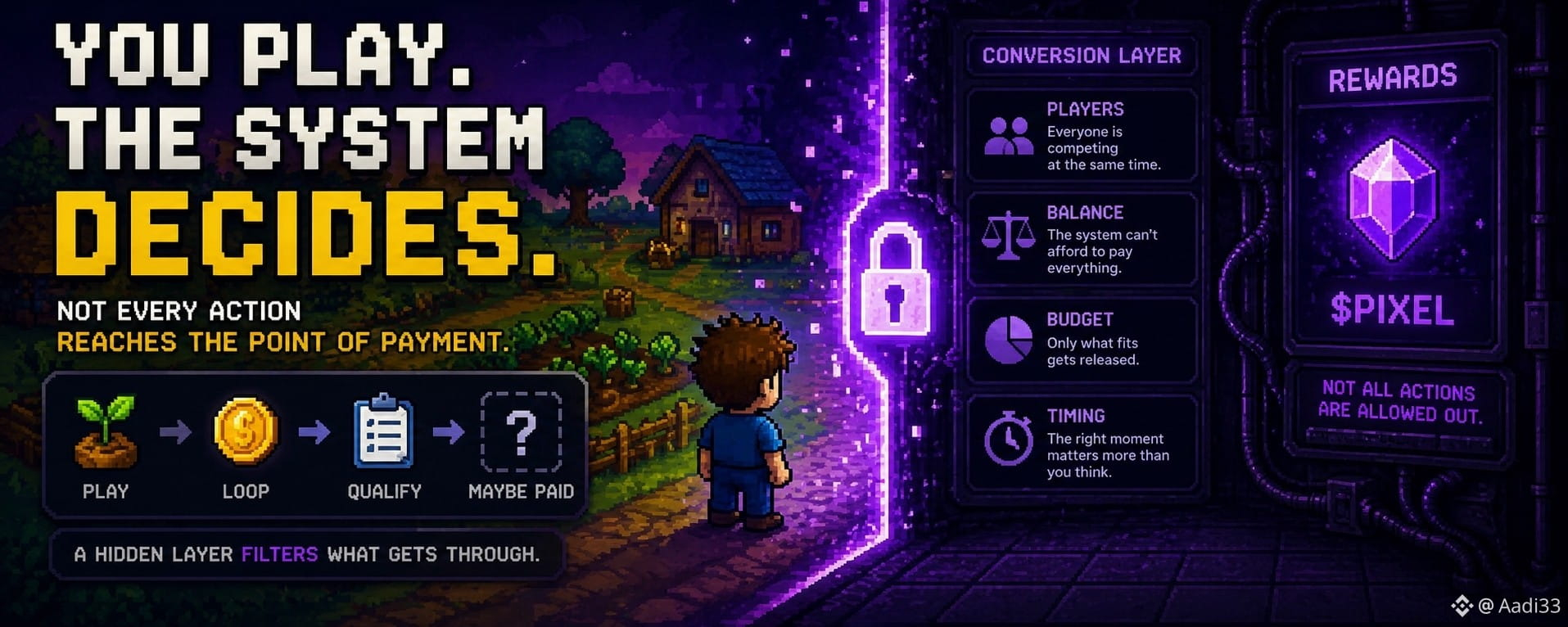
There’s something easy to miss when I first spend time inside Pixels. Not because it's hidden in a complex system or buried under mechanics, but because nothing initially feels wrong. The loop is simple. I move, I plant, I collect, I return. It feels consistent enough that I stop questioning it.
At the beginning, everything makes sense.
I perform an action, and I expect some form of outcome. Maybe not instantly, maybe not dramatically, but eventually. That expectation is so natural that I don’t even notice I’m carrying it. It’s just how games are supposed to work. Effort leads somewhere. Repetition improves results. Consistency builds progress.
But over time, something small starts to feel off.
Not in a way that breaks the experience, but in a way that refuses to fully settle. I repeat the same routine across multiple sessions. The same crops, the same timing, the same path through the world. From the outside, nothing has changed. And yet, the outcomes begin to shift in ways that are difficult to explain.
Sometimes the loop seems to convert into something meaningful. Other times, it simply passes through without leaving any visible result. The difference isn’t dramatic, but it’s enough to create doubt.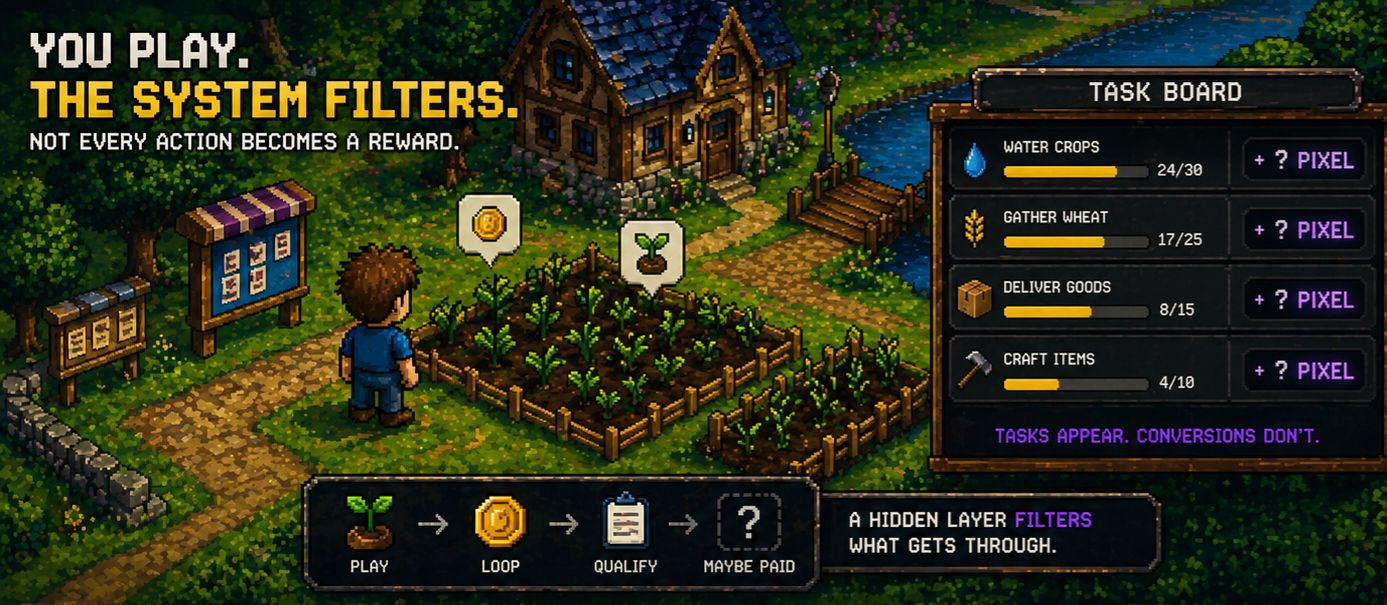
If the behavior is the same, why isn’t the result?
At first, it’s easy to blame myself. Maybe I’m missing efficiency. Maybe there’s a better pattern, a more optimal route, a detail I haven’t noticed yet. That assumption keeps me engaged for a while because it gives me control. It suggests that the system is fair, and I just haven’t mastered it.
But the longer I stay inside the loop, the harder that explanation becomes to maintain.
Because most of what I am doing doesn’t actually leave the system.
It stays contained within it.
Actions repeat, coins circulate, progress appears to move, but very little is forced to cross into a space where it has to be accounted for. The system allows activity to continue without demanding that it justifies itself as an outcome. And that distinction begins to matter more than the actions themselves.
This is where the experience quietly changes.
It stops feeling like I am directly earning from what I do, and starts feeling like I am positioning myself for something that may or may not happen later. The loop doesn’t disappear, but its meaning shifts. It becomes less about producing results and more about staying active within a system that decides when results are allowed to appear.
Not every action becomes a reward.
Some actions remain inside the loop, unresolved, almost invisible in terms of final outcome. They exist, they contribute to the flow, but they never reach the point where they are required to convert into something tangible. And once I begin to notice that, a different kind of question starts to form.
What actually determines which actions matter?
The answer is not obvious, and that is what makes it difficult to understand. It doesn’t feel random, but it also doesn’t feel directly controlled. Instead, it feels filtered.
As if every action I perform is being presented to a layer I cannot see, and something within that layer decides whether it is worth turning into a reward. Not just based on the action itself, but based on the overall state of the system at that moment.
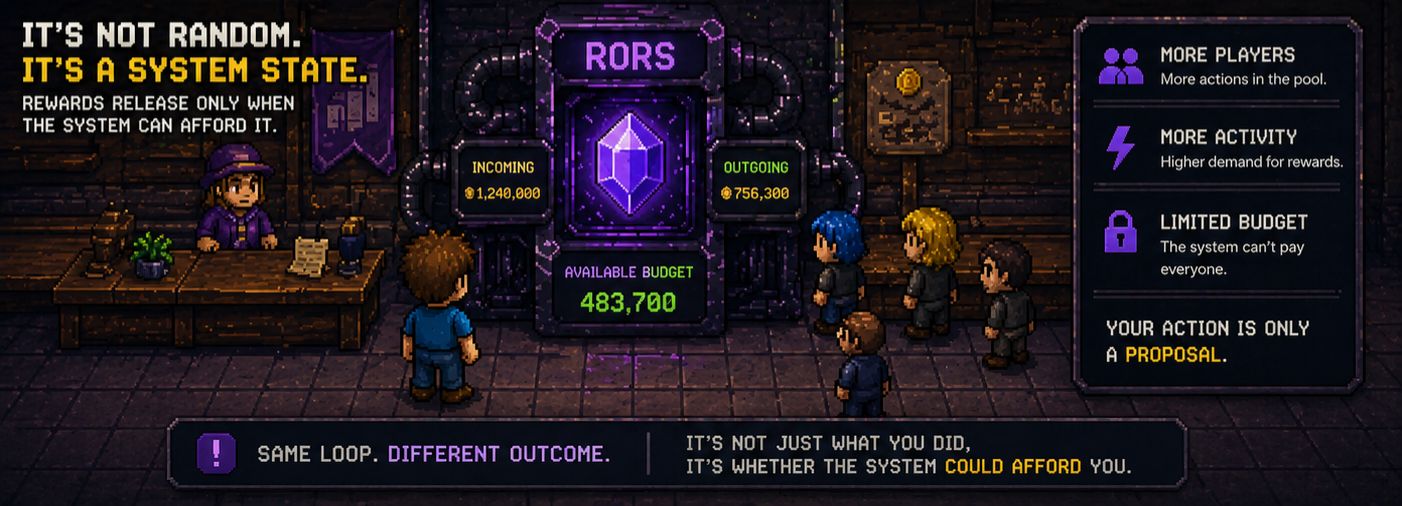
Other players are part of it. System balance is part of it. The total amount of value that can be distributed without destabilizing the system is part of it. These factors are not visible during normal gameplay, but they shape the outcome in ways that are impossible to ignore once I start paying attention.
This introduces a quiet tension.
Because it means that effort alone is not enough.
I can repeat the same loop perfectly, maintain consistency, avoid mistakes, and still see different results. Not because the system is broken, but because it is operating under constraints that are larger than any single player’s actions.
In that sense, the loop is not a direct path to earning.
It is a process of qualification.
I am not guaranteed an outcome. I am increasing the likelihood that when the system is in a state where it can release value, my actions are aligned with that moment. That alignment is subtle, and it is never clearly communicated. I only feel it indirectly, through inconsistencies that don’t have simple explanations.
This is why repetition starts to feel different over time.
At first, it feels productive. Then it feels necessary. Eventually, it begins to feel uncertain. Not because it lacks purpose, but because its purpose is no longer clear. I am still doing the same things, but the connection between those actions and their results becomes less direct.
That uncertainty doesn’t remove engagement. If anything, it can deepen it.
Because now I am not just interacting with the visible layer of the game. I am trying to understand the invisible one. The layer where actions are evaluated, filtered, and either allowed to pass through or kept inside the loop.
And that layer does not respond in ways that are easy to predict.
It responds to conditions.
Conditions that include timing, system capacity, overall activity, and possibly factors that are never fully revealed. This does not make the system unfair, but it does make it less transparent. It shifts the experience away from direct control and toward indirect influence.
I am still playing.
I am still making decisions.
But the outcome is no longer something I can trace cleanly back to a single action.
It is something that emerges from a combination of actions and conditions.
And that changes the meaning of progress.
Progress is no longer just about getting better at the loop. It is about understanding how the loop interacts with the system that sits above it. It is about recognizing that not all effort is immediately visible, and not all activity is meant to convert into results.
Some of it is simply absorbed.
Some of it remains within the system, contributing to its movement without ever becoming something I can claim as an outcome. That realization is subtle, but once it settles in, it becomes difficult to ignore.
Because it forces a different kind of question.
If rewards are not directly produced by what I do, but instead appear only when the system allows them to pass through, then what exactly am I optimizing for?
Skill?
Consistency?
Timing?
Or something less defined, like alignment with moments when the system is capable of saying yes?
There is no clear answer, and that may be intentional.
Because a system that converts everything immediately would not hold its balance for long. It would collapse under its own output. So it has to filter. It has to decide. It has to limit what becomes real.
And in doing so, it creates a gap between action and outcome.
That gap is where most of my experience actually exists.
I am still farming, crafting, moving, repeating. The loop continues exactly as it did before. But now there is an awareness that most of what I am doing never reaches the point where it has to matter.
It stays within the system, circulating, contributing, but not converting.
So the loop continues.
Not because it guarantees rewards, but because it keeps me present within a system where rewards are conditional. Where outcomes are not just earned, but allowed.
And once I start seeing it that way, the experience becomes something slightly different.
Less about direct earning.
And more about
And more about existing inside a system where every action is a possibility, but only some of them ever reach the point where they become real.