
I used to think AI in gaming would arrive in the obvious places first.
Smarter enemies. Better NPC dialogue. Personalized maps. Automated support.
That’s the version people can see, so it gets all the attention.
But after watching Pixels more closely, I think the more important use is happening somewhere players barely look.
Inside the reward system.
And honestly, that makes more sense than most of the flashy AI gaming ideas being marketed right now.
Because games rarely fail from lack of content alone. They fail when incentives stop making sense. Rewards get handed to the wrong behavior, real players get treated the same as farmers, budgets get burned chasing fake activity, and studios respond the usual way: bigger campaigns, louder events, more emissions.
Short-term spike. Long term leak.
I’ve seen that pattern enough times to know it’s not a content problem.
It’s an allocation problem.
That’s where Pixels feels different.
The mistake most people make is thinking rewards are generosity.
They’re not.
Rewards are spend.
The only question is whether that spend creates durable behavior or temporary numbers.
Pixels seems to be building around that reality.
You can feel it in how the system behaves. Some moments get rewarded heavily. Other moments that look active on the surface get very little. Sometimes timing matters more than raw effort. At first that can feel inconsistent.
Then you realize the system may not be trying to reward everyone equally.
It may be trying to spend efficiently.
That’s the anchor.
Pixels already has something valuable most new games don’t: years of player behavior tied to outcomes.
Who stayed. Who churned. Which loops created loyalty. Which incentives attracted extractors. Which events created real activity and which ones only inflated dashboards.
That history matters.
Because once you have enough of it, AI stops being a gimmick and starts becoming useful.
Not useful for making prettier worlds.
Useful for reading patterns humans can’t continuously track.
Imagine two players.
Both claim rewards. Both complete tasks. Both look active in a dashboard.
But one is likely to stay, spend time socially, return next week, and deepen into the ecosystem.
The other is farming every available edge and disappearing when incentives drop.
A human team can catch some of that.
A learning system can evaluate it constantly.
That changes everything.
Now rewards stop being fixed payouts.
They become decisions.
This is where the Pixels stack matters.
The Events system is constantly collecting behavioral signals: timing, repetition, completion style, return patterns, drop offs, reactions to previous rewards.
Stacked then makes more sense as the execution surface. Not just quests on a screen, but a layer where incentives can actually be deployed based on what the system is learning.
Then distribution happens through mixed outputs: $PIXEL, points, progression advantages, ecosystem rewards.
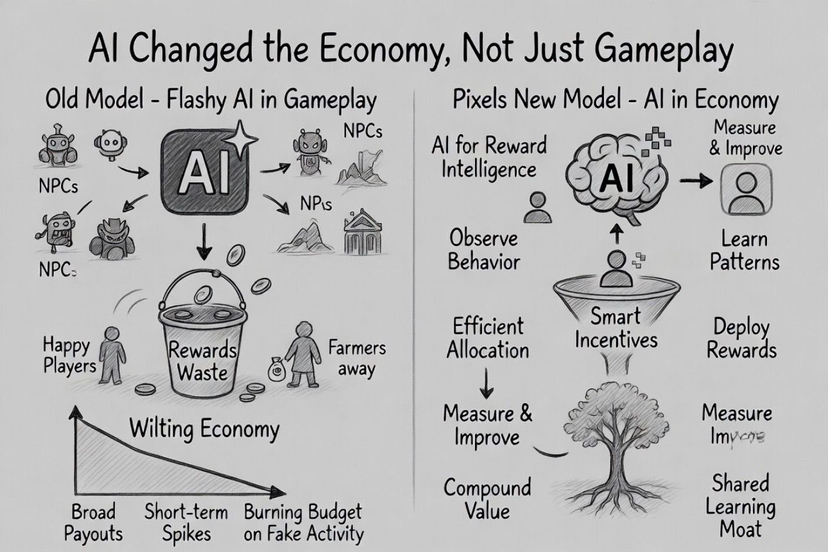
So instead of the old model:
launch event → pay everyone → hope it worked
You get something closer to:
observe behavior → predict response → place incentive → measure result → improve next round
That’s a real operating loop.
And this is where AI belongs.
Not replacing players.
Not replacing fun.
Replacing waste.
Because waste is everywhere in game economies.
Tokens paid to low value activity. Campaigns rewarding bots. Broad events attracting people who leave the next day. Budget spent where nothing compounds.
If a system can learn that 30 $PIXEL keeps a valuable player cohort engaged, while 300 $PIXEL on another segment gets farmed instantly, then the smarter move is obvious.
Spend less.
Get more.
That’s not hype. That’s economics.
This also scales beyond one game.
As Pixels expands through connected titles, data from one environment can improve decisions in another.
A player who shows consistency in one game, social stickiness in another, and progression discipline elsewhere becomes easier to understand system wide.
That means one game learning can improve the next game’s incentives.
This is where ecosystem finally means something real.
Not shared token.
Shared intelligence.
And it’s hard to copy.
Anyone can launch quests. Anyone can say AI powered rewards.Anyone can distribute tokens.
What they can’t instantly copy is years of labeled behavior tied to actual reward outcomes.
That creates a moat.
More users create more signal. More signal improves decisions. Better decisions improve reward efficiency. Better efficiency supports healthier growth.
That loop is stronger than most token narratives people focus on.
There are risks.
If the system chases only short term retention, it can become manipulative. If it misreads genuine players as low-value, it can underinvest where it matters. If it feels too opaque, users read intelligence as randomness.
So this isn’t automatic success.
But it is the right layer to optimize.
What changed my view on Pixels was simple.
I stopped seeing a game using incentives.
I started seeing a live economy trying to learn where incentives actually work.
That’s a much bigger idea.
The old model was:
make content pay users repeat
The newer model forming here feels more like:
watch behavior learn patterns deploy rewards carefully improve every cycle
If Pixels gets this right, people will say it added AI to gaming.
I think the real story would be smaller and more important than that.
It used AI to make rewards intelligent.
And in open game economies, that might matter more than any fancy NPC ever will.
