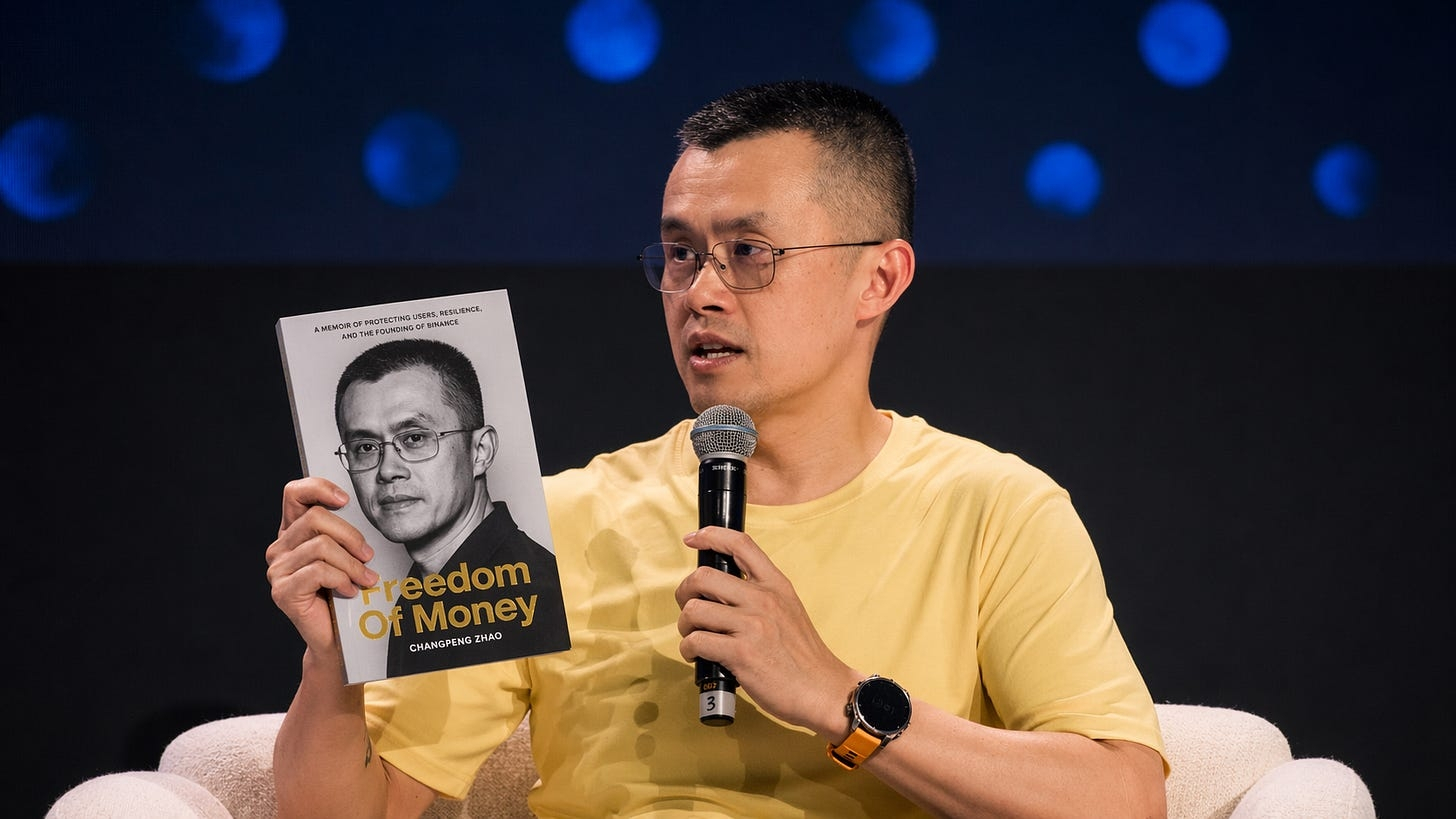
This AMA focused on CZ’s new book, Freedom Of Money, touching on his entrepreneurial journey, why he wrote the memoir, and his views on young people, founders, investors, and the future of crypto.
CZ said he has no plans to start another company at this point. Instead, he prefers backing projects as an advisor and investor. When evaluating founders, he cares most about mission-driven people who can survive bear markets and execute through tough cycles.
On setbacks and major life decisions, CZ stressed the importance of keep moving, adjusting direction when needed, staying disciplined on spending, and committing to long-term learning.
For young people, he believes the opportunity set today is actually bigger than before. In his view, AI, the internet, and blockchain will continue creating new paths for upside.
CZ also remains highly bullish on crypto. He believes blockchain adoption is still in its early innings, with much bigger roles ahead in payments, FX, commodities, and AI agent-driven transactions.
He added that the process of writing and publishing Freedom Of Money helped him reexamine his own journey, gain fresh perspective on some major events in his past, and find a sense of personal closure.
Whether He’ll Ever Start Another Company
Question: CZ, what has driven you all the way to where you are today, and what led you to start Binance in the first place? Beyond your current role as an advisor, do you still have that founder drive to build something from scratch again, whether in AI, crypto, or another field? Should we see that chapter as closed, or could there still be new surprises ahead?
CZ: On building a new company, I’m actually really happy with where I am today. I advise a number of projects, help founders, and support quite a few teams as a passive investor. Binance also has a very strong management team in place, and the business and platform are running well. Usually when a founder leaves, that creates risk, but Binance has held up well under pressure. So right now, I have no plan to go back, and no intention of starting another company.
At the moment, I’m mainly focused on learning about AI, and I’ve spent a lot of time on it. YZi Labs has also made a fairly large number of investments across AI, robotics, and crypto. So at this stage, I don’t have any new plans, though I’m not completely ruling out the future. People change, and no one really knows what life will look like in five or ten years.
That said, starting a company takes a huge amount of energy, both physically and mentally, and I’m not sure I’ll still want that kind of grind later on. But I do encourage people who want to build to start early and manage risk well. And I’m always happy to support strong founders.
Building From Scratch: Confidence, Conviction, and Long-Term Accumulation
Question: CZ, you also started from zero. How did you build the confidence to take the leap, keep going, and trust the path you were on?
CZ: I got exposed to entrepreneurship pretty early on, and I’ve always been a better fit for small teams and startup environments. Big companies were never really for me long term. Before Binance, I had already gone through a lot of failed startup attempts.
So my advice is: manage risk carefully when you start a business. Try not to take on heavy debt just because a venture fails. For me, everything built up over time. I first developed my technical skills, then learned business development, and later entered crypto, where I gradually built a real understanding of the market through hands-on experience.
Then I caught the ICO wave in 2017, slowly built a team, and eventually turned Binance into what it became. It was the result of long-term accumulation plus timing, not some overnight success.
Every founder has a different background and personality. The key is finding the path that fits you, something you genuinely care about and that also creates value for the world. If you can keep creating value, good outcomes usually follow.
Before I started Binance, I had already been working for 17 years. I wasn’t some breakout genius founder who appeared out of nowhere. I got here step by step.
How to Judge Direction When You’re at a Low Point
Question: After reading your autobiography, one line stood out to me most: “What should you do when life hits rock bottom? Keep walking, and you’ll walk out of it.”
But some people hear that and think it sounds a little too much like a motivational slogan. The reality is, some people really are trying hard and still can’t get out. Later I started thinking that maybe the issue isn’t just effort, but direction. If you’re heading the wrong way, working harder may not help at all.
So my question is: Binance must have faced plenty of forks in the road. Why were you able to keep choosing the right direction? During Binance’s early days, did you ever go down the wrong path and then correct course later? At the core, the question is: how should people choose direction?
CZ: That line in the book actually came from a belief I formed long before Binance. It wasn’t something I only realized after success. From my own experience, when you’re at a low point or under a lot of pressure, don’t rush to conclusions. Keep moving forward. A lot of things look less terrible a few days later. Sometimes the environment changes, and sometimes you’re just able to see things more calmly.
But “keep moving” doesn’t mean pushing ahead blindly. If you realize you’re going in the wrong direction, then you need to adjust quickly. Most of the time, you can feel whether a direction is working. If nothing is improving for a long time, that usually means you need to change your habits, your environment, or your approach.
I think one big reason people stay stuck is not a lack of effort, but a broken way of living. For example, if you’re constantly spending more than you make, have no savings, and aren’t continuing to improve yourself, then even if you work hard every day, it’s very difficult to truly change your situation.
My view is pretty simple: first, control your spending and try to save a little. Then carve out some time every day to learn, read, and build new skills so you keep improving. Even if the progress is slow, as long as the direction is right and you’re getting better day by day, things will improve over the long run.
That may not bring financial freedom quickly. It could take many years. But when people can see themselves improving, they feel more in control, and it becomes easier to get out of a low point. On the other hand, if you’re only draining yourself, burning through resources, and staying in place, it’s easy to get trapped.
So my answer is this: when you’re at a low point, keep moving forward, but keep checking your direction. If it’s wrong, adjust early. I’ve always believed that most people can gradually improve their situation over time, and staying optimistic matters a lot.
Writing Freedom Of Money: Why He Wrote It and What He Wants Readers to Take Away
Question: CZ, what did it feel like to publish Freedom Of Money and openly share both the biggest setbacks and biggest successes of your life? What do you most want readers to get from the book?
CZ: First of all, the biggest feeling was relief. Writing a book is a long process. There’s the writing, editing, endless revisions, then all the publishing decisions — whether to work with a publisher, how to get an ISBN, whether to self-publish, what the cover should look like. There are a lot of details. So I’m very happy the book is finally out.
I also read a lot of memoirs and books on writing. One thing I learned is that the first draft is never good. You just have to get it out, then keep revising. I went through many rounds myself, and each round took a lot of time, so the whole process was pretty long.
Another thing is that writing a memoir will almost inevitably upset some people. If you want to be honest, you can’t only write the polished parts. You also have to write about the problems, conflicts, and feelings you went through, and that naturally involves other people. So you have to accept that, and accept that some people will criticize or attack you for it.
But a book is different from social media. Social media is fragmented. A book lets you tell your story in a fuller way. It gave me the chance to explain my journey in my own voice and from my own perspective. That matters a lot to me, especially because I, Binance, and crypto have often been stuck inside negative narratives for a long time.
I didn’t write this book to make it a how-to guide or some success manual. I wrote it so people could better understand, in a more real way, how we got here — who I am, what Binance is, what decisions we made, and what mistakes we made too.
There’s actually a lot I left out. Some things are still too recent. Some are still ongoing and involve discussions or legal matters, so this isn’t the right time to make them public. Maybe years from now, there will be a chance to include them in a later version.
If there’s one core message in the book, it’s this: I want people to have a more real understanding of me, Binance, and the crypto industry.
How He Decides Whether a Project Is Worth Backing
Question: In your book, you mentioned that when Binance launched in 2017, many VCs passed because they thought the market was already saturated. Now that you’re investing yourself, how do you avoid missing the next Binance? What kind of founders and projects matter most to you?
CZ: Honestly, you can’t fully avoid that. Early-stage projects usually come down to a founder and an idea. The product often doesn’t exist yet, so there’s only so much you can evaluate. At that stage, you’re really betting on people. To be honest, if I had been an investor back then, I’m not even sure I would’ve invested in Binance either.
What I care about most today are founders with a real sense of mission — people who are pragmatic and can stay in the game for the long haul. Compared with founders who only talk about market size and upside, I’d much rather back people who genuinely want to build something meaningful.
I also like evaluating projects in bear markets. If a team is still building when the market is down, that usually tells you they’re not just chasing short-term hype. Beyond that, I look closely at execution. Ideally, they already have a product, demo, or prototype — not just an idea on paper.
So at the end of the day, what matters most to me is still pretty simple: is the founder solid, and can the team actually ship?
How to Tell Whether a Narrative Has Real Staying Power
Question: In your book, you put a lot of emphasis on long-term conviction. The market is relatively quiet right now, but there are still some resilient founders who keep building. So how do you usually tell whether a crypto narrative has real long-term potential or is just short-term hype? For example, with narratives like prediction markets or Perp DEXs, how do you separate signal from noise?
CZ: There’s no foolproof way. You can only look for signals.
One of the biggest things I watch is GitHub activity. If a project keeps shipping code and still has developers actively contributing, that usually means it’s genuinely evolving — that it still has a pulse. A lot of projects can look hot from a marketing perspective and generate a lot of noise at launch, but development activity often fades before the price does, and that’s usually a warning sign.
The second thing I look at is whether the project has survived multiple cycles. If it’s been through both bull and bear markets and is still building, it has a much better shot at lasting long term. On the other hand, some projects get extremely hot in one cycle and then gradually disappear.
New projects are obviously harder to judge. In those cases, beyond the product itself, I also look at the founder’s and team’s track record. If a founder jumps to a new project every one or two years, that’s a reason to question whether the latest one really has long-term commitment behind it. There can always be exceptions, but past behavior usually tells you something.
So for me, it still comes down to two core signals: GitHub activity, and whether the project has actually made it through cycles.
On the Intensity of Startup Life That Outsiders Never Really See
Question: From the outside, Binance’s rise looked incredibly fast. What most people saw was hype, growth, and headlines. But in your book, is there any behind-the-scenes story that would completely change how people understand that journey — something that’s never really been public before?
CZ: That’s a tough one. I’m not sure there’s anything that was completely unknown, but I do think a lot of people underestimate how intense things were for the team, especially in the early years.
Back then, there were many times when people literally slept in the office. An exchange runs 24/7, so the team was always on call. I was basically glued to my phone the whole time. Even when I wasn’t in the office or in front of a computer, I was still online and reachable.
I think what outsiders have the hardest time fully understanding is the physical and mental toll of those early startup years. The book does talk about working hard, but I’m not sure people can truly feel the level of intensity we were operating under. Later, as the team grew and processes became more mature, things got more stable, and that kind of constant pressure gradually eased.
So if there’s one thing people most often miss, it’s this: Binance’s early growth was built on extremely intense, almost around-the-clock commitment from the team.
Advice for Young People Who Feel Lost
Question: In your book, you mentioned that you started elementary school at age five and weren’t an especially strong student at first. It was only later, in high school, that you gradually improved.
I think a lot of young people today are in a similar place. They may not stand out early on, and their self-discipline may still be average. On top of that, Web3 is getting more competitive, with more and more talented people entering the space. That pressure makes it easy to feel lost and unsure about the future. So based on your own experience, what advice would you give to young people who feel this way?
CZ: I strongly believe young people today actually have more opportunities than previous generations.
The most important thing is to keep learning and improving while you’re still young. Don’t spend most of your time on games, social media, or short-term entertainment. Spend more of it learning new things and building real skills. When you’re young, you learn faster and have more room to grow. That stage is incredibly valuable.
You also don’t necessarily need to go down the most hardcore technical path, but you should build at least one core skill — whether that’s engineering, marketing, finance, business development, or something else. Get really solid at one thing first, then expand into other areas over time.
At a bigger-picture level, there are actually far more opportunities to build and create value today than before. The internet, cloud services, blockchain, and AI have all made it easier to build products, reach global users, and test ideas quickly. Yes, competition is tougher — but the opportunity set is bigger too.
So I don’t agree with the idea that “there are no opportunities now.” The reality is the opposite: opportunities keep expanding. The key is whether you’re willing to keep learning, keep improving, and invest your time in things that will compound for you over the long run.
On the Meme Ecosystem
Question: On the native Meme community side, a lot of builders are now turning your tweets into Memes, and the competition is getting pretty intense. Do you see more support coming for native Meme communities going forward, or more attention from the Binance ecosystem for communities that have been building consistently?
CZ: I’m not really a Meme trader, so when I post on X, I’m not trying to engineer content around Memes. If I did that, I’d end up being overly careful every time I said anything. I mostly just post in my normal way. Whether the community wants to turn that into Memes is up to them.
Actually, the Chinese title of Freedom Of Money has a bit of Meme culture baked into it. The English title is Freedom Of Money, but in Chinese I felt “币安人生” was more interesting and more fitting. The title itself was inspired by a community Meme, which I thought was fun, so I went with it.
That said, I do want to remind people that Meme coins are extremely volatile and very high risk. I’m not going to give specific trading advice. The market is free, and people can make their own judgments. At the infrastructure level, the BNB Chain ecosystem, including Binance.com, is already fairly supportive of Meme culture through things like launch platforms and PancakeSwap, which give it room to grow.
Beyond that, I don’t have much more to add. My view is that most Memes probably won’t last over the long term. But honestly, that’s true for most crypto projects too. Only a small number will still be around years later. Hopefully people can find something with real staying power.
Whether Writing the Book Changed How He Sees Himself
Question: A lot of authors say writing a book forces them to confront the past again — not just to revisit what happened, but to reinterpret it. Did writing this book change how you understand that chapter of your life, or even how you see yourself?
CZ: In some ways, yes. But it wasn’t so much a shift in identity. It was more that the process pushed me to reflect more deeply on a lot of past decisions and experiences.
Since founding Binance, my life has been fairly public, so a lot of what happened was already known. What people didn’t always know was how I actually saw those moments at the time, or what they felt like from the inside. Writing the book forced me to reorganize all of those experiences, and it gave me a much clearer view of how I’ve changed over the years.
From building Binance, to dealing with the U.S.-related events, to going to prison, and then coming out again — that whole stretch definitely changed my mindset in a lot of ways. And putting it all down in one place gave me a real sense of closure on some of it.
For example, when my father passed away, I thought I had already accepted it to some extent. But while writing the book, I revisited it in much more detail. Once the book was finally published, it felt like that chapter had truly been closed. The prison experience was similar. I had talked about it publicly before, but only in fragments. After writing it out fully in the book, I felt like I had genuinely turned the page psychologically.
So for me, writing the book was really a process of organizing, reflecting, and finding closure. And yes, I do think it made me a little more mature.
I actually encourage other people to write books too. Even if you never publish one, the process itself is valuable. Ideally, writing shouldn’t be for other people first — it should be for yourself. If you were telling the story to yourself, which stories would you choose, and how would you tell them? When you write from that mindset, it’s usually more honest, and more meaningful too.
Why He Chose to Tell His Story After the Storm
Question: Over the past few years, you and Binance were at the center of some of the biggest controversies in crypto. In that situation, a lot of people might have gone quiet for a long time. But you chose to write a book instead. Why did you feel that this was the right time to tell the story publicly?
CZ: Everyone handles pressure and controversy differently. For me, crypto has been described unfairly by traditional media and the outside world for a long time, and there are still a lot of misunderstandings around the industry. So I felt this was exactly the time to put our side of the story out there. My own experience, and Binance’s story, both say a lot. Yes, we made mistakes, and yes, we went through a lot. But at the same time, there’s also a lot of real and positive value in crypto itself.
I’ve already made peace with what I went through, and I don’t avoid telling people that I spent four months in prison. If someone wants to understand, I’m happy to share my perspective. After that, they can look at other information too and come to their own conclusions.
So I decided to write the book partly to fully tell that story, and partly to help people better understand me, Binance, and the crypto industry as a whole. For me personally, it was also a way to process everything and move on.
Is There Still Opportunity for Ordinary People in Web3?
Question: In the book, you mentioned that after reading the Bitcoin white paper early on, you sold your apartment and went all in. That left a deep impression on a lot of people.
But today’s environment is very different. Spot ETFs have been approved, and traditional financial institutions are already in the market. So the question is: for ordinary enthusiasts and founders still looking for opportunity in Web3, like you were back then, can this industry still create life-changing upside? Once big capital is here, what edge is left for regular people?
CZ: I’m still बेहद confident in blockchain. Of course, I can’t predict short-term prices. Whether it’s Bitcoin or anything else, it’s very hard to say where things go over the next few days, months, or even years. But one thing I’m very sure about is this: the industry is still early.
Compared with ten years ago, crypto today is obviously bigger and more mature. But it is nowhere near the end state. In my view, the three technologies that have most deeply changed the world over the past decade are the internet, blockchain, and AI. And blockchain still hasn’t come close to reaching its full potential. Because it touches money and finance, it has been under heavy regulation and pressure for a long time. A lot of applications that should have happened still haven’t really played out.
Take payments, lending, FX, commodities, and cross-border settlement. A huge amount of financial activity still hasn’t moved on-chain in a real way. Today, most people still look at crypto mainly as something to trade. But the real value of blockchain goes far beyond trading.
From a global asset allocation perspective, the share of wealth in crypto is still very low. The industry as a whole is still in a very early phase. So I don’t agree with the idea that ordinary people have already missed the opportunity. If anything, I think the opportunity is still very large. The difference is that the path is now more professional, and competition is tougher.
As for the edge ordinary people still have, I think it’s this: a lot of the people still here today are the ones genuinely building for the long term. AI has pulled away a lot of the hype, capital, and attention. That means the people still focused on blockchain now are often the ones who actually believe in it and are willing to commit for years. In that sense, today’s environment may not be worse at all. It may actually be better for real builders.
On top of that, AI itself will likely use blockchain a lot. Cross-border transactions between AI agents, instant payments, and global coordination may all need on-chain infrastructure. So I don’t think blockchain is anywhere near finished. If anything, it will keep playing a key role in the next technology cycle as well.
So my conclusion is very clear: ordinary people still have real opportunity in Web3, and the industry is far from saturated. The real advantage is not capital size. It’s whether you’re willing to keep learning, keep building, and go after areas that still remain underexplored.
Trade here 👇 👇 👇 #BinanceLaunchesGoldvs.BTCTradingCompetition