
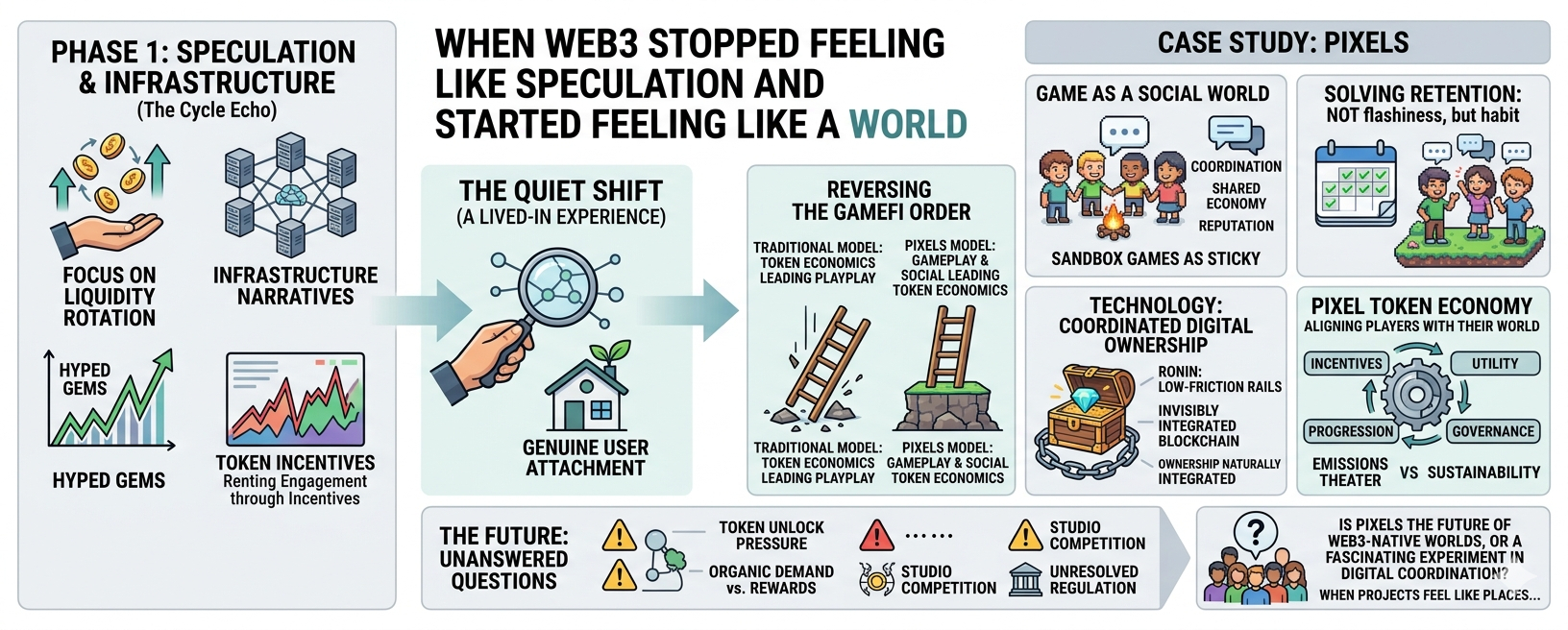
Lately I’ve noticed something interesting in crypto. As liquidity rotates and people keep chasing the next big infrastructure narrative, there’s also this quiet shift happening toward projects that actually feel lived in. Not traded. Lived in. That’s what made me start paying attention to Pixels. At first I assumed it was just another GameFi cycle echo — farming game, token incentives, community buzz, same old pattern. But the more I looked, the more I felt something slightly different was going on.
What caught my attention wasn’t the game itself at first. It was the fact that people kept talking about Pixels almost like a digital place rather than a token ecosystem. That made me curious. In a market where most “engagement” can be rented through incentives, genuine user attachment stands out.
I’ll be honest, I didn’t immediately get it. A pixel-art farming game on Ronin? Why was this drawing so much attention when so many play-to-earn experiments already burned out? My first reaction was mild confusion. We’ve seen what happens when token economics lead and gameplay follows. Usually it collapses under its own incentives.
But digging deeper, I think Pixels flipped that order in a subtle way.
What started making sense to me is that it feels less like a financial wrapper around a game and more like a social world that happens to have crypto rails underneath it. That distinction matters. Farming, resource gathering, land, crafting — on paper these sound simple. But the loop isn’t really about farming. It’s about coordination. People producing, trading, building reputations, participating in a shared economy. It reminds me a bit of why sandbox games became sticky long before Web3 existed. The game is almost an excuse for the network to form.
And that’s where I think Pixels matters in this cycle.
I’ve been watching markets long enough to notice narratives usually mature in layers. First speculation, then infrastructure, then applications people actually use. If that pattern holds, social casual games with functioning economies become more important than people realize. Not because they’re flashy, but because they quietly solve one of Web3’s hardest problems: retention.
That’s the underrated observation I keep coming back to. Most crypto projects optimize for acquisition. Pixels seems unusually focused on keeping people around.
The tech side also clicked for me once I stopped looking at it as “blockchain gaming” and started seeing it as coordinated digital ownership. Ronin gives it low-friction rails, which matters more than people think. In games, friction kills behavior. If every action feels expensive or clunky, users disappear. Ronin makes ownership feel almost invisible, and honestly that may be the right kind of blockchain design — the kind you barely notice.
Then there’s PIXEL itself. I’ve seen people reduce it to just another game token, but I think its role is broader. It sits across incentives, utility, progression, and governance in ways that try to align players with the world they’re helping shape. Not perfectly — no token model is perfect — but there’s at least an attempt at sustainability rather than pure emissions theater.
Compared with a lot of GameFi projects I’ve studied, Pixels feels less obsessed with financial engineering and more interested in economy design. Big difference.
And yes, there are risks. I don’t ignore those. Token unlock pressure is real. Game economies can break fast if rewards outpace organic demand. Competition is brutal, especially when traditional gaming studios are inching toward Web3 experiments. Regulation around tokens tied to gaming mechanics still feels unresolved too. Execution matters enormously here.
But what stands out to me is that Pixels seems to understand the danger zones because it emerged after earlier GameFi failures. Sometimes second-wave projects benefit from collective scars.
Another thing I keep thinking about is how social casual gaming may end up onboarding users into Web3 more effectively than DeFi ever did. Not through ideology. Through habit. Through fun. Through ownership that feels native instead of forced. That feels bigger than people are pricing in.
And maybe that’s why I keep coming back to this project.
I started looking at Pixels expecting a nostalgic farming game with token speculation attached. What I found instead was a live experiment in whether onchain economies can feel playful, social, and sustainable at the same time.
I’m still not sure whether Pixels is showing us the future of Web3-native worlds or simply one fascinating experiment testing the edges of digital coordination.
But honestly, maybe that’s the real question worth sitting with.
When a blockchain project starts feeling less like infrastructure and more like a place people want to return to… are we still looking at a game, or are we watching a new kind of network form in real time?
