
I’m watching Pixels with a kind of patience that I think this sector rarely allows itself. In crypto, especially around gaming, people want immediate proof. They want explosive charts, instant retention, and a token that moves fast enough to justify attention. But I keep coming back to a quieter question—what happens after the excitement fades? What remains when speculation slows down and people have to decide whether they actually want to stay?
That, to me, is where the real story of Pixels begins.
I’ve spent a lot of time looking at Web3 games that were briefly treated like the future and then disappeared into the usual silence. Most of them had the same problem. They were built around extraction before attachment. Players arrived because there was money to be made, not because there was a world worth inhabiting. The moment the financial incentive weakened, so did the game itself. What looked like community was often just temporary alignment around profit.
Pixels feels different because it seems to understand that dynamic from the start.
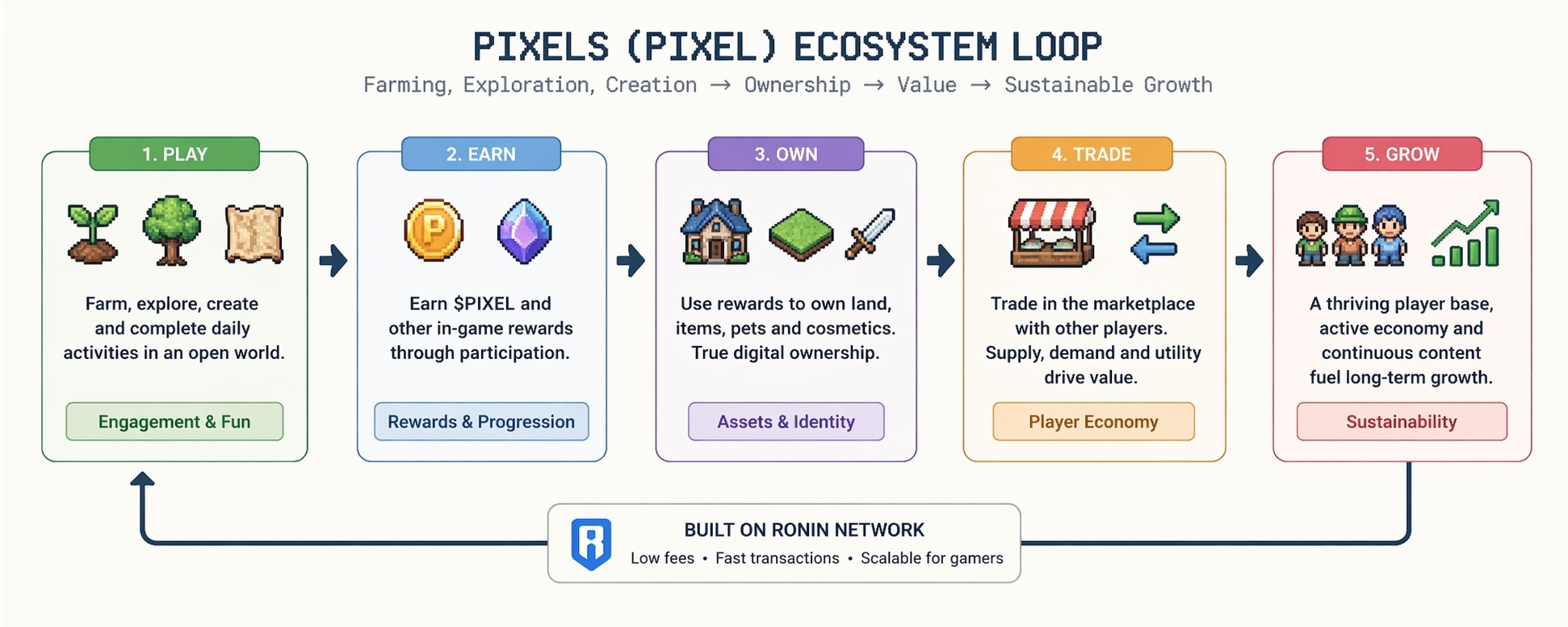
It doesn’t introduce itself like a crypto project trying to disguise itself as a game. It feels like a game first—farming, gathering, building, exploring, talking to people, slowly developing routines. The Web3 layer exists underneath, but it doesn’t dominate the first impression. That matters more than people think. Most users don’t want to enter a financial product wearing pixel art. They want a place that feels alive, and only later do they care about ownership, assets, or token mechanics.
That design philosophy is probably one of its strongest decisions.
There’s something psychologically important about soft entry. When people arrive because they enjoy the experience rather than because they’re calculating yield, their relationship with the platform starts from a completely different place. They build habits instead of strategies. They create attachment instead of temporary participation. In traditional gaming, that’s obvious. In crypto, we still seem surprised by it.
Being built inside the Ronin ecosystem also changes the way I look at Pixels. Ronin already carries the weight of history through Axie Infinity, and that history matters. Axie showed the entire industry what was possible when gaming and crypto aligned at scale, but it also exposed the fragility of a system where the economy becomes more important than the game itself.
Once players start treating gameplay like labor, everything changes.
Fun becomes secondary. Progress becomes transactional. Community starts to feel like an economy rather than a culture. The system can grow quickly, but it becomes incredibly sensitive to decline. If rewards drop, motivation disappears. If token value falls, loyalty evaporates. It stops being a world and starts behaving like a temporary job market.
That lesson still hangs over every Web3 game today, whether people admit it or not.
Pixels seems like a direct attempt to move away from that model. Its farming loops are repetitive, but repetition is not the enemy. In fact, repetition is often where real engagement begins. People underestimate how powerful routine is. Logging in every day, tending crops, upgrading land, checking in on familiar spaces—these things are simple, but they create emotional structure.
Games survive on rhythm more than spectacle.
That’s why I pay less attention to short-term user spikes and more attention to behavioral consistency. Are people building routines? Are they returning without needing to be bribed? Are they forming identity inside the system? Those signals matter more than almost any dashboard.
Pixels, at its best, creates that possibility.
The PIXEL token is where things become complicated, because tokens in Web3 always carry too much weight. They are supposed to be utility, governance, alignment, and liquidity all at once, and eventually that creates tension. Markets rarely allow tokens to remain simple. Speculation arrives quickly, and once it does, the product risks becoming subordinate to price action.
That is where many projects lose themselves.
If the token becomes the main reason users participate, the game starts serving the economy instead of the player. Design decisions begin to orbit emissions, not experience. Retention gets confused with reward dependency. It becomes difficult to tell whether users are staying because they care or because leaving feels financially irrational.
That distinction is everything.
For Pixels to sustain itself long term, PIXEL has to remain useful without becoming dominant. It should support progression, ownership, and participation—but it cannot become the entire emotional center of the ecosystem. The moment the token matters more than the world, the world starts to disappear.
I think land ownership reveals this tension most clearly.
In a lot of crypto games, land becomes detached from actual play. It turns into a passive financial instrument, a way for early holders to collect value from later participants. That model creates imbalance very quickly because it rewards possession more than contribution. It builds landlords, not communities.
That structure always feels dangerous to me because it weakens the social legitimacy of the game itself.
Ownership should create deeper participation, not passive extraction. Land should matter because it gives players expression, productivity, and a sense of permanence—not because it functions like rent collection. If Pixels can protect that distinction, it strengthens the world. If it can’t, it risks repeating the same mistakes that damaged earlier projects.
This is really the larger question around Web3 gaming: can ownership feel collaborative instead of exploitative?
Technology alone doesn’t solve that. Incentive design does.
Crypto often reduces incentives to money, but human behavior is much more layered than that. People stay for status, for familiarity, for recognition, for routine, for the feeling that a place remembers them. Financial incentives can accelerate participation, but they rarely create belonging on their own.
The strongest systems understand that emotional loyalty is more durable than economic loyalty.
That’s why I think Pixels benefits from being a casual social game rather than a high-intensity competitive one. Farming games are naturally better environments for persistence because they are built around maintenance, not constant excitement. They reward consistency. They allow identity to form slowly. They don’t need endless adrenaline to justify engagement.
Speculation is fast. Belonging is slow.
And slow systems are often stronger.
I also think the broader market is finally becoming more mature about blockchain gaming. The old obsession with putting everything on-chain is fading, replaced by a more practical question: what actually improves when ownership exists? Most players do not care about decentralization as a philosophy. They care about continuity. They care about whether their progress matters and whether their effort survives.
Pixels works best when blockchain becomes almost invisible—when ownership feels natural rather than performative.
That’s a much harder product decision than people assume. Crypto teams often want users to constantly feel the blockchain presence because they think visibility proves value. Usually the opposite is true. Infrastructure wins when it disappears.
The real test for Pixels won’t be another growth spike or another wave of market attention. Crypto is very good at producing temporary attention. The real test is whether the world still feels valuable during quiet periods—when the token isn’t trending, when incentives normalize, when users have no obvious reason to stay except the game itself.
Can it survive boredom?
That question matters more than any launch metric.
Because if a game can survive boredom, it can probably survive volatility too.
I think the future of Web3 gaming belongs to projects that stop trying to financialize every interaction and instead focus on creating environments where ownership actually improves emotional investment. Not ownership as speculation, but ownership as permanence. Not tokens as incentives alone, but tokens as tools inside a world people already care about.
Pixels feels like one of the few projects genuinely trying to walk that line.
Not perfectly, and certainly not without risk, but with a clearer understanding of what the problem actually is. The goal isn’t just onboarding wallets. It’s creating a place people return to when there’s no immediate reason to.
That is much harder than launching a token.
But it is also the only thing that matters.
Farming games are built on delayed outcomes. You plant now and trust that something meaningful grows later. That feels like the right metaphor for this entire space. The strongest projects are probably not the ones extracting the most value today, but the ones quietly building reasons for people to still be there tomorrow.
Pixels is interesting because it seems to understand that patience.
And in Web3, patience might be the rarest and most valuable design choice of all.