
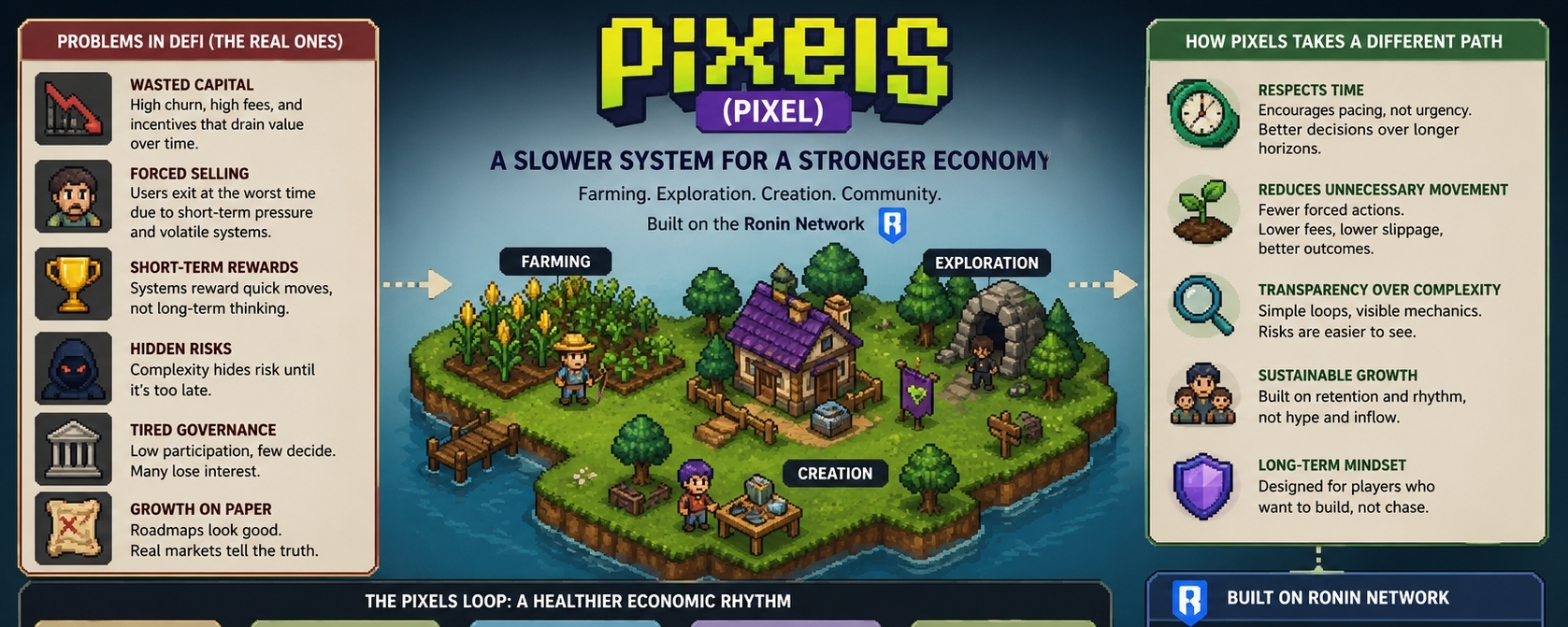
Pixels (PIXEL) doesn’t try to impress me at first glance. It doesn’t need to. The design reveals itself slowly, and that alone separates it from most systems I’ve watched over the years. I’ve spent enough time in DeFi cycles to recognize when something is built for attention and when something is built to endure pressure. Pixels leans toward the second category, not by claiming it, but by how it shapes behavior underneath the surface.
Most on-chain systems fail in ways that aren’t obvious at launch. They attract capital quickly, but they don’t respect it. Liquidity gets pulled into loops that look efficient but quietly drain participants over time. Rewards are front-loaded, incentives decay, and eventually the system begins to rely on new entrants to sustain old promises. I’ve seen that pattern repeat enough times to stop trusting surface-level growth.
Pixels seems to start from a different assumption. It treats time as a core variable, not just an afterthought. That changes things.
The farming loop inside Pixels isn’t just a game mechanic. It acts as a pacing layer for capital. Instead of forcing constant reactions, it encourages spacing between decisions. That matters more than most people think. In traditional DeFi setups, speed is often mistaken for intelligence. Traders are pushed to act quickly, adjust positions frequently, and chase yield shifts before they disappear. The result is predictable: people sell at the wrong time, rotate too late, and burn capital through friction they don’t even notice.
Pixels slows that cycle down. Not completely, but enough to change behavior.
When I look at it closely, I don’t see a system trying to maximize extraction. I see one trying to reduce unnecessary movement. That might sound small, but in financial systems, unnecessary movement is where most losses hide. Fees, slippage, emotional decisions—these things compound quietly. A slower environment doesn’t eliminate them, but it reduces their frequency.
That alone gives Pixels a different kind of stability.
There’s also something interesting in how it handles attention. Most protocols are built to keep users constantly engaged, but not in a meaningful way. Notifications, reward updates, governance proposals—everything is designed to pull you back in before you’ve had time to think. It creates a loop where participation feels active, but the decisions are shallow.
Pixels takes a softer approach. You can step away without feeling like you’re falling behind. That changes the relationship between the user and the system. Instead of reacting, you start observing. Instead of chasing, you start planning. It doesn’t force discipline, but it creates the conditions where discipline becomes easier.
That’s rare.
Another problem I’ve seen across DeFi is how systems handle risk. Most platforms don’t remove risk; they redistribute it in ways that aren’t immediately visible. Yields look stable until they aren’t. Liquidity appears deep until it suddenly thins out. Governance looks participatory but ends up controlled by a small group of actors who move faster than everyone else.
Pixels doesn’t solve all of that, but it exposes some of it more clearly. The simplicity of its loops makes it harder to hide structural weaknesses. When something breaks, it becomes visible faster. That transparency isn’t perfect, but it’s better than systems where complexity is used as a shield.
I’ve learned to respect systems that don’t try to look smarter than they are.
There’s also the question of capital efficiency. In many protocols, efficiency is defined in narrow terms—how much yield can be generated per unit of capital in the shortest time. That definition ignores the cost of volatility and user behavior. High efficiency often comes with high churn, and churn is expensive.
Pixels seems to take a broader view. It doesn’t try to squeeze maximum output from every moment. Instead, it allows capital to sit, grow, and interact at a steadier pace. That reduces peak returns, but it also reduces forced exits. And forced exits are where real damage happens. I’ve been there myself—holding something I didn’t want to sell, but the system left no other choice.
Pixels doesn’t eliminate that risk, but it lowers the pressure.
What stands out to me most is how it handles growth. Many projects design roadmaps that look strong in isolation but fail when exposed to real market conditions. They assume continuous expansion, constant user inflow, and stable sentiment. When those assumptions break, the system struggles to adapt.
Pixels feels more grounded. Its growth isn’t built on aggressive expansion alone. It relies on retention, on users finding a rhythm that keeps them engaged over longer periods. That’s harder to measure, and it doesn’t show up immediately in metrics. But over time, it creates a more durable base.
I’ve come to trust slower growth more than fast spikes.
That doesn’t mean Pixels is without flaws. No system is. The same pacing that protects users can also limit excitement. In a market that rewards speed and visibility, that can become a disadvantage. Attention is a resource, and Pixels doesn’t chase it aggressively. That could slow adoption in ways that matter.
There’s also the risk that users misinterpret the system. If people bring the same short-term mindset into a slower environment, they may not see the value. They might treat it like any other yield loop, expecting quick returns and constant stimulation. When that doesn’t happen, they leave. The system doesn’t break, but the user experience does.
I’ve seen that mismatch before. It’s not a design failure—it’s a behavioral one.
What keeps me interested is that Pixels doesn’t try to fight human behavior directly. It nudges it. Small changes in pacing, structure, and incentives create different outcomes over time. It’s subtle, and that subtlety is easy to miss if you’re only looking at surface metrics.
But subtle systems often last longer.
When I step back and look at the broader landscape, Pixels feels like a response to fatigue. Not just market fatigue, but structural fatigue. People are tired of systems that demand constant attention, constant adjustment, constant risk-taking. They’re tired of being pushed into decisions that don’t align with their long-term thinking.
Pixels doesn’t fix that entirely, but it offers an alternative path.
I don’t see it as a breakthrough. I see it as a correction.
And corrections matter more than innovations in the long run. Innovations attract attention, but corrections build resilience. They take what has been learned often through losses and apply it in quieter, more deliberate ways.
That’s what Pixels seems to be doing.
In the end, I don’t measure it by how fast it grows or how loud it becomes. I measure it by how it behaves under pressure, how it treats capital over time, and how it shapes the decisions of the people inside it.
So far, it shows signs of restraint. And in this space, restraint is rare.
That’s why it matters. Not because it promises something new, but because it avoids repeating what has already failed