
I keep coming back to a very basic thought whenever I look at blockchain-based games: most people don’t wake up thinking, “I want to connect a wallet today.” They just want to play something that feels fun, alive, and worth their time. That gap—between what players actually want and what Web3 often offers—is where something like Pixels starts to catch my attention.
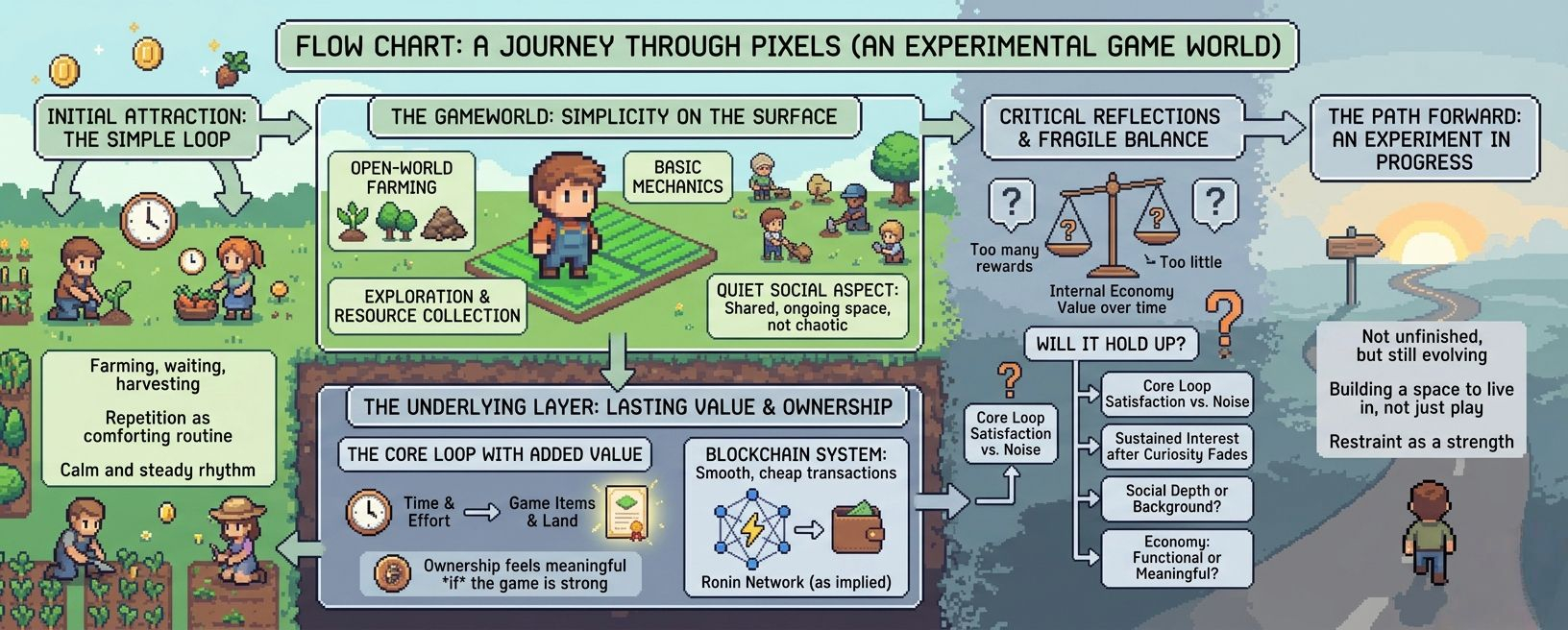
On the surface, Pixels feels familiar in a good way. It’s a farming and exploration game where you plant crops, collect resources, and slowly build your space. Nothing about that is new—and that’s exactly why it works. Instead of trying to completely change how games are played, it leans into what people already understand. The difference is what’s happening underneath: ownership, tradable items, and a wider economy connected to the game.
When I think about what Pixels is really trying to do, it doesn’t feel like it’s shouting, “This is a blockchain game.” It feels more like it’s quietly blending those elements into a normal gameplay loop. The farming, crafting, and exploring aren’t just there for fun—they’re also how players get used to the idea of owning things that exist beyond the game itself. Your land, your items, your progress—they’re not just stuck inside one world anymore.
But that brings up a question I can’t ignore: does ownership actually make the game better, or does it slowly turn everything into a system to optimize? There’s a difference between playing for enjoyment and playing for value. Pixels seems to understand that risk. It doesn’t throw complexity at you right away. Everything feels simple, almost gentle, like it’s trying to ease players into the idea instead of forcing it.
Still, I wonder how long that balance can hold. A farming game lives on its loop—plant, wait, harvest, repeat. That loop needs to feel satisfying on its own. If players are only sticking around because of tokens or tradable items, then something important is missing. But if the game is enjoyable even without thinking about the economy, then the Web3 part starts to fade into the background in a good way—it just becomes part of the system, not the focus.
Then there’s the social side. An open world means shared space, more players, more interaction. That can make the game feel alive, but it also makes the economy harder to manage. If too many players are trying to take value out without enough ways to spend or use it, things can fall apart quickly. Systems like this need careful balance, and even then, player behavior can be unpredictable.
What I do respect about Pixels is that it doesn’t try too hard to impress. It’s not trying to revolutionize gaming overnight. Instead, it’s focused on something smaller but more realistic—making Web3 feel normal inside a type of game people already enjoy. That’s actually harder than it sounds.
At the same time, I’m not fully convinced about its long-term pull. Casual games usually rely on simple habits—something that brings you back every day. In a Web3 setting, those habits can change. People might return more often, but for different reasons. Whether that makes the experience deeper or just more transactional is still unclear.
So for me, Pixels doesn’t feel like a big breakthrough, but it doesn’t feel like a failure either. It feels like a thoughtful experiment—one that’s trying to solve a real problem without overcomplicating things. And honestly, that makes it worth paying attention to. Not because it promises something huge, but because it’s quietly testing whether Web3 can fit into gaming without forcing everything else to change.
Pixels might not change gaming overnight, but it could slowly rewrite the rules while no one is paying attention.
