When most people first enter @Pixels it feels simple. You farm, craft, explore, complete tasks. The loop is familiar, almost relaxing. No pressure, no complexity, just steady progression.
But that surface-level simplicity doesn’t last.
The longer you stay inside the Pixels ecosystem, the more you start to notice that this isn’t just a game loop. It’s a system that is slowly guiding player behavior, controlling how value flows, and shaping how progression actually works.
And that shift is what makes $PIXEL interesting right now.
From Activity to Structured Progression
In traditional Web3 games, activity is everything. The more you grind, the more you earn. That model worked early on, but it also created one major problem: inflation.
Rewards get farmed, tokens get dumped, and the entire system loses balance.
Pixels is clearly moving away from that.
Instead of rewarding everything equally, the game is starting to filter progression. Not every action pushes you forward in a meaningful way. A lot of basic activity runs on off-chain Coins, which keep the system active but don’t directly translate into long-term value.
Real progression increasingly points back to $PIXEL.
That’s a deliberate design choice.
It separates “playing” from “advancing.
Pixel Is Becoming a Gate, Not Just a Reward
Earlier, pixel felt like something you could farm and exit. Now it feels more like something you need to hold and use.
Whether it’s unlocking higher-tier industries, upgrading production, or accessing better opportunities, pixel is becoming central to how far you can go.
This changes player psychology completely.
Instead of thinking: “How fast can I earn and sell?”
Players start thinking: “Where should I allocate my pixel for better returns inside the system?”
That’s a big shift.
Because once a token becomes tied to access and decision-making, it naturally reduces short-term selling pressure and encourages longer-term positioning.
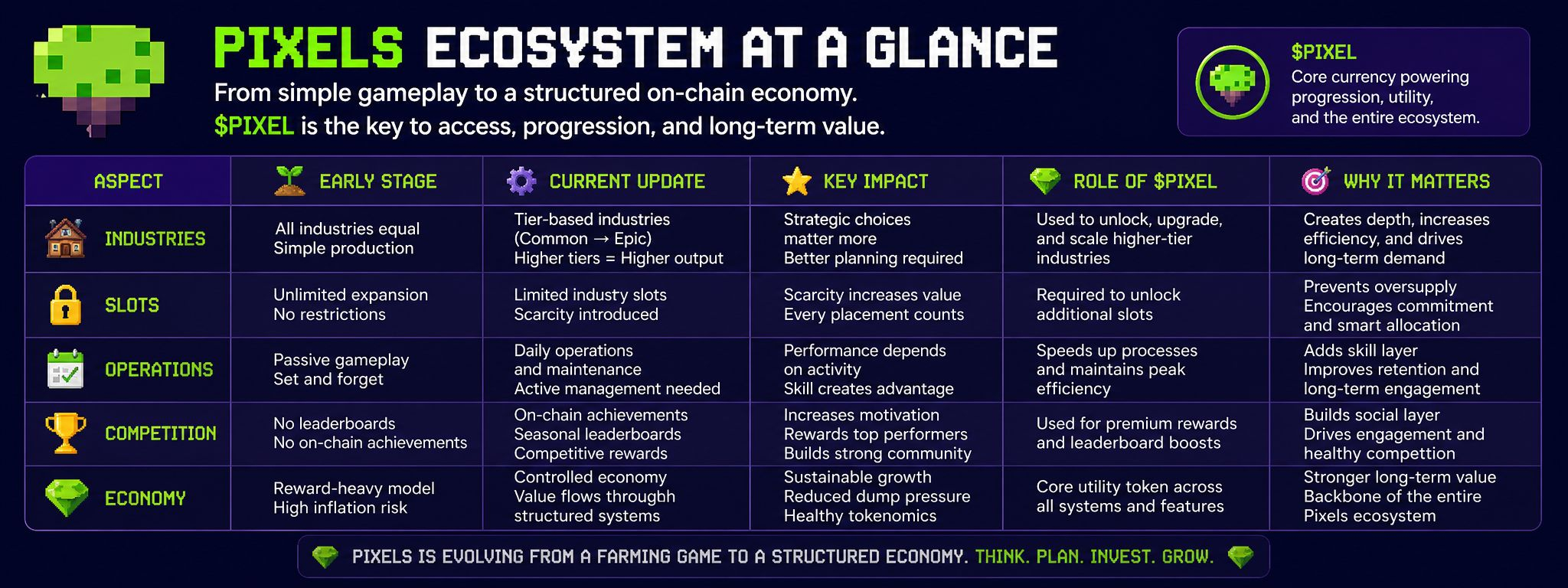
Tier-Based Industries Are Changing the Game
One of the most important updates is the introduction of tier-based industries.
Industries are no longer equal. They are structured across different levels, each offering different efficiency, output, and value potential.
This creates a hierarchy.
And with hierarchy comes strategy.
You now have to decide:
Which industry to build
When to upgrade
Where to allocate resources
How to optimize output over time
It’s no longer about doing everything. It’s about choosing the right path.
That’s where the system starts to feel less like a game and more like an economy.
Scarcity Through Limited Slots
Another key change is the introduction of limited industry slots.
Not every player can scale infinitely.
That alone changes everything.
Scarcity forces decisions. It introduces trade-offs. It makes every placement matter.
And more importantly, it increases the importance of $PIXEL.
Because in many cases, expanding your capacity or unlocking additional slots requires investment.
This ties growth directly to commitment.
The players who think long-term gain more control over production and positioning.
Daily Operations Are No Longer Passive
A lot of early GameFi models allowed players to set up once and collect rewards passively.
Pixels is moving away from that.
With daily operations and maintenance becoming part of the system, players are now required to stay engaged.
Efficiency is no longer automatic.
It depends on how actively you manage your setup.
This creates a skill layer inside the economy.
Two players with the same assets can now generate different outcomes based on how they operate.
That’s a sign of a maturing system.
Achievements, Competition, and Social Layer
Pixels is also expanding beyond pure resource loops.
On-chain achievements, seasonal leaderboards, and competitive rewards are being introduced to create a stronger social and competitive layer.
This does two things:
1. It adds meaning to progression beyond just earning
2. It keeps players engaged over longer periods
And again, pixel plays a role here.
From premium rewards to leaderboard boosts, the token is becoming integrated into multiple layers of the ecosystem.
Not isolated. Connected.
The Role of Stacked and System Intelligence
One of the most underrated aspects of pixels is how the system itself is evolving behind the scenes.
With the introduction of Stacked, the game is moving toward a more intelligent reward and progression model.
Instead of fixed outputs, rewards can be influenced by behavior, timing, and participation.
This creates a dynamic economy.
Not everything is predictable. Not everything is farmable in a linear way.
That reduces exploitation and improves sustainability.
Because the system isn’t just reacting. It’s adapting.
Controlling Inflation Without Killing Growth
The biggest challenge in Web3 gaming has always been balancing growth with sustainability.
Too many rewards lead to inflation. Too few rewards kill engagement.
Pixels is trying to find a middle ground.
Instead of removing rewards, it controls how and when they convert into meaningful progress.
A lot of activity stays in low-impact loops.
High-impact progression requires intention, planning, and often $PIXEL.
This slows down value extraction while still keeping the system active.
And that balance is rare.
From Farming Game to Economic Layer
At this point, it’s becoming clear that Pixels is not trying to be just another play-to-earn game.
It’s evolving into something closer to a structured economic environment.
Where:
Resources move through controlled channels
Progression is gated and intentional
Tokens have utility beyond rewards
Player decisions directly impact outcomes
And most importantly: Not everyone progresses the same way.
That’s what makes it interesting.
Why This Matters for $PIXEL
All of these changes point toward one thing.
Pixel is no longer just part of the system.
It’s becoming the backbone of it.
As utility expands across industries, upgrades, access, and competition, demand becomes more organic.
Not driven by hype, but by function.
And when a token is tied to real usage inside a controlled economy, its role becomes much stronger.
Final Thoughts
It’s still early.
Pixels is still evolving.
But the direction is clear.
Instead of chasing short-term growth through aggressive rewards, pixels is building a system that encourages sustainability, strategy, and long-term engagement.
That approach might not create instant hype.
But it builds something far more valuable over time.
A system where players don’t just participate.
They think, plan, and invest.
And that’s where things start to get interesting for $PIXEL