
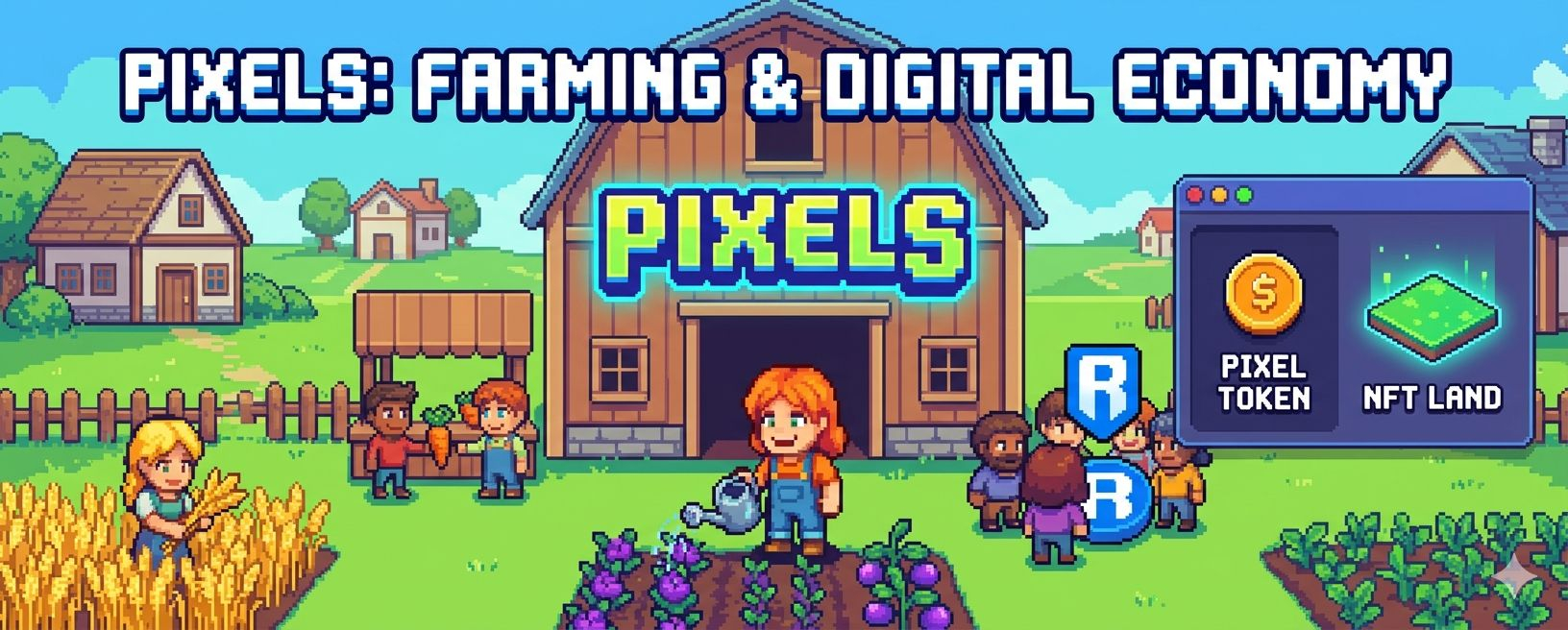

A farming game should not feel like the future of digital economies, but Pixels somehow makes that idea feel realistic. At first, it looks simple. A colorful pixel-art world. Crops to grow. Land to manage. Quests to complete. Players moving around, trading, exploring, and building their own rhythm inside the game. But once you look closer, Pixels is doing something more serious than casual farming. It is showing how Web3 gaming can move away from empty hype and become a real economy built around play, ownership, and community.
Pixels is a social casual Web3 game powered by the Ronin Network. Its world revolves around farming, exploration, creation, and player interaction. The game uses the PIXEL token as part of its economy, giving players a way to participate in activities that go beyond normal in-game progress. But the important thing is not just the token. Many crypto games have tokens. What matters is how Pixels uses blockchain without making the whole experience feel heavy or confusing.
That is where the project becomes interesting. A lot of Web3 games make the mistake of leading with money first and gameplay second. They attract users with rewards, token speculation, and promises of earning, but the actual game often feels weak. When the rewards slow down, the attention disappears. Pixels takes a more natural approach. It gives players a familiar game loop first: plant, harvest, craft, explore, socialize, and improve. The Web3 layer sits underneath that experience instead of constantly shouting for attention.
This matters because real players do not stay only for token charts. They stay because the game gives them a reason to return. They want progress. They want community. They want small daily goals that feel satisfying. Pixels understands this better than many projects in the space. Farming games already work because they create routine. You log in, check your land, collect resources, prepare the next task, maybe trade with others, maybe decorate or explore. It is simple, but it creates attachment. When digital ownership is added to that kind of loop, it can feel less like a gimmick and more like a natural extension of the game.
Ronin Network also plays a big role here. Ronin was built with blockchain gaming in mind, so Pixels fits better there than it would on a general-purpose network. The game’s move to Ronin helped connect it with a gaming-focused ecosystem, where users are already more familiar with digital assets, wallets, and on-chain activity. That does not solve every problem, but it does reduce friction. For a Web3 game, the network behind it matters because slow transactions, high costs, or poor user experience can kill momentum quickly.
The economy inside Pixels is where the bigger idea starts to appear. In traditional games, players spend months or even years collecting items, building progress, and improving their accounts, but that value usually stays locked inside the game. The company controls everything. If the game shuts down, changes its rules, or limits access, the player has very little control. Pixels challenges that old model by giving some in-game progress and digital assets a connection to broader ownership.
That does not mean everything in the game should become valuable. It should not. A healthy game economy needs balance. If every action is treated like an investment, the game becomes stressful and artificial. But if ownership is used carefully, it can make player effort feel more meaningful. Land, resources, items, and marketplace activity can become part of a living economy where players are not just consuming content, but helping shape the world around them.
A simple example is land. In a normal farming game, land is just a feature. You use it because the game allows you to. In Pixels, land and related activity can carry deeper importance because they connect to digital ownership and player-driven value. Players can farm, produce, interact, and participate in a system where scarcity, demand, and community behavior all matter. This is where Web3 gaming becomes more than a buzzword. It starts to create a world where time and effort have visible weight.
Still, Pixels has to be careful. Web3 gaming has a reputation problem, and honestly, that reputation did not come from nowhere. Many projects promised too much, focused too heavily on earning, and failed to build enjoyable games. Some attracted bots instead of real communities. Others became dependent on token price movement instead of player loyalty. Pixels must avoid that trap. If the game becomes too financial, casual players may lose interest. If the rewards feel meaningless, Web3 users may also drift away. The balance is difficult.
Another challenge is accessibility. Even when a blockchain game is designed well, wallets, tokens, NFTs, marketplaces, and transaction steps can still confuse ordinary players. Many gamers do not want to think about infrastructure. They just want the game to work. This is why Pixels’ best chance is to keep the experience simple on the surface. Let players enjoy the farming, the world, the social side, and the progression first. Then let them discover the ownership layer when it actually becomes useful.
The future of Pixels depends on whether it can keep growing without losing the relaxed feeling that makes it approachable. Bigger economies can bring more opportunity, but they can also bring pressure. More users can improve liquidity and community activity, but they can also attract speculation. More features can make the game richer, but too much complexity can make it feel crowded. Pixels needs to expand carefully. The charm of the game is its simplicity, and that should not be sacrificed just to look more advanced.
What makes Pixels worth watching is that it does not try to look revolutionary every second. It feels familiar first. That is a strength. A player plants crops, completes quests, talks with others, manages resources, and slowly begins to understand how digital ownership fits into the experience. No long lecture is needed. The game explains itself through action.
That may be the real lesson here. Web3 gaming will not win by forcing every player to care about blockchain from the beginning. It will win when blockchain improves something players already enjoy. Pixels is trying to do exactly that. It takes farming, exploration, and social play, then connects them to an economy where ownership has practical meaning.
Pixels is not perfect, and no Web3 game is safe from economic pressure, user speculation, or market cycles. But it has one thing many projects lack: a simple core experience that people can understand. If Ronin continues to support smooth gaming infrastructure and Pixels keeps protecting the balance between fun and finance, the project could become one of the stronger examples of how Web3 games should be built. Not as token machines. Not as empty promises. But as living digital worlds where play, ownership, and community actually work together.
