
I didn’t expect to spend this much time thinking about Pixels.
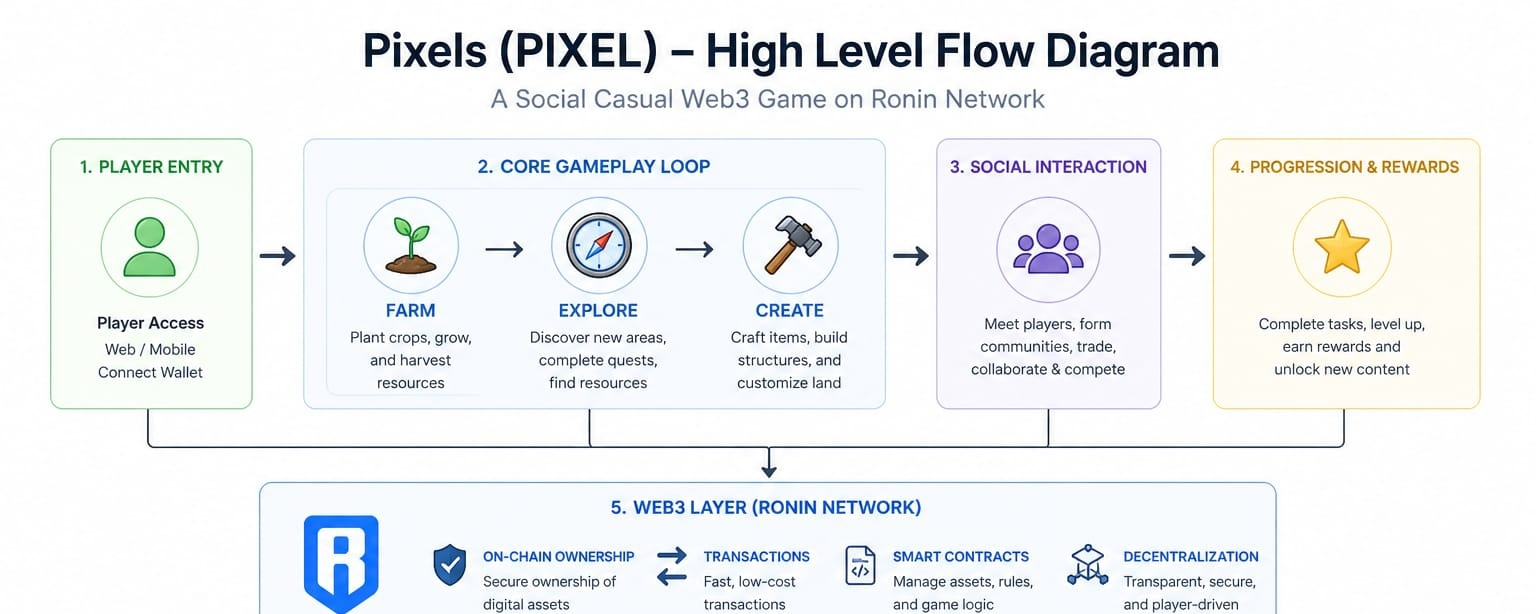
At first glance, it looks simple. Maybe even a little too simple. A farming game, some exploration, a social layer, and somewhere underneath it all, blockchain. I’ve seen that combination before, and honestly, it usually doesn’t hold my attention for long. But something about Pixels made me pause—not because it was impressive in a loud way, but because it wasn’t trying to be.
That difference stayed with me.
Most Web3 projects I’ve come across feel like they’re in a hurry to explain themselves. They want you to understand the system, the tokens, the structure—almost as if that understanding is the main experience. But Pixels doesn’t push you in that direction. It feels quieter. You can enter the world, start doing small things, and just exist there for a while without being reminded of the bigger system behind it.
And that changes how it feels.
You plant crops, you gather resources, you move around, you slowly build something. None of it is complicated, and maybe that’s the point. It doesn’t try to overwhelm you with features or force you to think too far ahead. It lets you settle into a rhythm. And I think that rhythm is doing more work than it seems.
Because underneath it, there is still a Web3 structure. Ownership exists. Progression connects to something more persistent. But the game doesn’t keep pointing at it. It doesn’t say, “look, this is the important part.” It just lets it sit there quietly, like something you’ll notice when you’re ready.
I find that approach… a bit more honest.
It feels like Pixels understands something that a lot of projects miss: people don’t build attachment through explanations. They build it through time. Through small, repeated interactions that slowly start to matter. If you enjoy being somewhere, you’ll eventually care about what you own there. But if you’re asked to care too early, it just feels forced.
So maybe what Pixels is really doing isn’t about farming or even social gameplay. Maybe it’s trying to make digital ownership feel normal. Not like a feature you have to learn, but like something that naturally fits into the experience.
That idea feels small when you say it out loud, but I don’t think it is.
Because outside of games, most digital spaces still don’t give you much to hold onto. You spend time, you build something, but it always feels a bit temporary—like it belongs to the platform more than it belongs to you. Web3 is supposed to change that, but often in ways that feel complicated or distant. Pixels doesn’t try to solve that directly. It just… softens the entry point.
Still, I don’t think it’s something to look at without questions.
A calm and simple experience is easy to get into, but it’s harder to make it last. What happens after the first few days? Or weeks? Does the world grow with the player, or does it start to feel repetitive? And if ownership is part of the system, what actually gives it meaning over time? These aren’t small questions, and Pixels doesn’t fully answer them yet.
So I can’t say it’s a solution.
But I also don’t think it’s trying to be one. It feels more like a shift in direction. Less noise, less pressure, less need to prove itself. Just a world that lets you come in, spend some time, and figure out your own reason to stay.
And maybe that’s why I keep thinking about it.
Not because it’s doing something dramatically new, but because it’s doing something slightly different in a space that rarely slows down enough to question itself.