
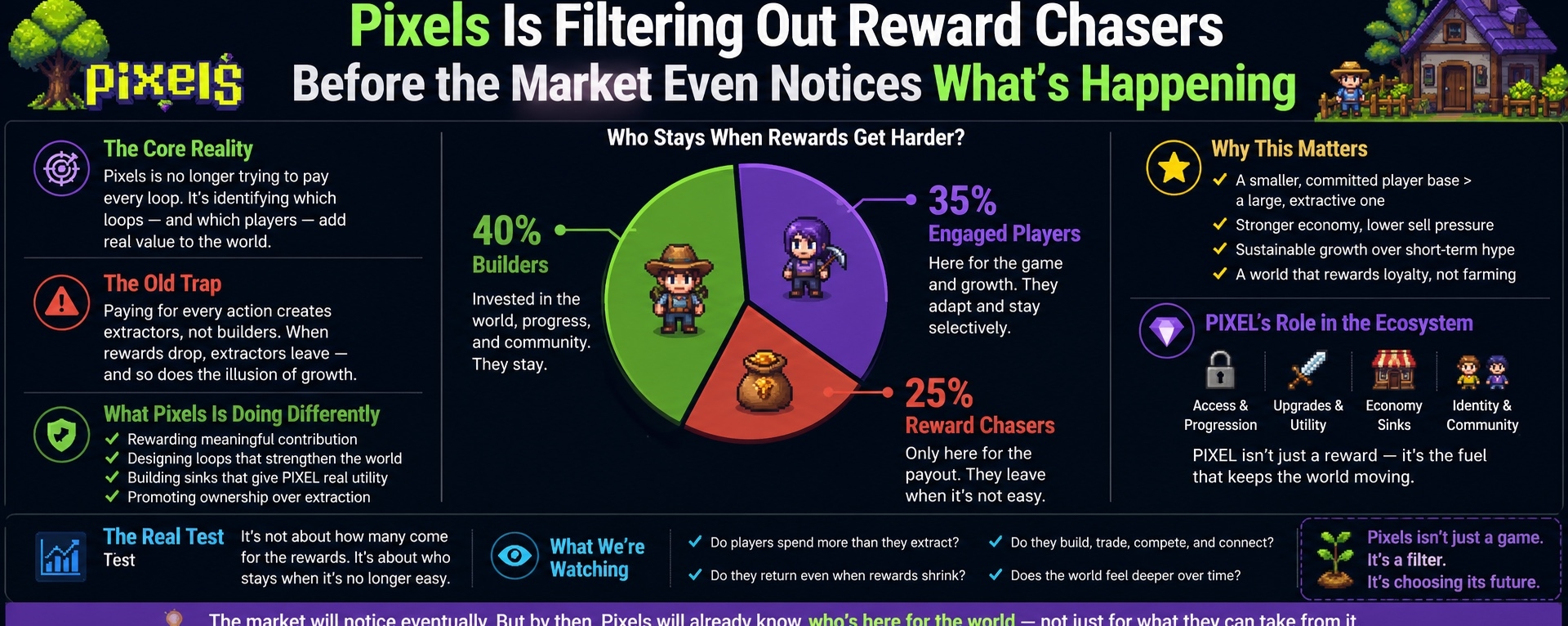

Pixels is not trying to entertain everyone anymore. At least that is how it looks to me.
It looks like a project slowly finding out who was actually playing and who was just passing through with a basket in one hand and an exit plan in the other. I have seen this pattern too many times in crypto gaming. The world looks alive when rewards are easy. People log in. People farm. People talk like they believe. Then the payout slows down and suddenly the community gets quiet in a very specific way. Not dead quiet. Worse than that. Transactional quiet.
That is the part worth watching with Pixels.
From the outside, it still looks soft. Crops, land, pets, items, small routines, little daily actions. Nothing about it screams pressure. But crypto has never cared about how gentle something looks. Put a token under it, attach rewards to behavior, and even the calmest game becomes a market experiment. People stop moving like players. They start moving like calculators.
I do not say that as an insult. It is just what this market does to people.
Pixels is now dealing with the old play-to-earn sickness, just in a more mature and exhausted cycle. The old version was simple. Pay people to show up. Watch the numbers rise. Call it adoption. Then act surprised when those same people sell everything they earn and disappear the moment another project offers a better loop. That story has been recycled so many times that even writing it feels tired.
But here’s the thing. Pixels does not seem to be chasing the old fantasy of paying every action forever. That matters. It may frustrate people, but it matters.
A game cannot pay every loop forever without turning itself into a leak.
Some loops are useful. Some loops are just noise. Some loops only exist because there is a reward attached to them. Remove the reward and the behavior vanishes. That is not community. That is rented movement.
I am less interested in how many people show up when the system is generous. That part is easy. I am looking for the moment this actually breaks, or does not break, when the easy part is gone. That is where projects tell the truth about themselves.
Pixels has to find out whether its players care about the world or only about the output. There is a big difference. A real player cares about progress, items, land, identity, upgrades, social position, maybe even the strange little pride of having a place inside the game. A pure farmer cares about efficiency. Time in. Reward out. If the math gets worse, the emotional bond disappears because there was no bond in the first place.
Most crypto games never survive that separation.
They confuse activity with loyalty. They confuse wallets with users. They confuse grind with culture. The dashboard looks busy, so everyone pretends the economy is healthy. Then the reward pressure starts showing up. The token weakens. The farming crowd complains. The team adjusts emissions. People call it failure. Maybe sometimes it is. Sometimes it is just the first honest moment the project has had.
Pixels feels like it is somewhere near that honest moment.
Not cleanly. Not perfectly. Nothing in crypto gaming is clean. But the direction matters. If the project keeps rewarding every repetitive action equally, it risks training players to extract without attachment. If it becomes too strict, it risks draining the energy that made people show up in the first place. That is the ugly balance. Too much reward and the economy rots. Too little reward and the crowd leaves before the deeper game has time to matter.
There is no elegant answer.
This is why I do not like the simple takes around projects like Pixels. People want to say bullish or bearish, alive or dead, strong or weak. It is easier that way. But the real situation is messier. Pixels is trying to turn attention into behavior, and behavior into attachment, and attachment into an economy that does not collapse every time rewards become less exciting.
That is a hard road.
And honestly, most projects do not make it.
I have watched enough gaming tokens run the same cycle. First comes the dream. Then the farming. Then the screenshots. Then the calculators. Then the complaints about emissions. Then the team starts talking about sustainability. By then, half the users are already mentally gone. They are still around, maybe, but only because they are waiting for one more exit window.
Pixels has to avoid becoming that.
The project needs rewards, but rewards cannot be the soul of the game. Once rewards become the soul, everything else becomes decoration. The land becomes a workplace. The tasks become shifts. The token becomes wages. The player becomes an employee with no contract and no loyalty.
That is the danger.
A game world has to make people want to stay even when the reward is not screaming at them. Not forever. Not blindly. But enough that the experience has weight beyond the payout. Pixels has to make the token feel like something that belongs inside the world, not just something pulled out of it. That is easy to write and painfully hard to build.
Spending has to feel natural. Progress has to feel worth it. Scarcity has to feel earned, not forced. The grind has to feel like part of the game, not like unpaid labor after the rewards got cut.
That last part is where many projects lose people.
Players can accept friction when it creates meaning. They hate friction when it feels like the system is just making extraction harder while offering nothing deeper in return. Pixels has to be careful there. Very careful. Because a community can handle slower rewards if the world feels richer. It cannot handle slower rewards and emptier play at the same time.
That is where I keep looking.
Not at the loudest announcements. Not at every small price move. Not at people forcing excitement into posts because they need the market to care again. I am looking at whether the game gives users a reason to return when there is less to farm. I am looking at whether players spend because they want to improve their place in the world, or whether every decision still ends with the same tired question: what can I pull out?
That question ruins games when it becomes the only question.
Pixels is not fighting only for attention. It is fighting against the habits crypto already trained into its own users. That is a brutal thing to fight. The market taught people to chase yield, farm campaigns, rotate fast, take profits early, trust nothing, and leave before the next crowd leaves. Then projects act wounded when users behave exactly that way.
Pixels inherited that audience.
So now the project has to do something harder than attract people. It has to retrain them. Slowly. Through design. Through reward discipline. Through systems that make certain behavior matter and make empty repetition less valuable.
Some people will hate that.
They will call it less rewarding. They will say the game is not what it used to be. Maybe they will be right from their point of view. If someone arrived only for the loop, and the loop pays less, then the project did get worse for them. But that does not automatically mean the project got weaker. It might mean the project is choosing who it can afford to keep.
That sounds harsh, but economies are harsh.
Every crypto game eventually has to decide whether it wants more users or better users. The market usually wants both. It wants mass activity and low sell pressure. It wants endless rewards and a strong token. It wants everyone earning while somehow nobody dumps. It is nonsense, but people still want it because the alternative requires patience and patience feels stupid in crypto until suddenly it is the only thing that mattered.
Pixels is sitting inside that contradiction.
The project has to keep enough reward to make participation feel alive, but not so much that the token becomes a daily exit door. It has to make the world engaging without pretending that fun alone solves everything. It has to attract players who care about the game and investors who care about the economy, while knowing those two groups do not always want the same thing.
That tension will not go away.
Maybe Pixels handles it. Maybe it does not. I am not here to dress it up. The risk is real. A soft-looking game can still carry a hard economic problem. If rewards lose meaning, people leave. If rewards stay too loose, value leaks. If the world does not deepen, the grind starts to feel hollow. If the token has no strong reason to be used inside the experience, it remains something people earn and sell.
That is the part I would not ignore.
The project needs players to feel that value moves both ways. Not just from the game to the user. From the user back into the world. Time, attention, spending, identity, social energy, competition, status. All of it. Without that, Pixels becomes another familiar machine with prettier colors.
And we have seen enough machines.
What makes Pixels worth paying attention to is not that it has solved the problem. It has not proven that yet. What makes it worth watching is that the project seems to be standing in front of the right problem. It is not enough to ask how many people can be pulled in with rewards. The better question is how many people remain when rewards stop doing all the emotional work.
That is where the real base appears.
Not during hype.
Not during easy earning.
Not when everyone is loud.
The real base is the group that stays when the system becomes less generous and more demanding. Maybe smaller. Maybe quieter. But possibly more useful. Crypto hates quiet until it realizes that noise was never the same as strength.
Pixels is trying to find that quieter strength.
It may lose people while doing it. It probably has to. The users who only wanted easy extraction were always temporary anyway. The problem is that temporary users can make a project look healthier than it is. They create motion. They fill charts. They give the illusion of scale. Then they leave behind the question everyone avoided.
Was there a real game underneath the rewards?
That is the question Pixels has to answer now. Not with branding. Not with polished updates. Not with another round of market noise. With behavior. With retention that survives friction. With players who care after the easy loop fades. With an economy that does not have to bribe every hand movement just to stay alive.