
I keep coming back to Pixels, almost absentmindedly at first, like revisiting something simple. But the longer I spend with it, the harder it becomes to see it as just a game. There’s a quiet structure underneath it that doesn’t announce itself, something that only becomes visible when you stop playing for rewards and start paying attention to how the system holds everything together.
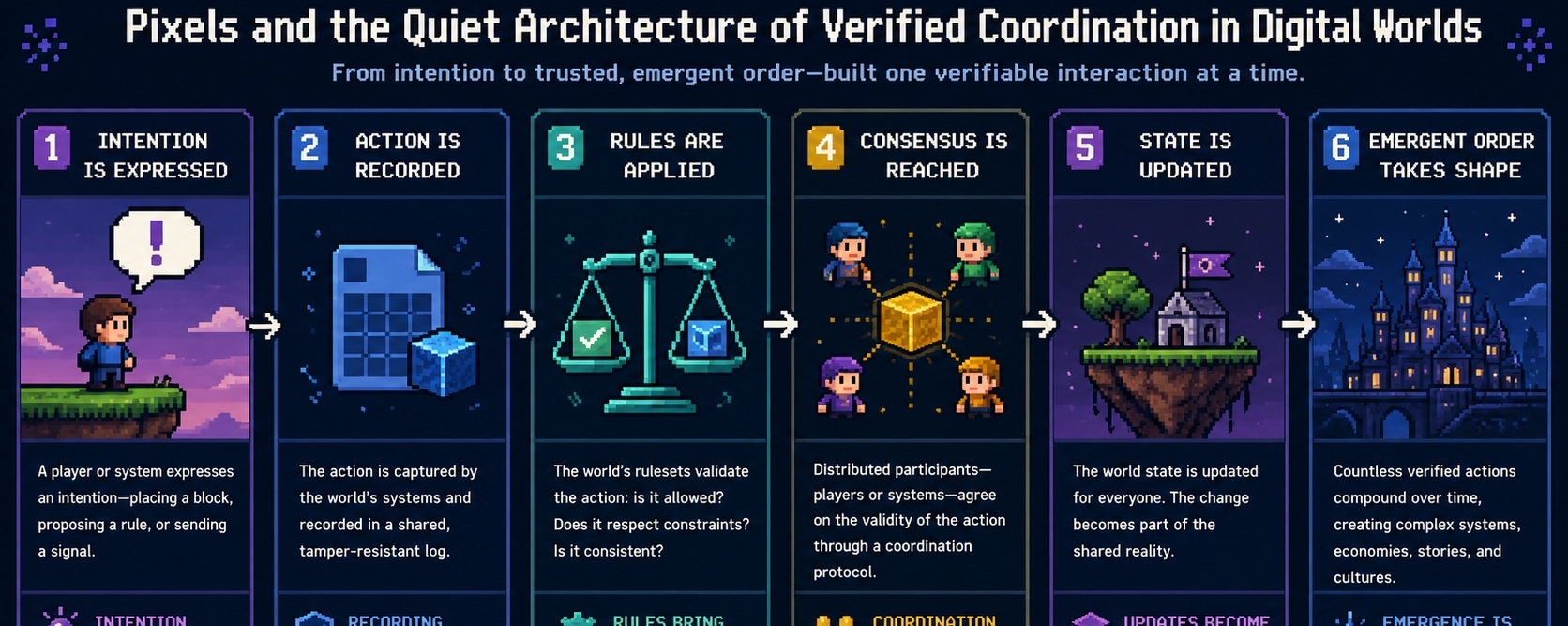
At the surface, it’s calm and familiar—planting crops, wandering around, collecting resources. But what feels different is not what you do, it’s what happens to those actions after you do them. They don’t vanish. They stay. They settle into the system as if they matter beyond the moment. That persistence creates a strange shift in perception. You’re not just passing time—you’re leaving behind a trail that the system continues to recognize.
As I kept observing, I started noticing how much of this depends on the underlying structure of the Ronin Network. It doesn’t try to impress with complexity. Instead, it quietly supports a constant flow of small, repeatable actions. And that’s where something subtle happens. In most environments, tiny actions are too insignificant to track or verify individually. Here, they’re not ignored—they’re absorbed into a shared record. The system doesn’t just process activity; it remembers it in a way that feels neutral and consistent.
That consistency changes behavior in ways that aren’t immediately obvious. When you know that what you do will be recorded exactly as it happened, without interpretation or bias, your relationship with the system becomes more grounded. You stop relying on whether something “feels fair” and start relying on the fact that it simply is. It’s a quiet replacement of trust with something more mechanical—verification.
What I find interesting is how this affects coordination between people. There’s no central figure organizing interactions, no authority stepping in to correct or interpret outcomes. Instead, everyone operates within the same shared structure, one that doesn’t shift depending on who you are. That shared structure becomes the meeting point. It’s less about agreement and more about alignment—everyone is responding to the same underlying reality.
Over time, this begins to resemble something larger than a game. It starts to feel like a small institution, but without offices, without managers, without the visible scaffolding we usually associate with organized systems. The rules are embedded directly into the environment, and the environment itself enforces them. It’s not controlling behavior in an obvious way—it’s shaping it by making certain outcomes reliable and others impossible.
I’ve also been thinking about what happens when systems like this extend beyond human interaction. There’s nothing in its design that requires a human presence. An automated agent, a simple AI, or even a network of bots could participate in exactly the same way. They would follow the same rules, interact with the same persistent state, and rely on the same verification mechanisms. In that sense, the system doesn’t just coordinate people—it creates a neutral ground where different kinds of actors could coexist.
That idea keeps pulling my attention back. Because once machines begin interacting in these environments, coordination becomes less about communication and more about shared structure. The system itself becomes the language. Instead of negotiating trust, participants—human or machine—simply act within a framework where outcomes are already defined and verifiable.
There’s also something almost philosophical about how simplicity plays into all of this. Farming, collecting, crafting—these are repetitive, almost meditative actions. Yet they’re precisely the kind of actions that scale well in a system like this. When repeated consistently and recorded reliably, they form patterns. And those patterns, over time, become a kind of collective behavior that no single participant controls.
The more I sit with it, the more I feel like Pixels is less about entertainment and more about observation. It’s a place where you can quietly watch how a system organizes activity without constant intervention. It doesn’t demand attention—it rewards patience. And through that patience, it reveals something about how coordination might evolve when it’s built on verification rather than assumption.
I wouldn’t describe it as revolutionary in an obvious sense. It doesn’t try to overwhelm you with complexity or ambition. Instead, it does something more subtle. It shows how a system can remain simple on the surface while quietly reshaping the relationship between action, ownership, and shared reality underneath.
And maybe that’s what keeps me looking at it. Not because of what it claims to be, but because of what it quietly demonstrates—how small, consistent actions, when anchored in a system that remembers and verifies, can begin to form a new kind of order.