
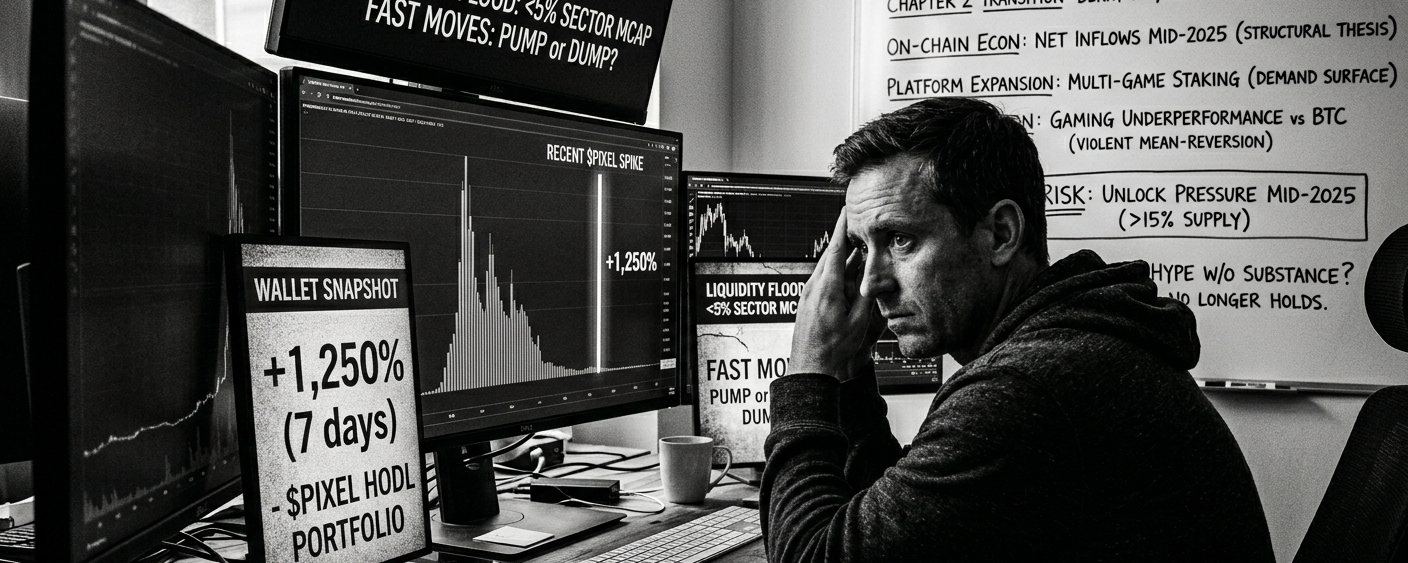
I think... there's a version of this conversation that starts with price targets and percentage gains. I'm not interested in that version. What i want to talk about is the structural reason why a token sitting at a $6 million market cap can do something to a portfolio that bitcoin simply cannot — and why that mathematics is both the opportunity and the risk at the same time.
So lets start with the size of the problem... When bitcoin needs to add $100 billion in market cap to move 10%, that requires an enormous amount of new capital entering the asset. Institutional flows, etf inflows, macro tailwinds, all of it working in the same direction. Bitcoin moves when the world moves. Pixel moves when a few hundred serious buyers decide the risk-reward has shifted. Those are fundamentally different dynamics, and they produce fundamentally different outcomes for people holding positions.
I think this is what low-cap tokens actually offer: Asymmetric exposure to conviction.
A $6 million market cap means the token is essentially invisible to any fund with meaningful aum. InstitUtions can't build positions without moving the market against themselves. That creates a window — sometimes narrow, sometimes wide — where retail participants and smaller funds can accumulate before the asset gets discovered by larger capital. When that discovery happens, the move is not gradual. liquidity is thin, supply on exchanges is limited, and even modest demand produces outsized price action. Pixel demOnstrated this earlier in 2026 when it posted a 192% move in a single day on $388 million in volume. The market cap at the time was a fraction of that volume figure. That ratio tells you everything about what low-cap volatility actually looks like in practice.
But the same mechanism that produces 192% up days produces 60% down weeks. The illiquidity that works in your favor during accumulation works against you during distribution. A single large seller in a thin market can erase weeks of price progress in hours. This is not a design flaw — it's the nature of the asset class. The question isn't whether the volatility exists. It's whether you understand it well enough to position around it.
A big question? what makes pixel a useful case study is that it isn't purely speculative. There's an underlying game with real users, an in-game economy with measurable on-chain flows, and a structural transition underway from a dual-currency model to a single token. The chapter 2 update, the shift away from the inflationary berry system, the multi-game staking expansion — these are fundamEntal changes with the potential to alter the token's demand profile. That combination of genuine utility and low market cap is exactly the setup that produces the kind of moves that reshape portfolios. It's not just a number going up. It's a thesis getting validated by on-chain data, and late capital rushing in to catch what early capital already captured.
I believe the portfolio math is simple even if the execution isn't. A 1% allocation to an asset that triples is a 2% gain on your overall portfolio. Unremarkable. But a 5% allocation to an asset that does what pixel is structurally capable of doing — even a 3x or 4x move from current levels, well below its all-time high — changes the character of what you're holding in a way that no large-cap position can replicate. The upside is disproportionate to the allocation size. That's the trade.
I think... what separates the people who benefit from this dynamic from the people who get hurt by it is usually one thing: position sizing relative to conviction quality. the mistake isn't buying low-cap tokens. The mistake is buying them at sizes that force panic selling when the inevitable 40% correction arrives before the real move happens. Low-cap investing requires the kind of patience that most people claim to have and very few actually demonstrate when the price is down and there's nothing on the timeline to explain why.
I feel pixel is one example. There are others across every cycle. The pattern repeats because the structure never changes — small float, thin liquidity, legitimate utility underneath the noise, and a gap between where the market has priced the asset and where it should be if the thesis plays out. Finding those gaps before the market closes them is the work. It's uncomfortable and often lonely. The assets that can change portfolios fast are almost always the ones that look like bad ideas right before they don't.