
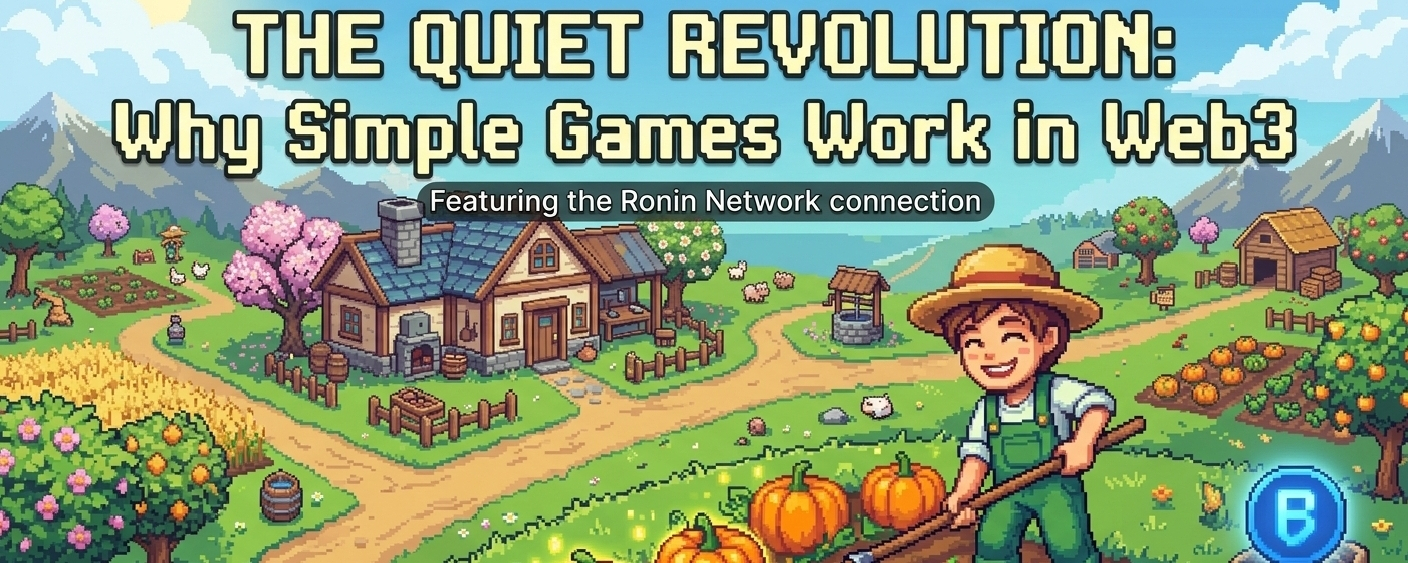
Why do people keep returning to simple games, even when they know there’s nothing particularly complex waiting for them? It’s an honest question. Most players are not looking for ownership models or token systems—they’re looking for something that feels easy to step into after a long day. This is where many Web3 games have struggled. They introduced big ideas about digital ownership, but often forgot to make the experience feel natural.
Before games like Pixels came along, the problem was already clear. Traditional online games gave players time, progress, and community—but not real control. Web3 tried to fix that by offering ownership through tokens and assets. On paper, it sounded like a major shift. In practice, it often felt disconnected. Players were suddenly expected to think about wallets, economies, and rewards before they had even decided if they liked the game.
Earlier projects leaned heavily on incentives. They told players, directly or indirectly, that their time could translate into value. And for a while, that worked. People joined, explored, and participated. But over time, it became clear that many of these experiences were driven more by rewards than by enjoyment. When the rewards slowed down or became unpredictable, interest faded just as quickly.
Pixels takes a quieter approach. Instead of trying to convince players with big promises, it starts with something familiar—a farming game. You plant crops, explore, interact with others, and slowly build your space. There is nothing revolutionary about these mechanics, and that seems intentional. The game does not rush to explain its blockchain elements. It lets players settle into the rhythm first.
Its connection with the also reflects this mindset. Rather than building everything from scratch, Pixels relies on an ecosystem that is already focused on gaming. This makes the experience smoother, especially for new users. Logging in, playing, and progressing feels closer to a normal game, even though blockchain features are still present in the background.
The way Pixels handles its economy is also worth noting. It separates everyday gameplay from its main token, $PIXEL. This means players can go about their routine—farming, crafting, exploring—without constantly thinking about value or rewards. It’s a small design decision, but it changes how the game feels. When everything is tied to a token, even simple actions can feel pressured. Pixels seems to be trying to avoid that.
Still, this approach is not without its challenges. Keeping a game economy stable is difficult, especially when players can earn and move value outside the game. Farming games naturally involve repetition, and when that repetition connects to rewards, it can create imbalance. Too many players doing the same thing can quietly weaken the system over time.
There is also the question of who this game is really for. Pixels works best for players who enjoy slow, steady progress—people who don’t mind routine tasks and gradual growth. For them, the addition of ownership may feel like a bonus. But for players looking for fast action or deep competition, the experience might feel limited.
Even with its simpler design, Web3 still brings a layer of complexity. Wallets, tokens, and external systems are easier to use than before, but they are not completely invisible. Some players will adapt quickly. Others may lose interest before they fully understand how everything works.
In many ways, Pixels feels like an attempt to make Web3 gaming less noticeable. It does not try to impress players with technology. Instead, it tries to make that technology fade into the background while the game itself takes the lead. Whether that balance can last is still uncertain.
Because in the end, one quiet question remains: if players enjoy the game but stop paying attention to ownership altogether, does that mean Web3 has succeeded—or does it mean it no longer really matters?