

Pixels didn’t arrive like some loud Web3 machine trying to sell everyone a dream.
It was quieter than that.
A small farming world. A few tasks. Some land. Some crafting. A daily grind that felt simple enough to understand without needing to open ten tabs and pretend you enjoyed reading game economy docs.
And maybe that was the point.
I’ve seen too many crypto games come in with massive promises, recycled words, fake depth, and token systems that fall apart the moment real users stop caring. Most of them don’t fail because the idea is bad. They fail because there is no reason to stay once the first wave of rewards dries up.
Pixels at least understood the first rule.
Give people a reason to come back.
Chapter 1 was not trying to be too clever. That helped. You farmed, gathered, crafted, upgraded, completed tasks, and slowly built your place inside the world. It was basic, but basic is not always bad. Sometimes basic is the only thing that survives when the market gets tired of noise.
The early version worked because it did not force the player to care about everything at once. You could just play. That sounds small, but in Web3 gaming, it is rare.
Most games want you to care about the token before you care about the game.
Pixels flipped that a little.
Not perfectly. Nothing is perfect here. But enough.
The farming layer was easy to understand. The social layer was light. The economy sat underneath it without completely choking the experience. That gave the project room to breathe.
But here’s the thing.
A farming loop alone gets old.
No matter how clean the design is, people eventually feel the repetition. Plant. Harvest. Craft. Repeat. Again. Again. Again. The grind can be relaxing for a while, but if there is no deeper reason behind it, players start treating the game like a checklist.
That is where Bountyfall matters.
Not because it magically fixes everything.
It doesn’t.
It matters because it changes the weight of the grind.
Before, a lot of the activity felt personal. Your land. Your progress. Your upgrades. Your rewards. Your little corner of the world.
Now Pixels is pushing players into something more social. Unions give people a side. Yieldstones give that side a resource to fight around. Hearths give the season a visible pressure point. Sabotage adds friction.
Friction is important.
Too much friction kills a game. But no friction makes everything feel dead.
Bountyfall adds just enough tension to make the daily actions feel less empty. A task is not only a task anymore. A resource is not only a resource. A deposit is not just another number moving up.
It becomes contribution.
That word gets abused in crypto, I know. Every project says the community contributes. Most of the time it means people posting banners, repeating slogans, and pretending engagement is culture.
Pixels is trying to make contribution happen inside the product.
That is different.
When a player collects Yieldstones and puts them toward a Union, the action has direction. It helps something. It belongs somewhere. The player is not only grinding for themselves. They are adding weight to a shared side.
That can create loyalty.
Or at least habit with a little more meaning.
And honestly, in this market, that already counts for something.
The Union system is the part I’m watching most closely. Not because factions are new. They are not. Games have used sides, teams, guilds, alliances, and seasonal competition forever. But in Web3, where users often behave more like extractors than players, giving people a reason to identify with a group can change the way the economy moves.
People defend what they feel attached to.
People return when they think their absence matters.
That is the bet.
Bountyfall is trying to turn lonely farming into group pressure.
I like that direction, but I’m not blindly impressed by it.
The system can still break in obvious ways. One Union could become too dominant. Rewards could feel too thin. Sabotage could become annoying instead of fun. Casual players could feel like they are just feeding a system they don’t fully understand. Landowners could end up with too much influence, or not enough. Both are problems.
This is where these games usually start showing cracks.
Not in the trailer.
Not in the announcement.
In the second, third, fourth cycle, when the first excitement fades and the same players have to decide whether the loop still feels worth touching.
That is the real test.
Pixels has always had a softer identity. That matters. The world does not feel hostile. It does not feel like a trading terminal wearing pixel art. It has routine. It has charm. It has that slow daily rhythm that can keep people around if the systems do not become too heavy.
But Bountyfall makes the world sharper.
Now there is competition. There is defense. There is timing. There is the quiet stress of watching another side move faster. That changes the mood.
Maybe that is needed.
Because Web3 gaming cannot live forever on cozy farming and reward farming at the same time. One of them has to become deeper. Otherwise, the whole thing turns into another loop of users farming until the numbers stop making sense.
I’ve watched that movie too many times.
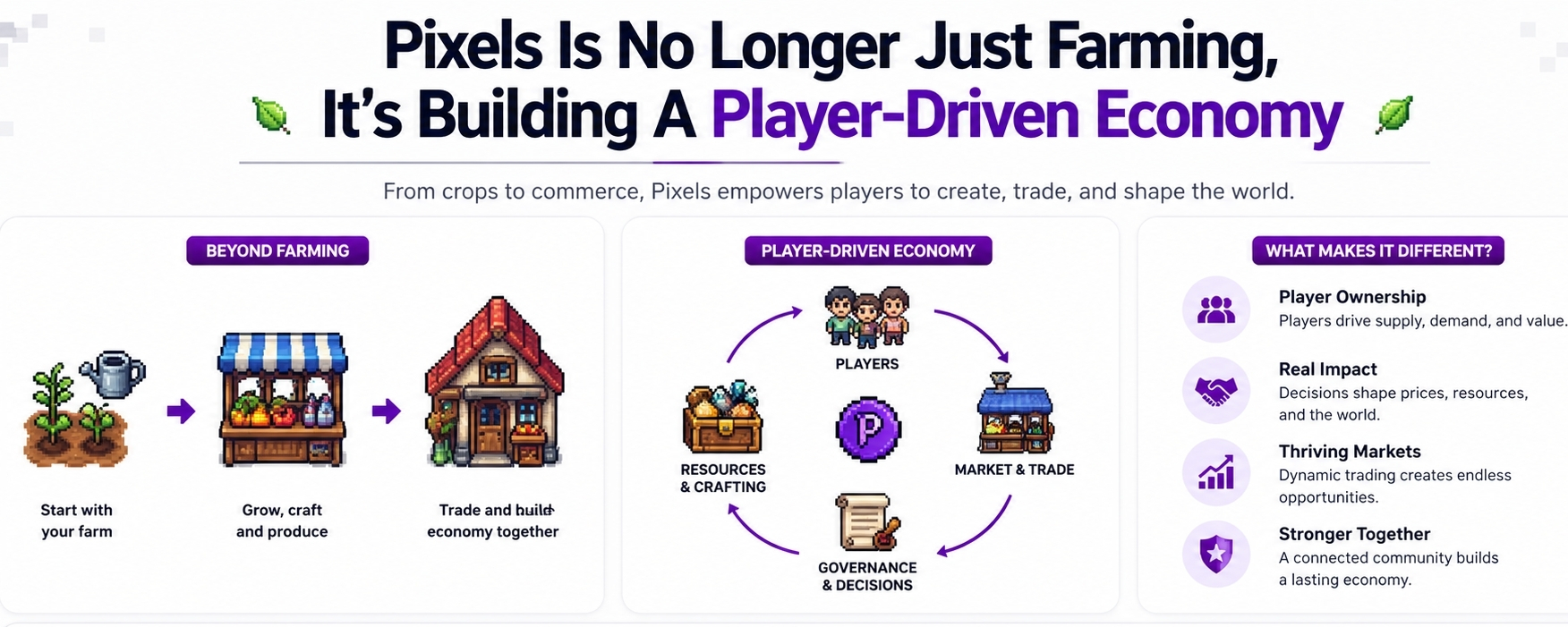
The interesting part is that Pixels is not throwing away its base. It is still using farming, crafting, land, tasks, and resources as the core. It is just pulling those actions into a wider social structure.
That is the right kind of expansion.
Not more noise.
More connection.
A player who just wants routine can still play. A more active player can push for Union progress. A landowner can care about deeper utility. A competitive player can look at the season and find a reason to grind harder.
That mix is difficult to maintain.
It always is.
The more layers a game adds, the easier it becomes to lose the simple feeling that made people enter in the first place. I don’t want Pixels to become another system where new players feel late before they even start.
That would be a bad sign.
For now, though, the project is trying to do something that actually makes sense. It is moving from isolated progress toward shared pressure. It is making the player’s daily effort feel connected to something outside their own farm.
That sounds simple.
It is not.
Most Web3 games never get there.
They stay stuck between reward mechanics and community marketing, hoping the token can carry the empty parts. It never does for long.
Pixels has a better chance because its world already had behavior before Bountyfall arrived. People were already used to logging in, completing tasks, moving through the economy, and building small routines. Bountyfall gives that existing behavior a sharper reason.
That is where the project gets interesting.
Not because it is perfect.
Because it still has something to prove.
I’m watching for the moment the system either starts creating real loyalty or becomes another seasonal grind dressed up with better language. That is usually where the truth shows up.
For now, Pixels still feels alive enough to watch. Quietly.