
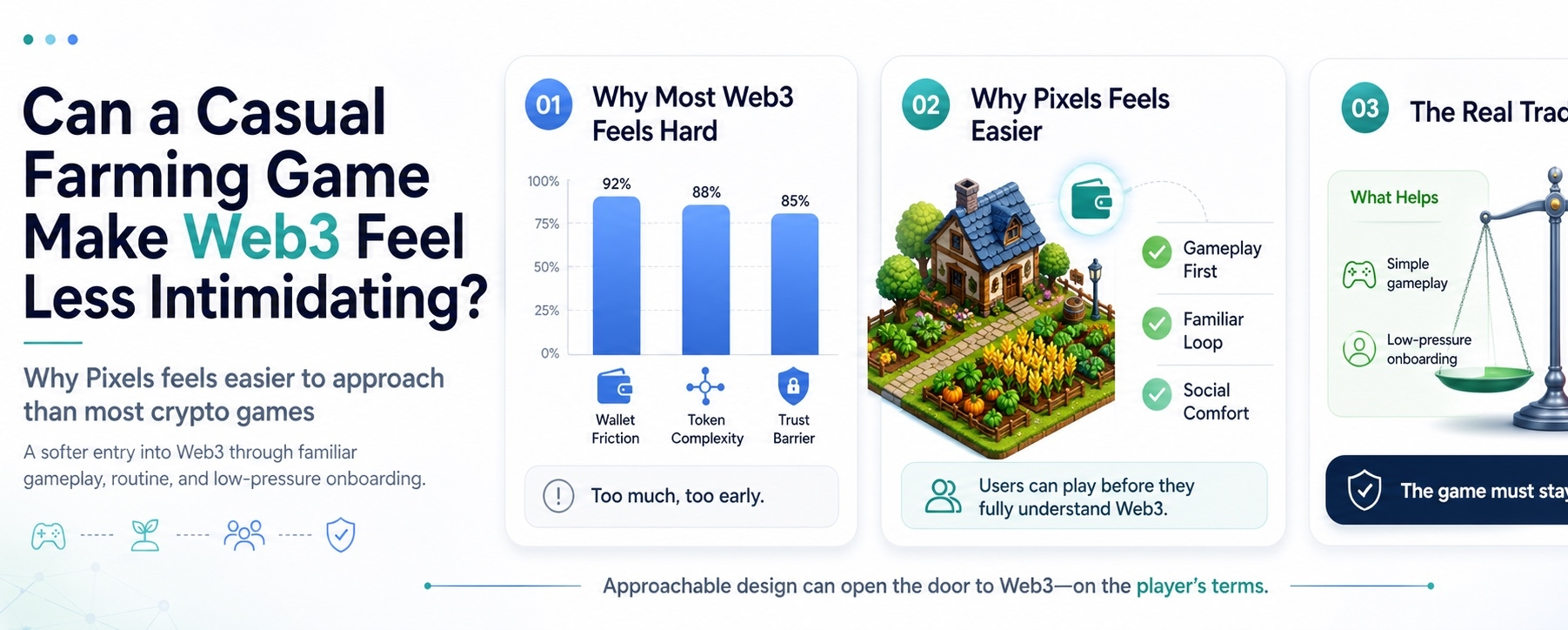

I have a strange habit now when I look at crypto projects.
I don’t start with the token. I don’t start with the roadmap. I don’t even start with the community numbers, because I’ve seen enough inflated activity in this market to know that numbers can tell the truth and still mislead you.
I start by asking one simple thing:
Would I understand this if I wasn’t already damaged by crypto?
That sounds half-joking, but I mean it.
After years in this market, you stop noticing how abnormal everything has become. You forget that signing a wallet transaction is not normal behavior for most people. You forget that reading token unlock schedules before using an app is not normal. You forget that Discord roles, staking pages, liquidity pools, bridges, gas settings, and NFT marketplaces are not natural parts of everyday life.
Crypto people adapt to weirdness and then mistake that adaptation for progress.
That is why Pixels interests me in a quieter way.
Not because I think it is flawless. Not because I think a farming game can magically solve Web3’s adoption problem. I’ve heard too many “this will onboard the next billion users” lines to take that kind of talk seriously anymore. But Pixels makes me think about a different possibility: maybe Web3 becomes less scary when it stops acting like Web3 at the front door.
A farming game is not intimidating by nature.
You enter a world. You move around. You gather things. You plant crops. You wait. You come back. You improve your space. You interact with other people. There is a softness to that loop. It does not demand much from you at first. It does not need you to have a thesis. It does not ask you to believe in a financial system before you know where anything is.
That matters more than it sounds.
Because the biggest problem with Web3 is not only that it is complicated. The bigger problem is that it makes people feel stupid for being new.
I’ve watched this happen again and again. Someone outside crypto tries to use a product, and immediately the product starts testing them. Connect wallet. Choose network. Approve transaction. Confirm signature. Understand fees. Avoid scams. Don’t click the wrong link. Don’t lose your seed phrase. Don’t get drained. Don’t misunderstand the token. Don’t buy the top.
And then crypto people wonder why normal users do not stay.
Of course they don’t stay. The first experience feels like walking into a room where everyone already knows the rules and nobody wants to explain them without making you feel behind.
Pixels, at least on the surface, does not begin that way. It begins with a game loop people can recognize. That does not make it safe. It does not remove the market layer. It does not make the token economy harmless. But it changes the emotional temperature of the first encounter.
And I think that is important.
I don’t come to Pixels as someone looking for another farming game. I come to it as someone who has watched crypto repeatedly fail at being approachable. The part that catches me is not the crop system or the land idea by itself. It is the possibility that a person could enter this kind of world and not immediately feel like they are being asked to become a trader.
That is rare.
Most Web3 games I’ve seen had the same hidden problem. They called themselves games, but they behaved like markets with graphics. The gameplay was often just a delivery mechanism for rewards. The community was lively as long as the numbers moved. The excitement was less about playing and more about being early.
I’ve seen that energy. I know what it looks like.
It is fun until it turns.
Then suddenly everyone becomes honest. The players were not really players. The community was not really a community. The economy was not really sustainable. The “utility” was not really useful. The whole thing was held together by belief, incentives, and the fear of missing out.
That history makes me cautious with Pixels too.
I don’t fully trust any Web3 game that has a token attached to it. That does not mean I dismiss it. It means I watch the pressure points. I watch whether the game stays readable for someone who does not care about price. I watch whether the token becomes a tool or a tax. I watch whether new players feel invited or late. I watch whether the social layer feels human or just transactional.
That last one matters to me more than people think.
A game can have thousands of active wallets and still feel empty. A world can look busy and still be driven by extraction. Crypto activity often has this strange hollow quality, like people are present but not settled. They are there, but they are also halfway out the door, waiting to see whether the reward is worth their time.
A farming game has a chance to create a different kind of presence.
Not guaranteed. Just a chance.
Because farming games are built around return, not urgency. They reward small habits. They create attachment through repetition. You do not need a dramatic reason to log in. Sometimes you log in because something you started yesterday is ready today. Sometimes you log in because your space feels unfinished. Sometimes you log in because the world has become part of your routine.
That is very different from crypto’s usual rhythm, which is panic disguised as opportunity.
Pixels sits between these two rhythms. That is what makes it interesting and also risky.
The game wants patience. The market wants movement.
The game wants comfort. The token wants attention.
The game wants people to return because they care. The economy risks attracting people who return because they calculate.
That tension is not a small detail. It is the whole thing.
If Pixels can keep the farming and social experience at the center, then Web3 becomes easier to approach almost by accident. The blockchain layer becomes something the player discovers instead of something they must survive. Ownership becomes connected to use, not just speculation. Tokens become part of a world, not the reason the world exists.
But if the financial layer gets too loud, the magic breaks quickly.
A casual player can feel when a game is not really built for them. They may not use crypto language to explain it, but they can sense it. They sense when every design choice is pushing them toward spending, staking, holding, upgrading, or competing economically. They sense when “community” really means market participants. They sense when the world is pretending to be cozy while quietly measuring them as liquidity.
That is the danger.
And it is not only Pixels’ danger. It is the danger of almost every Web3 consumer product.
Crypto wants mass adoption, but it keeps building entrances that feel like checkpoints. Then when something softer appears, something like a farming game, it becomes tempting to overload it with all the same financial machinery that made the rest of the space exhausting.
I hope Pixels avoids that. I’m not saying it will. I’m saying that is the line I would watch.
My personal view is that Web3 will not become normal through people learning more crypto jargon. It will become normal through products where the crypto part is not the emotional burden. The user should not feel like they are doing infrastructure work. They should feel like they are doing something they already understand, with extra possibilities underneath.
That is why a casual game might matter more than a technically impressive one.
A technically impressive Web3 product can still feel cold. A simple game can feel approachable. And approachability is not a minor feature in crypto. It is almost the missing foundation.
Pixels reminds me that maybe the next useful step in Web3 does not need to look futuristic. Maybe it looks ordinary. Maybe it looks like farming, crafting, decorating, chatting, and slowly building a small place that feels like yours.
There is something almost funny about that.
After all the big talk about changing finance, replacing platforms, rebuilding the internet, and creating new digital economies, maybe one of the better ways to make blockchain less frightening is to let someone harvest virtual crops without making them feel like they have entered a financial battlefield.
Still, I can’t ignore the other side.
The moment assets have value, behavior changes. The moment rewards exist, people optimize. The moment a token trades openly, the game has an audience that may care more about candles than crops. That is not a moral failure. It is just crypto. Incentives attract incentive-driven people.
So the real test for Pixels is not whether it can attract users during a good narrative cycle. The test is whether people still recognize it as a game when the market mood changes.
When rewards are less exciting, do people still come back?
When price action is boring, does the world still feel alive?
When speculation cools, is there still a reason to plant, build, explore, and talk?
Those are the questions I trust more than slogans.
Because I’ve seen projects survive hype and still fail at meaning. I’ve seen big communities disappear when the incentives changed. I’ve seen “revolutionary” games become ghost towns once the earning model stopped working.
A real game has to outlive the reason people first showed up.
That is where Pixels has both promise and pressure. Its casual nature gives it a better emotional base than many Web3 games, but its crypto layer still brings all the old complications with it. It can make Web3 feel less intimidating, yes, but only if Web3 does not slowly make the game more intimidating in return.
That is the part I keep circling back to.
A farming game can soften the first step. It can make blockchain feel less like a locked room. It can give people a reason to interact before they understand everything. It can turn ownership from an abstract claim into something connected to daily use.
But it cannot escape economics just by being cute or casual.
And it cannot build trust if the player eventually feels like the game was only a prettier way to pull them into a market.
So my view on Pixels is cautious, but not dismissive. I think it is one of those projects where the interesting part is not the loudest part. The interesting part is not simply the token, the chain, the land, or the user count. The interesting part is the feeling that Web3 might become easier to approach when it is wrapped inside something slow, familiar, and human.
That does not sound like much.
But in crypto, it kind of is.
Because this market has spent years trying to make people feel urgency. Buy now. Claim now. Stake now. Bridge now. Mint now. Don’t miss it. Be early. Move fast. Take the risk.
Pixels, at least in its best version, points toward another mood.
Come in. Look around. Do a few things. Return later. Learn slowly.
That is a very different invitation.
Maybe it will work. Maybe the market will distort it. Maybe Pixels will manage to keep the game at the center, or maybe the token economy will become the loudest thing in the room like it usually does.
I’m not ready to make a grand claim.
But I do think a casual farming game can make Web3 feel less intimidating if it remembers why people trust games in the first place. Not because games promise ownership. Not because they have assets. Not because they connect to a chain.
People trust games when they feel fair enough, understandable enough, and worth returning to.
If Pixels can protect that feeling, then the Web3 part has a chance to become less frightening.
Not invisible.
Not perfect.
Just less sharp around the edges.
And after years of watching crypto make simple things feel complicated, that would already be something.
