
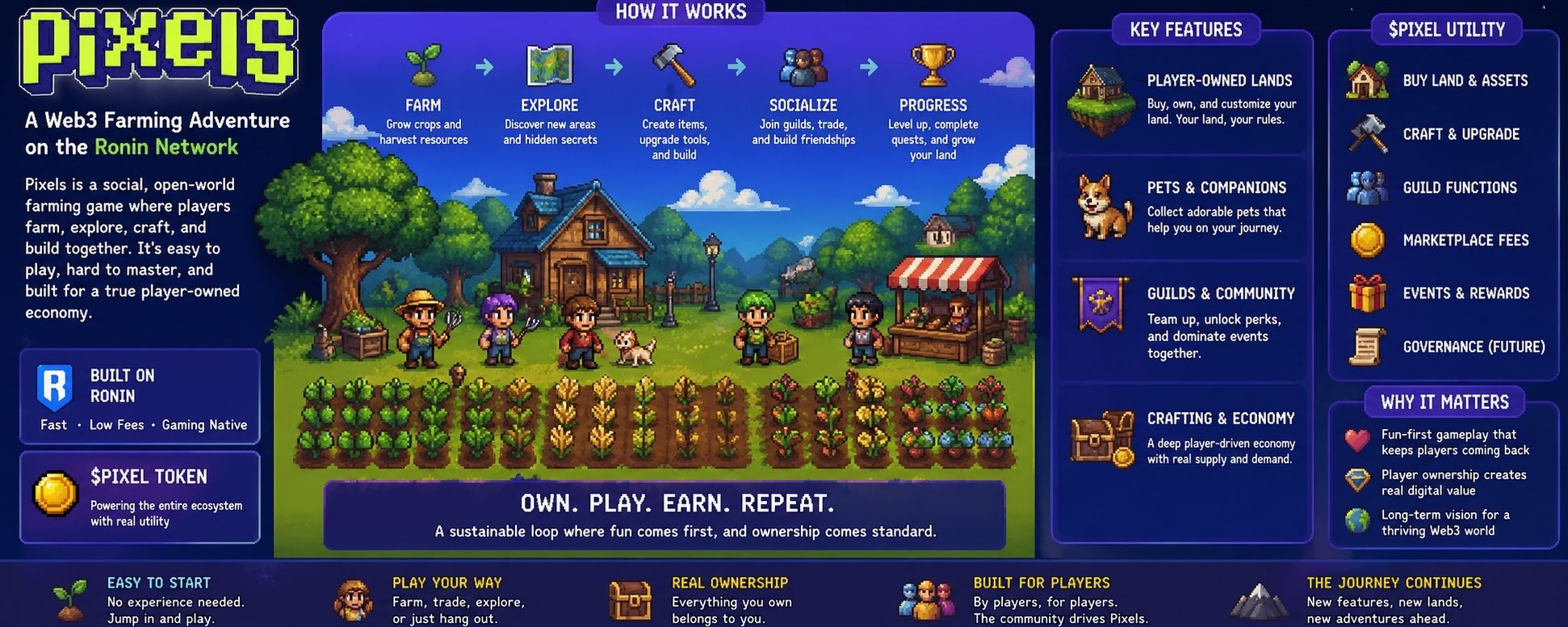

Pixels is the kind of project that sounds too soft for crypto until you remember how much of crypto has been dressed-up farming anyway. We have farmed yield, points, airdrops, liquidity, Discord roles, testnet tasks, fake activity, leaderboard positions, and anything else the market could turn into a future claim. Pixels just makes the farming visible. Crops. Energy. Land. Pets. Guilds. A little world full of people clicking around, trying to figure out whether they are playing a game or working inside another reward machine.
Honestly, that is what makes it interesting.
Not because it is perfect.
It is not.
Pixels sits right in the middle of the mess that Web3 gaming has been trying to avoid talking about for years. Everyone says they want games to be fun first, but the moment a token appears, people start calculating. How much can I earn? How fast can I withdraw? Is land worth it? Is the pet useful? Is the guild giving access? Is the reward route optimized? Is the token bleeding? Is this still a game?
That question follows Pixels everywhere.
The first time you look at it, it feels harmless. A pixel farming world on Ronin. You plant things, gather resources, craft, upgrade, visit other players, join guilds, use energy, and slowly build some kind of identity inside the game. It has that cozy surface that makes it easy to underestimate. But under the hood, Pixels is dealing with the same trauma that wrecked half the old GameFi market: fake users, shallow loops, reward dumping, bot farms, overpaid early players, angry latecomers, and tokens that become the whole conversation.
Look, anyone who lived through the last few crypto gaming cycles knows the pattern.
A game launches.
Rewards are good.
Everyone calls it the future.
Guilds pile in. Bots pile in. Farmers pile in. Twitter gets loud. The chart goes vertical. Then the emissions hit, rewards drop, casual players leave, and suddenly the whole thing looks less like a game and more like a faucet that ran out of pressure.
Pixels is trying to not become that.
Trying is the key word.
Because this stuff is hard to build. People act like you can fix Web3 gaming by saying “fun first” in a whitepaper. You cannot. Fun does not remove the token. Fun does not stop farmers. Fun does not magically create sinks. Fun does not make land politics disappear. Fun does not protect an economy from people who see every mechanic as something to extract.
Pixels has to deal with all of that in public.
That is why the project feels more real than a lot of cleaner-looking games. Clean is easy before users arrive. Clean is easy in a trailer. Clean is easy when the economy has not been attacked by thousands of people trying to squeeze it. Pixels has already been through the uglier part. The part where players optimize everything. The part where rewards need adjusting. The part where the market starts judging the game through the PIXEL chart. The part where every change annoys somebody.
And there is always somebody.
If rewards are too generous, the economy gets farmed.
If rewards are too tight, players complain.
If land gets stronger, free players feel pushed down.
If land gets weaker, holders feel betrayed.
If PIXEL has utility, people ask if it is forced.
If PIXEL lacks utility, people ask why it exists.
This is the plumbing of crypto gaming. Not the pretty part. The necessary part.
Pixels is basically a project trying to make that plumbing work without turning the whole experience into a spreadsheet. That is harder than it sounds. The game needs enough simplicity for normal people to enter, but enough depth to stop the economy from becoming a bot buffet. It needs free-to-play access, but it also has NFT assets that need to matter. It needs PIXEL demand, but it cannot make every action feel like a tax. It needs guilds, but guilds can become little power centers. It needs farming, but farming cannot only mean extraction.
The thing is, Pixels works best when it feels daily.
Not loud.
Not cinematic.
Daily.
You log in, use energy, gather something, craft something, check a task, visit a place, maybe interact with a guild, maybe look at your pet or land, maybe think about whether your time was worth it. That routine is not glamorous, but crypto needs more products with routine. Most of this industry is built around events: mint, claim, bridge, stake, unstake, dump, rotate, repeat. Pixels gives people something slower. A world that asks for repeated attention instead of one transaction and an exit.
That is rare.
But it also creates the main danger. Repetition can become attachment, or it can become labor. Pixels has to keep pushing toward attachment. If players feel like they are only clocking in for rewards, the magic dies. If the world feels like it remembers their time, then maybe it has a chance.
Ronin helped because Pixels did not land in a random chain vacuum. It moved into a gaming culture that already had scars. Ronin users understand what happens when a crypto game becomes too financial too fast. They saw Axie at the top. They saw what came after. That history matters. Pixels inherited a community that knows both hope and damage.
That makes the project’s growth feel less naïve.
People came in knowing the risks. Some came to play. Some came to farm. Some came for the token. Some came because Ronin had momentum again. Most people were probably some mix of all of it, because crypto users are rarely pure. We pretend we are one thing, but we are usually three tabs open at once: the game, the marketplace, and the chart.
Pixels understands that kind of user.
It does not fully escape them.
Chapter 2 felt like the project admitting that the early loop needed more weight. More progression. More crafting depth. More meaning behind tools, resources, land access, guilds, and account growth. That matters because shallow games get eaten alive. If everyone can do the same basic action forever, bots win. Farmers win. The economy loses.
So Pixels had to make the inside more complicated.
Not complicated for the sake of it.
Complicated because the game needed bones.
Skills matter. Tools matter. Resource tiers matter. Specks matter. Guilds matter. Land matters. All of that gives the world more structure. It also gives the team more knobs to turn, which is both good and dangerous. More knobs means better balancing. It also means more ways to upset players.
That is the job, though.
Build the machine while people are inside it.
PIXEL is the sharpest part of the machine. The token gives the ecosystem weight, but it also brings the usual crypto sickness. Price becomes mood. Liquidity becomes confidence. Emissions become drama. Utility becomes debate. When PIXEL is strong, people talk about adoption. When it is weak, people question everything. That is unfair, but it is also how this market works.
No point pretending otherwise.
A Web3 game with a token cannot say, “Ignore the token.” Nobody will. The token is part of the experience, even for people who say they are just there for the game. It changes how players think. It changes how holders judge updates. It changes how outsiders value the project. PIXEL has to be useful enough to matter, but not so aggressive that the game starts feeling like every door has a payment terminal in front of it.
That balance is ugly work.
This is where I respect Pixels more than I trust it blindly. There is a difference. I respect that it is trying to build real sinks, progression, social systems, guild structures, and longer-term reward design. I respect that it did not stay as a shallow crop-clicking faucet. I respect that it has had enough actual users to expose real problems.
But I do not think any of this is solved.
The game still has to prove that people stay when rewards are not exciting. It has to prove that land ownership does not turn into a closed club. It has to prove that pets and NFTs can create attachment beyond speculation. It has to prove that guilds strengthen the world instead of turning it into politics and gatekeeping. It has to prove that PIXEL demand can come from inside the ecosystem, not just from exchange listings and market cycles.
That might take time.
Maybe a lot of time.
And the market is not patient.
Crypto wants proof now. Players want rewards now. Holders want price action now. Builders need months, sometimes years, to make the boring infrastructure actually work. That mismatch is where good projects get misunderstood and bad projects get exposed. Pixels is living right inside that mismatch.
What makes Pixels worth watching is not that it avoids the mess.
It does not.
It walks straight into it.
The game is trying to turn a reward-hungry crowd into a community that cares about a world. That is a brutal task. Crypto users have been trained to leave. Take the airdrop and leave. Farm the points and leave. Mint and leave. Bridge and leave. Stake until unlock and leave. Pixels is asking some of those same users to stay, decorate, craft, upgrade, join, build habits, and maybe care about a tiny digital farm.
That is almost absurd.
But maybe that is why it matters.
Because if Web3 gaming ever works, it probably will not start with a perfect metaverse. It will start with messy little worlds that slowly make ownership feel normal. Worlds where the infrastructure is mostly invisible when it works, where the economy does not collapse the moment farmers arrive, where NFTs are not just exit tickets, where a token has a job beyond being dumped into liquidity.
Pixels is not there yet.
But it is trying in the open.
And that counts for something in a sector full of games that looked expensive and felt empty.
The project still feels like a question more than an answer. Some days it feels like a cozy farming game with crypto rails underneath. Some days it feels like a crypto economy wearing a cozy farming skin. Maybe that tension never fully goes away. Maybe the best Pixels can do is keep making the game side heavier, stickier, more human, so the market side does not swallow it whole.
For now, I see Pixels as one of the few Web3 games that has actually reached the stage where its problems are worth taking seriously. That sounds like a strange compliment, but in crypto it is not. Most projects never get far enough to have real problems. Pixels did. Now it has to keep doing the slow, annoying, unglamorous work: balancing the economy, deepening the game, protecting real players, giving PIXEL a reason to exist, and making sure the world still feels like a place people want to return to when nobody is shouting about it.