
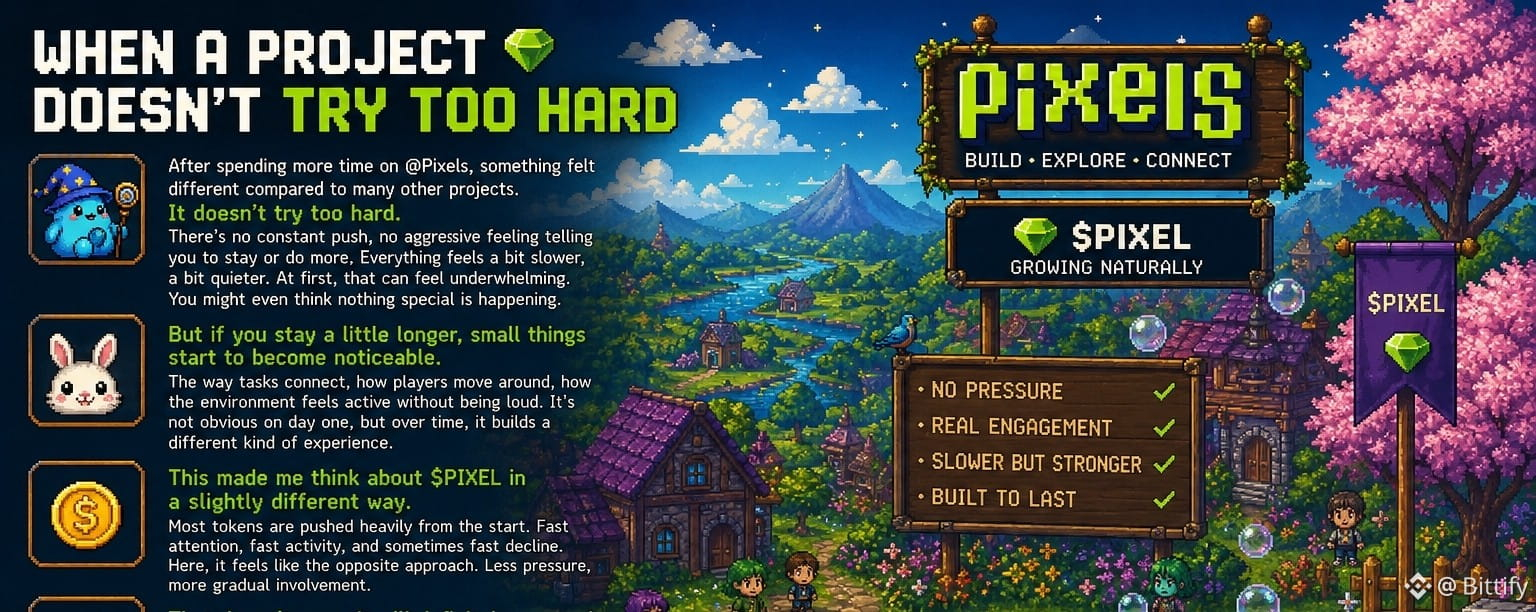
After spending more time on @Pixels something felt different compared to many other projects.
It doesn’t try too hard.
There’s no constant push, no aggressive feeling telling you to stay or do more. Everything feels a bit slower, a bit quieter. At first, that can feel underwhelming. You might even think nothing special is happening.
But if you stay a little longer, small things start to become noticeable.
The way tasks connect, how players move around, how the environment feels active without being loud. It’s not obvious on day one, but over time, it builds a different kind of experience.
This made me think about $PIXEL in a slightly different way. Most tokens are pushed heavily from the start. Fast attention, fast activity, and sometimes fast decline.
Here, it feels like the opposite approach. Less pressure, more gradual involvement.
That doesn’t mean it will definitely succeed. In fact, slower systems can also struggle if they don’t grow at the right pace. But they have a different kind of potential.
Because when something grows slowly and naturally, it often becomes more stable.
From what I’ve seen, @Pixels is not trying to force engagement. It’s allowing it to develop. That’s harder to build, but it can last longer if done right.
And if that direction continues, then $PIXEL won’t just depend on short-term attention. It will depend on how many people actually stay and keep using the system.
That’s not loud progress, but it’s meaningful. #pixel @Pixels $PIXEL
