
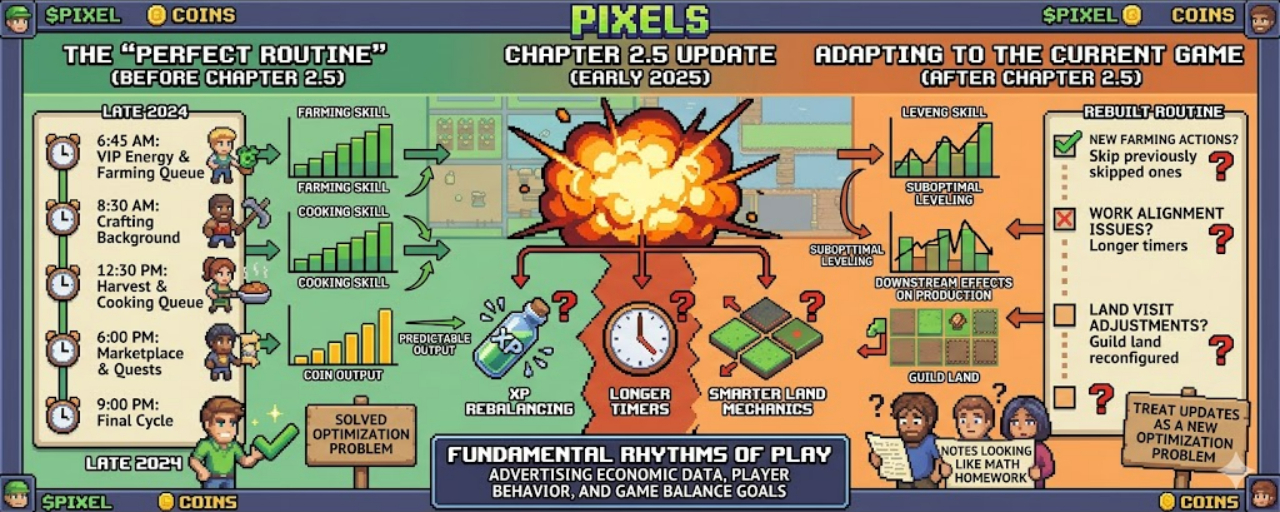
I had a routine. A real one. Not a casual routine, a timed, optimized, slightly embarrassing routine.
6:45 AM: log in, collect VIP energy, start farming queue. 8:30 AM: log off for work, crafting running in background. 12:30 PM: check in, harvest, start cooking queue, collect whatever the crafting station had produced. 6:00 PM: evening session, marketplace check, skill work, quest completions. 9:00 PM: final farming cycle, close out.
Three months of playing Pixels had produced this. It worked well. My skills were leveling at a consistent rate. My Coin output was predictable. I had a good sense of what each session would produce before I started it.
Then Pixels dropped Chapter 2.5. 💀
Chapter 2.5, released in early 2025, included three significant changes: XP rebalancing across skill categories, longer timers on certain resource generation activities, and what the patch notes called "smarter land mechanics." I read the patch notes the morning of the update. I understood them intellectually. What I didn't understand was how completely they would disrupt the felt experience of my Pixels sessions.
The XP rebalancing was the first thing I noticed.
Under the old system, I had found a set of actions that leveled my farming and cooking skills at roughly equal rates, which I preferred because it kept both skills progressing without one running far ahead of the other. After the rebalance, the XP values on several of those actions shifted. Some things I had been doing for XP were now worth less. Some things I had been skipping were now worth considerably more. My equal-leveling strategy, which had felt optimized, was now genuinely suboptimal.
I spent two days replaying familiar activities and checking their new XP outputs. My notes from this period look like small math homework. 🤔
The longer timers were the second disruption, and in some ways the more interesting one.
Pixels had received community feedback that certain short-timer activities created a grind feeling: you had to check in every few minutes to maintain momentum. The Chapter 2.5 change lengthened some of these timers. On paper, this was a quality-of-life improvement. Less frequent check-ins required. More flexibility in your schedule. In practice, for a player who had built their schedule around specific intervals, the new timers didn't fit the slots I had been using. My 8:30 AM check-out had been timed to the old cycle. The new cycle didn't align cleanly with my work schedule.
I had to rebuild my routine from scratch.
This is the honest, somewhat uncomfortable thing about playing Pixels as a live game: it changes. Not just visually, not just in terms of new content areas. It changes the fundamental rhythms of efficient play. A strategy that was well-tuned to one version of the game may be wrong for the next. The XP values, the timers, the resource generation rates, these are all live parameters that Pixels' team adjusts based on economic data, player behavior, and game balance goals. Adapting to those changes is part of playing.
What Chapter 2.5 taught me that I hadn't internalized before was the difference between being good at Pixels and being good at the current version of Pixels.
I had become quite good at Pixels circa late 2024. My routines were efficient for that game. Chapter 2.5 shifted enough parameters that those routines were now efficient for a game that no longer existed. The new version was still recognizable. Same world, same characters, same core loops. But the arithmetic underneath had changed, and efficiency in a resource optimization game is arithmetic.
The smarter land mechanics were the change I most underestimated.
Without going into every detail, the update adjusted how resources are generated per land plot and how players access those resources. For free players on Specks, the changes were relatively minor. For land owners, and for players like me who relied heavily on visiting guild land, the changes had downstream effects on production rates. Some land configurations that had been highly efficient were now less so. Some that had been mediocre had become more attractive.
My guild spent about a week reconfiguring the land layout in response to this. The guild leader, who had significantly more understanding of the land mechanics than I did, made most of those decisions. But watching the reconfiguration process taught me something about how land value actually works in Pixels. It's not static. It's not just about the raw land traits. It's about how those traits interact with the current state of the game's resource economy. A land that was optimized for one version of Pixels may need to be rethought for the next.
Here's what I believe now that I didn't fully believe before Chapter 2.5.
Pixels is not a game you master once. It's a game that evolves, and the players who stay competitive are the ones who treat each major update as a new optimization problem rather than a disruption to a solved one. My three-month routine was never a permanent answer. It was an answer to a specific version of the game at a specific time.
Whether that's frustrating or exciting is probably a good litmus test for whether you're the right fit for Pixels.