
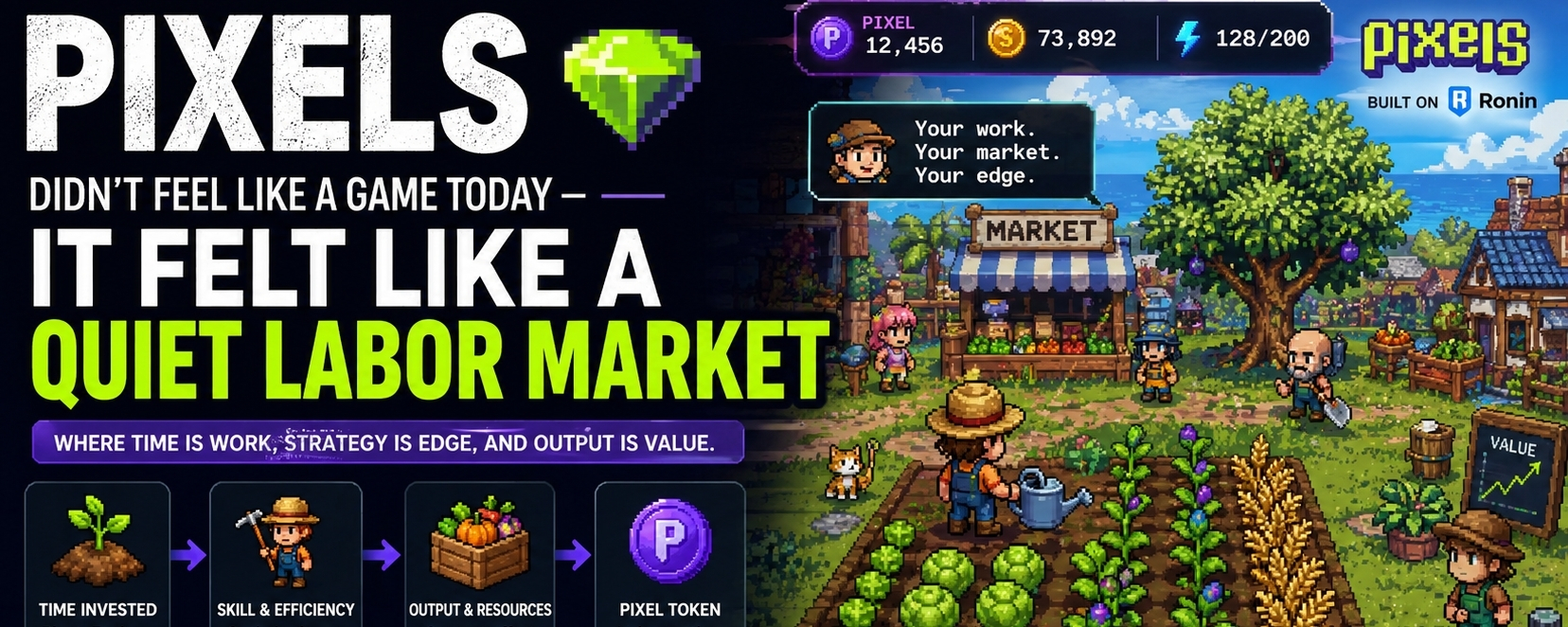
I logged into Pixels earlier thinking I’d just check crops, maybe expand a bit, nothing serious. Ten minutes in, I wasn’t thinking about the game anymore. I was thinking about yield per minute. About loops. About whether I was wasting time doing the wrong activity.
That shift is the whole point, I think.
My core take after spending time inside Pixels today is this: it’s not really building a game economy — it’s quietly constructing a coordination layer for digital labor, where time gets priced, optimized, and competed over.
And the weird part is… it doesn’t tell you that directly.
On the surface, Pixels is simple. Farming, exploration, crafting. The usual loop. But once you stay inside a bit longer, the visible layer starts to fade and the system underneath becomes clearer. Every action is tied to output. Every output is tied to resource flows. And those flows are tied, eventually, to on-chain value.
So behavior starts changing.
You stop asking “what’s fun?” and start asking “what’s efficient?”
That’s the first mechanism layer: conversion of play into measurable productivity.
The game doesn’t force you to optimize, but it quietly rewards you if you do. Better routes, better crop cycles, better coordination with land or resources — all of it compounds. And because assets and outputs have economic weight, inefficiency starts to feel like loss, not just missed fun.
I noticed this in a very small moment. I was walking between plots, and instead of just doing it casually, I caught myself thinking there must be a faster path. That thought doesn’t come from game design alone — it comes from economic framing.
Then you zoom out a bit.
Pixels runs on Ronin, which means transactions are cheap and fast enough that these micro-actions can actually scale. That matters more than it sounds. Because if every small action had friction, this system wouldn’t hold. The entire loop depends on low-cost repetition.
So the second mechanism layer is infrastructure enabling high-frequency economic behavior.
Without that, it’s just a farming sim. With it, it becomes something closer to a micro-economy where thousands of small actions aggregate into real output.
And once that loop stabilizes, a third layer starts forming — coordination.
Not everyone is doing the same thing. Some players optimize farming. Others focus on resources. Some trade. Some just grind specific loops better than others. Over time, you get specialization. And specialization leads to something that looks very familiar: roles.
That’s where it stopped feeling like a game to me.
It started feeling like a soft labor market.
Not in a dystopian sense, but in a structural one. Time is being allocated. Efficiency is being learned. Output is being compared. And players are, quietly, competing on productivity.
The important part is that this isn’t forced. It emerges.
Which is why it’s harder to see at first.
Now, where does the PIXEL token fit into this?
Not as a reward gimmick — at least not primarily. It acts more like the settlement layer for this activity. It’s where value crystallizes. All these micro-optimizations, resource flows, and time investments eventually point toward something measurable, and PIXEL becomes the unit that anchors that.
It reduces friction between in-game effort and external value. Without it, everything stays closed. With it, the loop extends outward.
That’s powerful, but also where things get fragile.
Because the system only holds if the outputs remain meaningful. If too many players optimize too quickly, or if value extraction outpaces value creation, the whole thing starts to feel like work without payoff. And unlike traditional games, players here are more sensitive to that shift.
I don’t think this is solved yet.
There’s a real dependency on balance — between fun and efficiency, between output and demand, between participation and reward. If any of those tilt too far, behavior changes fast. And in a system like this, behavior is everything.
One practical scenario I kept thinking about: imagine a new player entering. At first, they play casually. But as soon as they see others earning more by optimizing, the pressure shifts. They either adapt or fall behind. That creates a subtle but real gradient between players — not just in skill, but in economic positioning.
That’s not typical game design. That’s closer to market structure.
What I’m watching now is whether Pixels leans into this or tries to hide it. If they keep building systems that reward coordination, specialization, and efficiency, this “labor layer” becomes the core product. If they pull back and prioritize casual play, the system might lose its edge but gain broader accessibility.
The key signal will be player behavior over time. Are people logging in to relax, or to optimize? Are communities forming around roles and output, or just social interaction? And importantly, does the value loop sustain without constant external push?
If the answer leans toward sustained coordination, then Pixels isn’t just a game.
It’s a place where digital work quietly takes shape.
And once that clicks, it’s hard to unsee.
