
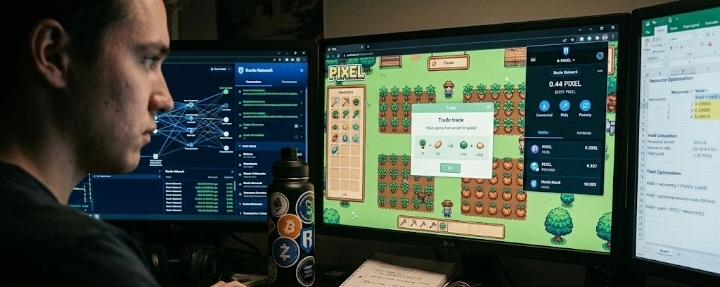

@Pixels I didn’t open Pixels (PIXEL) expecting to question anything. It looked familiar enough—soil, seeds, a quiet loop of planting and harvesting. I’ve seen that rhythm before, the kind that fills time without asking much in return. But something felt slightly off from the beginning, and not in a dramatic way. It was quieter than that. More like a hesitation. The kind you don’t notice until you’ve already clicked a few times and wonder why it doesn’t feel disposable.
The first thing that unsettled me wasn’t the gameplay. It was the idea—subtle at first—that what I was doing might persist beyond the game itself. When I harvested something and traded it, the reward didn’t stay contained inside the interface. It moved outward, into a wallet I controlled. That small shift—almost invisible if you’re not looking for it—changed how I interpreted everything else. I wasn’t just progressing inside a closed loop. I was participating in something that extended beyond it.
That’s when the question stopped being abstract. If this isn’t fully contained, then where does it actually live? And if it doesn’t live in one place, who’s holding it together?
Following that thread led me, almost reluctantly, to the infrastructure beneath it—Ronin Network. I didn’t approach it as something to admire or critique. I approached it like evidence. Transactions weren’t just recorded; they were confirmed by a network that didn’t belong to a single owner. That sounds clean in theory, but in practice it raises a different kind of tension. Systems that distribute control also distribute responsibility, and sometimes ambiguity.
The more I watched how things moved, the more I realized that stability here wasn’t coming from authority. It was coming from agreement—repeated, procedural, and sometimes imperfect. But agreement at scale has a cost. If you optimize for speed, you reduce friction but also compress the space for verification. If you optimize for decentralization, you slow everything down. This system clearly leans one way. Not completely, but enough to suggest a priority: usability over purity.
And that decision doesn’t just sit quietly in the background. It shapes behavior in ways that aren’t immediately obvious.
Once transactions become fast and cheap, hesitation disappears. You don’t think twice before acting. You experiment more, trade more, optimize more. That shift from “playing” to “optimizing” doesn’t happen all at once. It creeps in. You start noticing patterns. Which actions yield more? Which resources are undervalued? You stop asking what’s fun and start asking what’s efficient.
That’s where the system begins to feel different. Not better or worse—just oriented around something else. It rewards awareness. It rewards timing. And eventually, it rewards those who are willing to treat it less like a game and more like a system to be navigated.
But optimization has a way of bending toward its edges. It doesn’t stay contained within intended boundaries. I started noticing behaviors that didn’t feel like play at all—automation, coordination, accumulation strategies that seemed less about engagement and more about leverage. It’s not surprising. Strong incentives tend to produce strong responses. The system doesn’t need to encourage exploitation for exploitation to emerge. It just needs to make it possible.
At that point, something else becomes visible. Rules aren’t static here. They evolve, sometimes quietly, sometimes reactively. And even in a system that presents itself as distributed, decisions still get made. Adjustments still happen. Governance doesn’t disappear—it just becomes less obvious, more embedded.
That’s where things start to blur. Because once governance becomes part of the experience, the system is no longer just technical. It becomes political in a subtle way. Not in the sense of ideology, but in the sense of influence. Who gets to decide what counts as acceptable behavior? Who intervenes when balance shifts too far? And how visible are those interventions to the people inside the system?
These questions don’t feel urgent at small scale. But scale changes everything.
When participation grows, scarcity sharpens. What felt abundant early on starts to compress. Access becomes uneven, not by design necessarily, but by timing. Those who arrive earlier move differently than those who arrive later. They don’t just have more—they operate with different assumptions. And slowly, without any explicit declaration, a kind of structure forms. Not rigid, but noticeable.
It makes me wonder whether the system is quietly optimizing for a specific type of participant. Someone patient enough to learn its patterns. Attentive enough to track its shifts. Maybe even strategic enough to stay ahead of its corrections. That doesn’t exclude others, but it does change how comfortable the experience feels depending on who you are.
What complicates things further is that the system doesn’t exist in isolation. The value moving through it is influenced by forces outside of it. Market conditions, sentiment, volatility—these things don’t ask for permission before entering. They leak in. And once they do, behavior inside the system starts to reflect pressures that didn’t originate there.
That’s when the experience begins to split. Some people remain anchored in the act of playing. Others drift toward trading. A few start thinking in terms of systems—flows, inputs, outputs. The same environment, but different interpretations layered on top of each other.
I don’t think there’s a single way to understand it anymore. It depends on what you’re looking for, and maybe more importantly, what you’re willing to notice.
What I keep coming back to isn’t a conclusion, but a set of things I’m still watching. Whether new participants can find their footing without inheriting someone else’s advantage. Whether adjustments to the system feel predictable or reactive. Whether activity reflects genuine engagement or just efficient extraction. And how the system behaves when attention inevitably shifts elsewhere.
I don’t know yet what would count as confirmation that this structure holds, or what would signal that it’s starting to fracture. But I have a sense of where to look. And for now, that feels more useful than deciding what it is.
