
Look, I’ve seen this movie before.
A simple game shows up. Friendly graphics. Low barrier. Easy loop. This time it’s Pixels, a farming sim where you plant crops, craft items, and hang out with other players. Nothing intimidating. That’s the point. It’s supposed to feel harmless.
But then there’s the layer underneath. There’s always a layer underneath.
Pixels runs on the Ronin Network, which already has history. Not theory. History. It carried one of the biggest play-to-earn booms we’ve seen, and the crash that followed wasn’t subtle. So when someone says, “This time it’s different,” you have to ask what actually changed.
Because the core idea hasn’t.
They’re trying to fix play-to-earn. That’s the pitch. Slower rewards. Better balance. More focus on gameplay. Less obvious speculation. It sounds tidy. On paper, at least. But the real problem they’re trying to solve is much uglier: how do you pay players without constantly needing new players to fund them?
That’s the whole game.
Let’s be honest. If users are earning something that has real value, that value has to come from somewhere. Either new money comes in, or existing players subsidize each other, or the system quietly dilutes everyone over time. There isn’t a fourth option hiding in the code.
Pixels doesn’t escape that. It just softens the edges.
What most people miss is that this isn’t really about farming or social gameplay. It’s about behavior. The game is designed to guide how you spend time, what you produce, and when you sell. Every action feeds into a market. You’re not just playing—you’re participating in a small, controlled economy.
And economies have gravity.
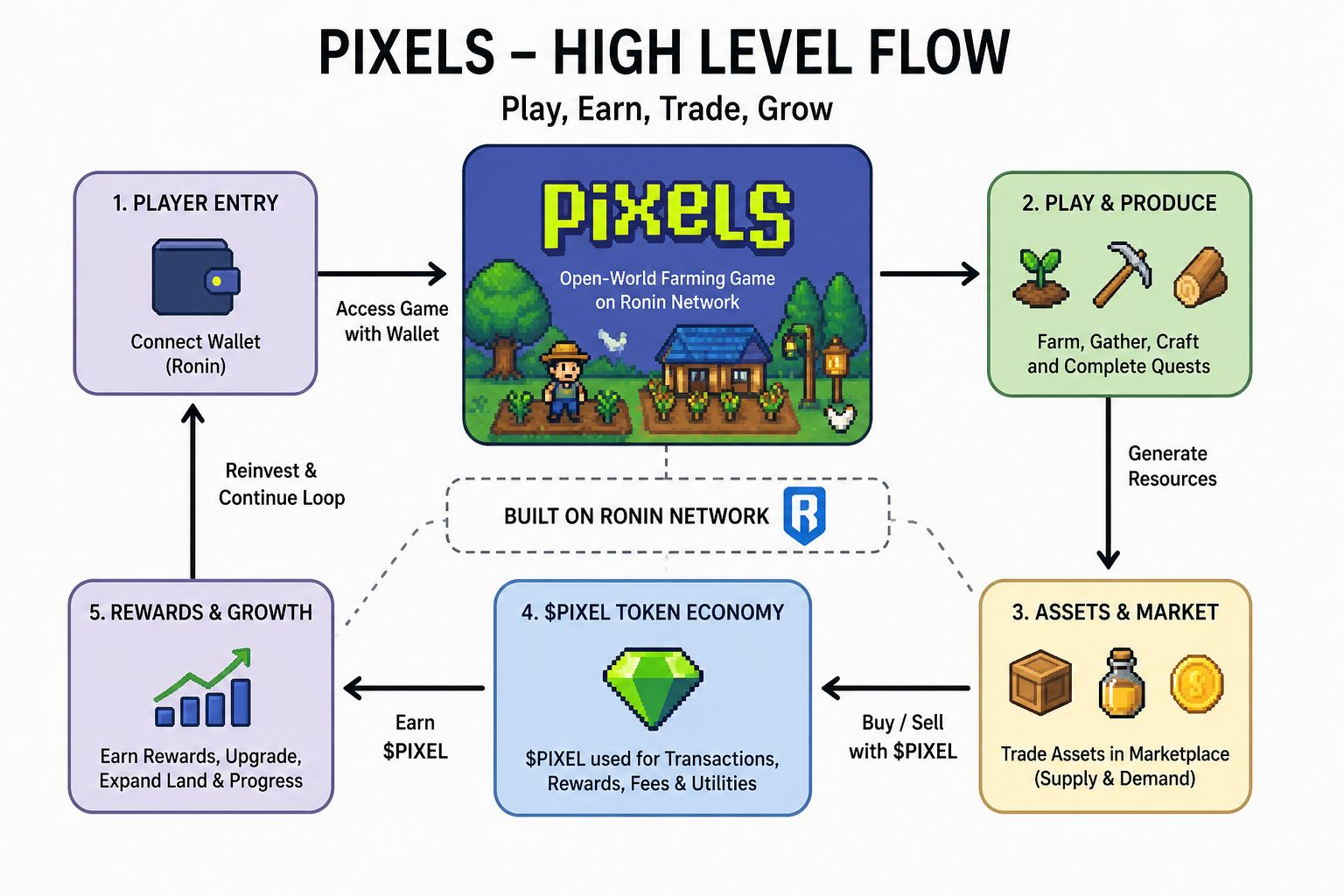
Here’s how it actually works, stripped of the branding. You log in with a wallet. You own assets. You produce resources. Those resources can be traded. Prices move based on supply and demand. You optimize. Everyone does. Because once there’s money involved, even a little, people stop playing casually.
They start calculating.
So the system slowly shifts. What starts as a game becomes a set of strategies. What looks like farming becomes yield optimization. And what feels social at the beginning starts to thin out as players chase efficiency instead of interaction.
I’ve watched that transition happen more than once. It’s predictable.
Now let’s talk about the token, because that’s where things get uncomfortable. The token is doing multiple jobs at once. It’s a reward. It’s a currency. Sometimes it’s a gate. That sounds efficient. It isn’t. It creates tension.
If the token price goes up, speculation floods in and distorts everything. If it goes down, players lose interest because their time stops paying off. So the system is constantly trying to balance something that doesn’t really want to be balanced.
That’s not design elegance. That’s ongoing damage control.
And then there’s the part nobody likes to say out loud. Who actually benefits?
Early users, usually. They get in when assets are cheap and liquidity is thin. They accumulate. Then later users arrive, bringing demand. Prices stabilize or rise just enough to make it all feel sustainable. For a while.
Then growth slows.
When that happens, the pressure shifts downward. Rewards shrink. Asset values soften. The late entrants—the ones who believed the “sustainable model” narrative—are left holding things that no longer justify the time they put in.
It doesn’t collapse overnight. That’s the tricky part. It just… fades. Quietly.
Now, to be fair, Pixels is trying to avoid the obvious mistakes. It’s slower. Less aggressive. More controlled. That’s real. But slowing down a system doesn’t change its structure. It just stretches the timeline.
The same forces are still there.
And there’s another angle people don’t think about enough: control. This is supposed to be decentralized, or at least adjacent to that idea. But who’s tuning the economy? Who adjusts rewards, drop rates, sinks? Not the players. Not in any meaningful sense.
There’s always a central hand on the wheel.
Because without that, the system would spiral even faster.
So now you have something interesting. A game that looks casual, but behaves like a managed economy. A token that wants to be both stable and valuable, which is a contradiction. A player base that’s told to enjoy the experience, while being quietly nudged to optimize every move.
It works. For a while.
Until it doesn’t.
And when it breaks—and systems like this always break somewhere—it won’t feel like a game shutting down. It’ll feel like the value just slowly leaked out, one trade at a time, until people stopped logging in.
