

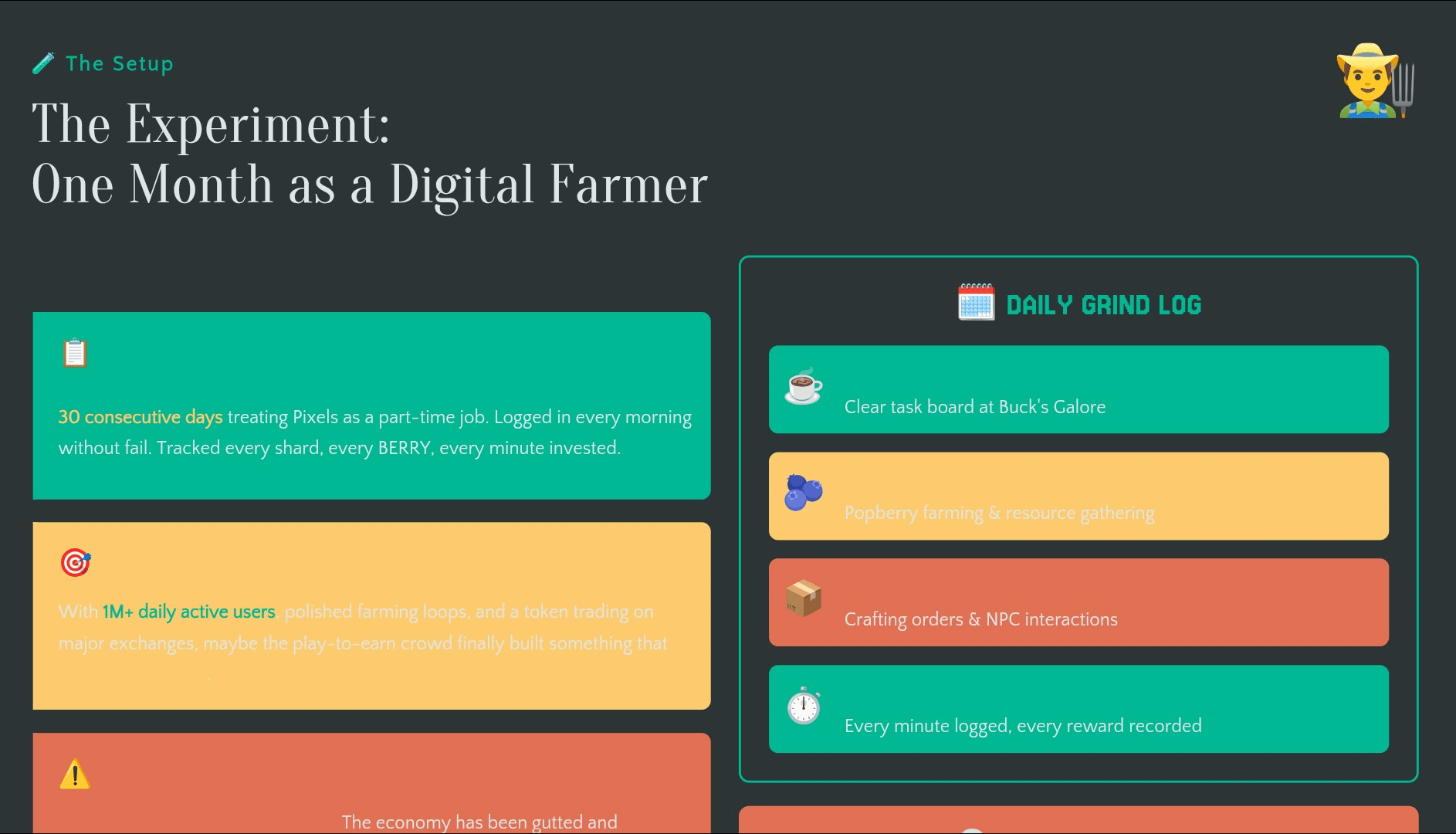
I told myself I'd give it thirty days. One full month of treating Pixels like a part time job logging in every morning, clearing the task board at Buck's Galore, harvesting Popberries, delivering crafting orders, doing exactly what the game asked of me. I tracked every shard, every BERRY, every minute. I wanted to believe the hype. The game has over a million daily active users, a polished farming loop, and a token that actually trades on major exchanges. Maybe, I thought, the "play-to-earn" crowd had finally built something that respects your time.#pixel
I was wrong. Spectacularly, depressingly wrong.
By the end of month one, I had earned roughly 180 PIXEL shards—worth about 4,200 BERRY at the going conversion rates. At the current token price of roughly 0.0075 , that haul converts to less than 1.35. Ten yuan. For twenty hours of work. Do the math that's about five cents per hour. You'd make more picking up plastic bottles on the street.
I didn't quit early because I'm a masochist. I stuck with it because I needed to understand why it felt so bad. And the answer wasn't just "low token price." It was structural. The entire economy has been gutted and repackaged as a "sustainable business model," but sustainability here just means the developers found a way to extract labor while giving out as little value as possible.$YGG
Here are the three things that became impossible to ignore.
1. The Rewards Are Shrinking and Randomized
There was a time, earlier in the game's lifecycle, when completing daily tasks at the task board meant guaranteed PIXEL shard drops. You knew what you were working for. That predictability is gone. Now, shards drop at lower, probabilistic rates—sometimes you get one, sometimes you get nothing, sometimes the game throws you a handful of BERRY and calls it even. It's a slot machine where the house edge keeps increasing.
The cruelty of this design is that BERRY itself has been inflated into irrelevance. The game originally ran on a dual-token system, but the team phased BERRY out and consolidated everything into PIXEL . What they didn't fix was the underlying inflation. BERRY floods the economy through routine farming, and its purchasing power has roughly halved compared to six months ago. So even when the task board pays you in BERRY, you're getting monopoly money. When it pays in PIXEL shards, the RNG gates mean you can't plan around it. Your hourly wage isn't just low—it's unpredictably low, which is somehow worse.
2. The Token Price Outlook Is Bleak
Let's say you're an optimist. You tell yourself, Sure, 180 shards is nothing now, but what if PIXEL moons?" I looked at the forecasts before I started this experiment, and they sobered me up fast. According to CoinCodex's algorithmic models, PIXEL is projected to drop toward the 0.004–0.005 range in the coming months . That's a 25% haircut from where it sits today. If that plays out, my month of grinding doesn't just pay five cents per hour—it pays less.
The market isn't buying the narrative. Despite 1 million DAUs and a recent Chapter 3 update introducing combat and exploration realms, the token trades like a distressed asset. There are supply unlocks adding millions of PIXEL into circulation—the next one on April 19, 2026, releases 91.18 million PIXEL —and the "Farmer Fee" on direct withdrawals—anywhere from 20% to 50%—means the game taxes you heavily just for cashing out. The exchanges list it, the charts look active, but the trend is unmistakable. This isn't a token accumulating value. It's a token bleeding it.
3. The Psychology Is Predatory, Not Playful
This is the part that genuinely bothered me. The task board doesn't just underpay you—it hooks you. The variable-ratio reinforcement schedule is straight out of a casino design manual. Some days you log in and get a decent shard drop, and your brain releases a little hit of dopamine. Most days you get scraps. But you keep coming back because maybe tomorrow will be the good day. It's a Skinner box dressed up as a farming sim.
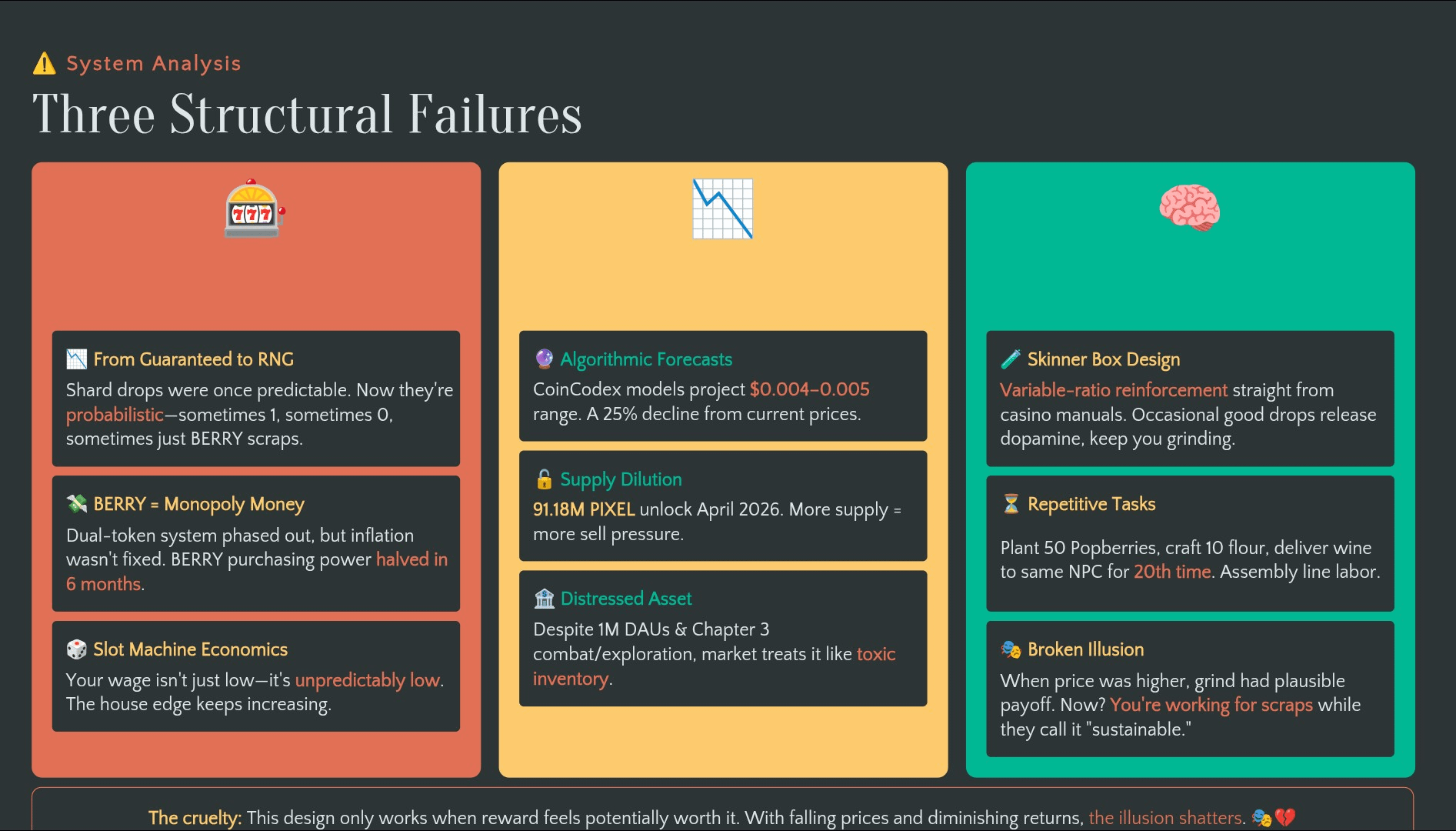
The problem is that this psychological trap only works when the reward feels potentially worth it. When PIXEL was newer and prices were higher, the grind had a plausible payoff. Now, with the coin price falling, returns diminishing, and the tasks themselves growing more repetitive—plant 50 Popberries, craft 10 flour, deliver wine to the same NPC for the twentieth time—the illusion shatters. You're not playing a game. You're working an assembly line where the boss keeps lowering your paycheck while telling you to be grateful for the "sustainable economy."
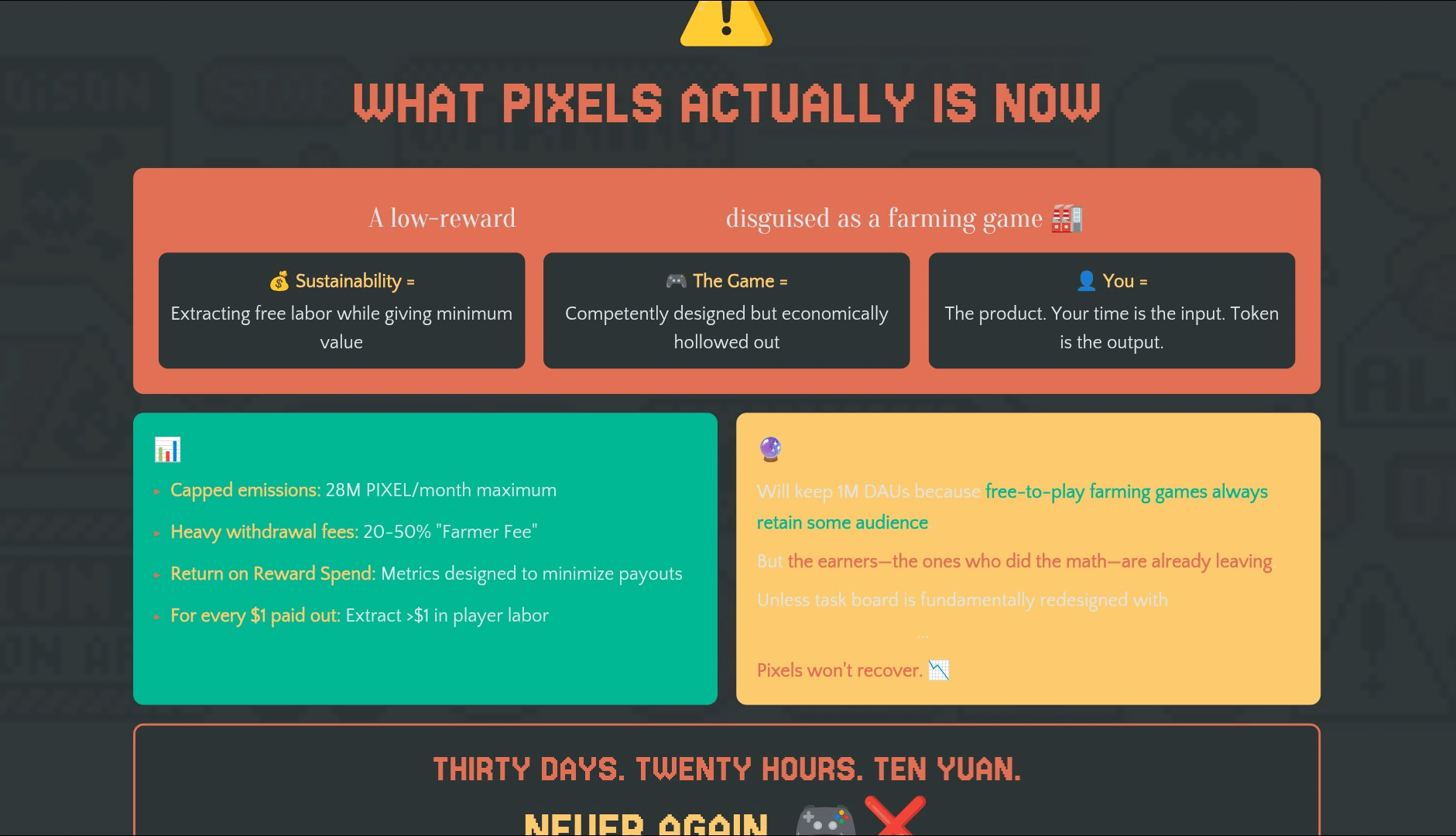
And that's exactly what this is: a cost-control tool. The developers aren't hiding it behind complex tokenomics anymore. The "Return on Reward Spend" metrics, the capped emissions at 28 million PIXEL per month, the heavy withdrawal fees—all of it is engineered to ensure that for every dollar of value the ecosystem pays out, it extracts more than a dollar in player labor and engagement metrics. You are the product. Your time is the input. The token is the output, and they've tightened the spigot until it's barely dripping.
What Pixels Actually Is Now
I went into this experiment hoping to find a Web3 game that had learned from the mistakes of Axie Infinity's inflationary spiral. Instead, I found something more cynical. Pixels took the user-acquisition lure—"earn crypto by farming!"—and slowly converted it into a low-reward digital sweatshop. The "sustainability" they trumpet is just the sustainability of extracting free labor from players who haven't done the hourly-wage math yet.
The game itself isn't terrible. The farming loop is competent, the social features work, and the pixel art is charming. But the economic layer—the entire reason most people show up—has been deliberately hollowed out. What was once a promise of ownership and earning potential is now a chore list that pays less than a vending machine refund.$RIVER
Unless the task board is fundamentally redesigned to reward actual content engagement rather than repetitive grinding—unless the shard drops become predictable and meaningful again, and the token economy stops treating players as disposable labor inputs—Pixels won't recover. It will keep its million DAUs for a while, because free-to-play farming games always retain some audience. But the earners, the ones who did the math, are already leaving. I know, because I'm one of them.
Thirty days. Twenty hours. Ten yuan.
Never again.