
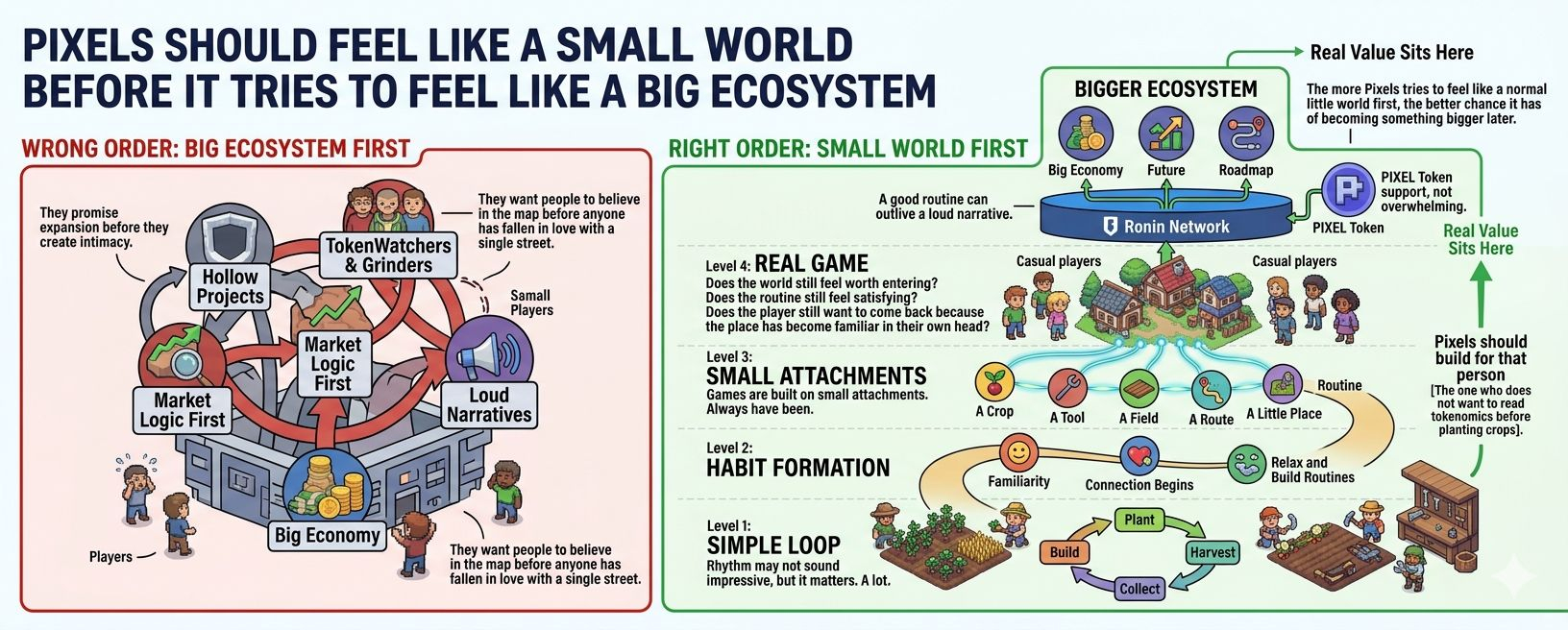
The mistake Web3 games keep making is trying to feel huge too early. Big ecosystem. Big economy. Big future. Big roadmap. Big token plans. Big community vision. Everything has to sound massive before the player even knows if the game feels good for ten minutes. It is backwards. Completely backwards.
Pixels does not need to win by sounding big.
It needs to win by feeling small in the right way.
That sounds strange, but it is true. Farming games work because they shrink the world down to something you can touch. A crop. A tool. A field. A route. A daily task. A small upgrade. A little place that starts feeling familiar after enough time. That is where the connection begins. Not with the whole Ronin ecosystem. Not with the token. Not with some giant speech about the future of Web3 gaming. Just with the player doing one small thing and thinking, okay, I can come back to this.
That is how habits form.
Pixels has that kind of base. You can farm, gather, craft, explore, and settle into a rhythm. The game does not need to explain itself too hard when it leans into that. The loop is simple. And simple is good. Simple lets people relax. Simple lets people build routines without needing to understand every layer underneath. The more Pixels tries to feel like a normal little world first, the better chance it has of becoming something bigger later.
Web3 usually gets that order wrong.
It wants the ecosystem before the attachment. It wants the market before the memory. It wants the player to care about the big picture before the small picture has done its job. That is why so many projects feel hollow. They talk like cities but feel like empty rooms. They promise expansion before they create intimacy. They want people to believe in the map before anyone has fallen in love with a single street.
Pixels should avoid that trap.
Its strength is not that it can be explained as part of a Web3 gaming thesis. Its strength is that the player can understand the basic actions right away. Plant. harvest. collect. build. repeat. That rhythm may not sound impressive in a pitch, but it matters. A lot. A good routine can outlive a loud narrative. A familiar task can do more for retention than a dozen dramatic announcements.
The Ronin Network matters too, but it should not become the whole identity. Ronin gives Pixels a smoother base. Faster transactions. Less friction. A better chance to feel playable. Good. That is useful. But players should not have to care too much. The best chain is the one that stops interrupting the game. If Ronin is doing its job, the player feels less pain, not more branding.
Same with PIXEL.
The token can support the economy. It can have uses. It can connect to parts of the game and ecosystem. But if the token becomes louder than the world, Pixels starts losing the plot. A player should not feel like every action is secretly about market logic. A farming game needs calm. It needs softness. It needs the freedom to let some moments be small and useless. If everything gets pulled into token value, the game becomes colder.
And Pixels cannot afford to become cold.
The whole appeal depends on the world feeling approachable. Open. Casual. Social. A place where someone can drop in and find a rhythm without needing to become a crypto analyst. That kind of player matters. The one who does not want to read tokenomics before planting crops. The one who does not care about every update thread. The one who just wants the game to work and feel good. Web3 ignores that player too often, then wonders why normal people stay away.
Pixels should build for that person.
Not only that person, sure. The Web3 crowd will always be there. The token watchers, the grinders, the people studying every economy change. Fine. They have their place. But they should not define the whole atmosphere. If they do, Pixels becomes another project that feels alive only when people are measuring it. That is not enough.
A real game has to feel alive when nobody is measuring it.
That is the key. When the chart is quiet. When the announcements slow down. When there is no huge event. When the only thing left is the player and the loop. Does the world still feel worth entering? Does the routine still feel satisfying? Does the player still want to come back because the place has become familiar in their own head?
That is what Pixels has to prove.
Not that it can be part of a big ecosystem. Plenty of projects can say that. Not that it can produce noise. Every Web3 game can produce noise. Pixels has to prove it can make the small things matter. The field. The task. The crafted item. The little upgrade. The walk across the map. The slow habit of returning.
That is where the real value sits.
Web3 people may hate hearing that because it is not dramatic. It does not sound like a revolution. But games are built on small attachments. Always have been. Big worlds are only powerful when players first care about little corners inside them. Big economies only matter when people already care about what they are trading. Big ecosystems only last when the simple daily experience has enough life in it.
Pixels should start there and stay honest about it.
Be a small world first. Be a place people understand. Be a routine that does not feel like work. Be a game people can enjoy without needing to defend the whole Web3 idea every time.
If it can do that, then maybe the bigger ecosystem starts to mean something.
If it cannot, then all the big talk is just decoration around another empty project.
