
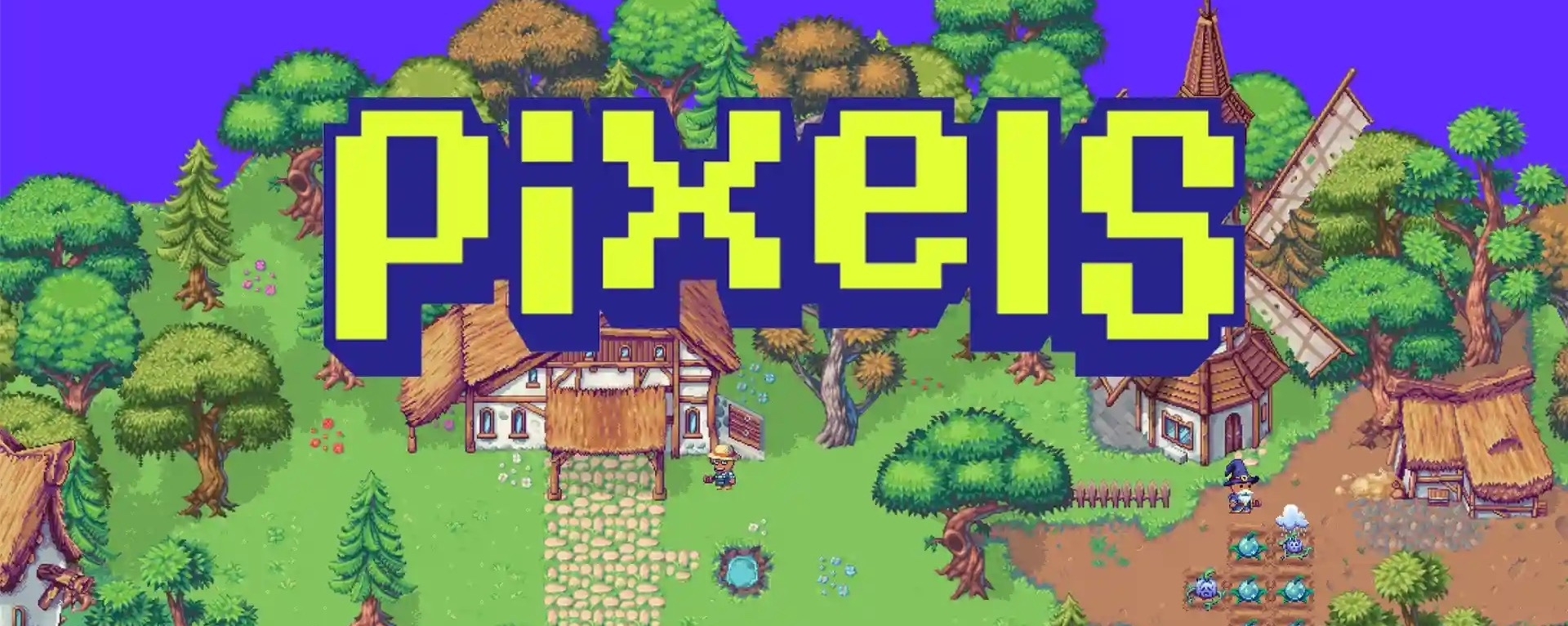

I’ll be honest I first looked at Pixels the same way I’ve been looking at most of GameFi lately: not with excitement, but with a kind of quiet pattern recognition.
The market hasn’t really been offering clean narratives. Liquidity rotates, but it doesn’t commit. AI had its phase of intensity and now sits in the background, still relevant but less dominant. Restaking feels structurally important, but crowded enough that attention diffuses quickly. RWAs keep trying to anchor something more stable, but even that hasn’t fully captured retail imagination.
So attention fragments.
It doesn’t disappear—it just spreads thin across multiple ideas, none strong enough to fully hold it. And in that kind of environment, GameFi starts to reappear in a different way. Not as the loud, promise-heavy cycle we saw before, but as something quieter. Less about “the future of gaming,” more about where idle attention goes when nothing else feels urgent.
That’s where Pixels kept showing up for me.
Not as a headline. Not as a breakout. Just… there. Consistently active in a way that didn’t spike or collapse. And in a market like this, that kind of persistence starts to stand out more than volatility.
When I opened it, nothing about it felt like it should command long-term attention.
The loop is almost deliberately simple. Farming, gathering, repeating small actions that don’t require much thought. No steep learning curve, no pressure to optimize immediately, no sense of urgency. It’s the kind of design that feels easy to dismiss, especially if you’re used to evaluating GameFi through complexity or token mechanics.
But that simplicity isn’t accidental.
It functions more like an interface than a limitation. It lowers the barrier not just to entry, but to continued participation. You don’t have to “re-engage” with it each time—you just return to it.
And that shift—from engagement to routine—is where it starts to feel different.
Because most GameFi systems still struggle with the same core issue: they can attract users, but they can’t keep them. Incentives bring people in, speculation drives early activity, but once the intensity fades, so does the user base.
Retention remains unresolved.
Infrastructure like Ronin Network helps address part of that problem. It removes friction. Fast transactions, low costs, minimal onboarding barriers it makes interaction feel almost invisible. And that matters, because in GameFi, even small frictions can break user flow.
But friction wasn’t the only reason people left previous cycles.
Even when access improves, behavior doesn’t automatically follow.
And that’s what Pixels seems to be probing not how to onboard users, but how to keep them returning without relying entirely on financial motivation.
Inside the game, incentives are present, but they don’t dominate the experience. They sit in the background, shaping behavior without fully defining it. You’re aware of them, but they’re not always the reason you log in.
What brings you back is something quieter.
Repetition.
There’s a subtle shift that happens when a system stops feeling like something you “play” and starts feeling like something you “check.” The actions don’t change much, the rewards don’t spike dramatically, but the act of returning becomes easier each time.
That’s not something GameFi has historically been good at.
Most systems leaned heavily on ownership—tokens, NFTs, assets—as the core reason to engage. The assumption was that if users had financial exposure, they would stay aligned with the system.
But ownership doesn’t always translate into habit.
In Pixels, ownership feels secondary to routine. You don’t return because you hold something valuable. You return because you’ve already built a pattern of returning.
And that raises an uncomfortable question for GameFi as a whole: what if sustained engagement has less to do with what users own, and more to do with what they repeatedly do?
If that’s true, then a lot of previous design assumptions start to feel incomplete.
Because incentives, while necessary, become harder to calibrate. Push them too far, and the system becomes extractive—users optimizing for rewards rather than engaging with the loop itself. Pull them back too much, and the system risks losing attention entirely.
Pixels seems to sit somewhere in that narrow middle.
Not fully driven by speculation, but not detached from it either.
That balance feels fragile.
Accessibility adds another layer to it.
The ease of entry no heavy setup, minimal friction, intuitive loops makes it easy for new users to try. But it also makes it easy for them to leave. There’s no strong commitment barrier, no sunk cost forcing them to reconsider before disengaging.
So retention can’t rely on friction.
It has to rely on behavior.
And behavior is harder to engineer than incentives.
That’s why I keep thinking of this less as a successful game and more as a quiet test within GameFi. A test of whether attention can persist in a low-intensity environment. A test of whether routine can replace speculation as the primary driver of engagement.
Because in the current attention economy, dominance isn’t always necessary.
Sometimes it’s enough to be the place where attention settles temporarily.
The place people return to when nothing else is demanding their focus.
But that creates its own uncertainty.
Is that kind of attention durable?
Or is it just idle?
There’s a difference between users who return because they’ve formed a habit, and users who return because they haven’t found something better yet. From the outside, those behaviors can look similar. Over time, they lead to very different outcomes.
And it’s not clear which one is happening here.
Token design adds another layer of ambiguity.
On paper, you can analyze emissions, sinks, reward structures. But in practice, the real signal comes from how users behave when conditions change. When rewards flatten. When activity stabilizes. When the broader market shifts focus elsewhere.
Do users stay?
Or do they drift?
Those answers don’t show up in models. They show up slowly, in patterns that are easy to miss because they don’t announce themselves.
That’s why I keep coming back to it not because it’s clearly working, but because it hasn’t clearly failed either.
It exists in that middle space where something is happening, just quietly.
In a way, it feels like GameFi stripped down to a simpler question: can a system hold attention without constantly amplifying incentives?
Not capture it.
Hold it.
And I don’t think that question is fully answered yet.
Some days, it feels like this might be a glimpse of a more sustainable direction where engagement comes from routine rather than reaction, where users don’t need constant stimulation to stay involved.
Other days, it feels more temporary.
Like a soft pocket of attention that exists only because the rest of the market hasn’t fully decided where to go next.
Maybe that’s what GameFi looks like in between cycles.
Not booming, not collapsing just absorbing leftover attention and turning it into something repeatable, even if it’s not deeply anchored.
So I keep checking in.
Not with conviction, but with curiosity.
Watching whether the routines deepen or fade.
Whether the balance between incentives and behavior holds, or starts to break.
Whether this is the beginning of something more persistent—or just another phase where attention slows down before moving again.
For now, it stays unresolved.
And that uncertainty feels more honest than trying to force a conclusion.
